Scottish citizens

Breaking up a country means defining who you exclude. Despite their best efforts, the Scottish Government’s plans for citizenship prove it

Scottish independence looks further away than it has for some time — to my profound relief, for now. My identity is rooted in Scottish unionist and left-liberal English versions of Britishness. I’m not just a transactional unionist. I have no wish to be left behind by history: some latter-day, London-resident echo of a kaisertreu Austro-Hungarian after Austria-Hungary.

So perhaps I shouldn’t give the Scottish Government’s latest independence papers too much credence. Humza Yousaf is performing a shakier version of the dance Nicola Sturgeon perfected. With few concrete options, growing voter weariness and an impatient base, he must pretend to advance when he knows he cannot. But a lack of independence monomania does not equate to a lack of support. Scotland is still, at best, a narrowly pro-UK country. The national question may, with luck, be on the cusp of becoming dormant for now: it is nowhere near dead.

So who the Scottish Government thinks is Scottish could well matter one day — and for me, hits very close to home. It’s at pains to prove itself more liberal on citizenship than the UK Government. Unlike British nationality law, children of any nationality brought up in Scotland would be able to register as citizens. The child of a Scottish citizen would be entitled to citizenship, wherever they were born. (The British Nationality Act 1981 generally only permits this one generation down.)

By both descent and geography, this draws the boundaries of citizenship wider than the UK. But its approach to those of us already born at the point of independence is rather narrower. As you’d expect, British citizens habitually resident or born in Scotland would, by default, be Scottish citizens. British citizens with a parent born in Scotland would have the same right, as would those born in Scotland for 10 years (or five as a child).

I can understand if this sounds broad to most. But it ignores the fact that few, if any, of us plan our lives on the basis of the breakup of our state. This is a problem of which both my sister and I would fall foul. Our father is Scottish; our mother is English. We were both born in Norway. Dad worked in oil and gas: a common enough choice for someone who graduated from Aberdeen, where he met Mum. We’d lived in Scotland, the United States, Venezuela and England by the time we turned 18. As a result, we wouldn’t meet the five- or 10-year criteria.

To add to the mix, Dad is one of a line of Scots who worked around the world. My grandfather, born and brought up in Scotland, worked for Shell. As a result, Dad, who went to school and university in Scotland and started working there, was also born abroad. (The English half of my family also travelled. The only reason applying for a British passport isn’t an all-consuming nightmare for me now is that my mother was — just about — born in England, not overseas.)

Had Scotland been an independent state in 1986, I’d have been the child of a Scottish citizen, and entitled to citizenship in my turn. But it wasn’t, and so the Scottish Government’s policy cuts me off from half my nationality. I see little justice in saying I’m not a Scot in due course, just because Mum and Dad didn’t plan for the break-up of Britain 45 or 50 years in advance. Scotland is where the family home is: I feel at least as Scottish as English. As a unionist, I fretted and simmered from 2011 to 2014 because ‘the English’ couldn’t see the danger.

One way to address this would be to extend citizenship rights to British citizens with at least one grandparent born in Scotland (I have two). This is broadly analogous to Ireland, which extends citizenship rights to anyone with an Irish citizen grandparent. The Scottish Government points to Ireland favourably, after all. And as British citizens could live (and then work and vote) in Scotland anyway, it makes little difference after independence. Another, broader option would be to extend rights to the children of those on the current list.

Inevitably, I hope this is all hypothetical. If it isn’t, and if I am eventually cut off from who I feel I am, I’d feel the emotional injustice profoundly. I accept nationality laws do people far more practical damage every day. I grant the Scottish Government is offering quite a broad citizenship law for a separate future. But its patchier provision for the unionist past and present expose something core to the nationalist project.

To be fair to them, they can’t entirely help it. Nations can’t exist without a definition of who does and does not belong, and how and whether that can change. But the British state and nation have been around a long time. We have no legal definition of who belongs to the older nations which formed them, because we didn’t need any. If the United Kingdom breaks up, we will need some. The question of who We are and who They are will take centre stage, by definition. The new Scottish and remaining UK states will have to decide whether to recognise the contents of different people’s hearts and minds.

When the UK narrowly voted for Brexit, losing European citizenship loomed larger than anyone expected. Perhaps the reality of losing something crystallised a sense of self many felt only hazily before. Perhaps there were always more of them (us, in my case) than we knew. But I’m pretty sure destroying a centuries-old union, with a nation tacked on, would cut far more deeply.

People who want to do it should have no illusions: they are in the business of creating a new Other and a new Them. That is what nationalism in a plurinational democracy means. No amount of liberal dressing — performative, genuine or both — can hide it.

Political religion

The blurring of tolerance for personal belief and acceptance of political positions is not an accident

What equal marriage really boils down to for the people it affects.

Same-sex relationships only received legal recognition in the UK within my adult lifetime. Equal marriage in Great Britain had to wait until I reached my late 20s; Northern Ireland held on until my early 30s. By the time it was delivered, it felt long overdue. That it commands such support, and that Britain is now (in the main) so relaxed about people like me, is an extraordinary political and social shift.

Still, a minority of opponents remains. The fact that Scotland’s Finance Secretary is among them is no surprise. The real surprise is how many of her erstwhile backers seem surprised. In any event, we now know she would have voted against equal marriage had she been an MSP. We also know she would do the same again today — though we are assured she won’t actively seek the chance to do so.

Opposing her on this basis would, you might think, be as reasonable a ground as any. Some tell us equal marriage is a settled issue and so we shouldn’t worry. But a politician’s opinion on one issue often gives a clue to how they might act on something else. We know Kate Forbes would ideally restrict the right to marriage. What would Kate Forbes as First Minister say about LGBT inclusion in schools? How would she approach conversion therapy (on which she already sounds distinctly evasive)?

More generally, we don’t usually accept ‘it’s a settled issue, so you shouldn’t worry’ when it comes to equalities. You could also describe equal pay legislation as a settled issue. I doubt ‘I would vote against equal pay today, but it’s a legal right and so I would uphold it’ would wash with anyone at all, quite rightly. And yet, a striking number of people seem happy to argue that position here.

I suspect some treat this differently for two distinct but intertwined reasons. First, there is still more room for open dislike of homosexuality than many other protected characteristics. Second, Kate Forbes’ view on the legal right to marry — not just on religions’ freedom not to perform it — is determined by her theology. Because most religions traditionally regard same-sex relations as sinful, some see her view on gay and bi people’s marriage rights as a matter of private conscience.

Sir Tom Devine said, ‘If Kate Forbes is hounded out of the opportunity to obtain high office in our country because of her personal beliefs we can no longer be seen as a tolerant and progressive nation.’ One might note that being the Scottish Finance Secretary is hardly a junior role. Even setting that aside, this is absurd. First, declining to vote for or endorse a candidate you disagree with is the very stuff of politics. Second, Kate Forbes’ personal beliefs, properly understood, are not the real risk to her ambitions. The real risk is that, given the chance, she would vote to shape the law according to her beliefs on private morality, at least some of the time.

A vote in the Scottish (or any other) Parliament is not, by definition, a private matter. In voting on a Bill, MSPs legislate for the whole of Scotland. Even when passing motions, they send a message from the Parliament to and on behalf of voters. When Kate Forbes says she would vote against equal marriage today but uphold current legal rights, she is not making a personal statement. She is making a political calculation that this is a fight she cannot win. She has given gay and bi people good reason to doubt her support for their rights, now and in future. Anyone who cares about that has every right to say as much and vote accordingly.

Does there have to be some compromise from gay people in the name of religious freedom? Yes, of course. We accept religions’ right to discriminate in who they marry, and often in who they appoint. We accept safeguards in hate crime laws to protect their right to denounce our specific sins. Bluntly, in many contexts we afford a level of courtesy to beliefs we would otherwise label rank bigotry when affirmed in the name of God.

That is tolerance in action. Do I think the belief in a requirement to follow the Word is a defence against the charge of homophobia? Frankly, no. But I accept, in the name of rubbing along together and the rights of others to live freely, that it is often better not to spell that out. And if a politician is a religious conservative, but has no wish to give that legal force, we should accept that. Forbes’ views on sex outside of marriage are personal: she does not wish to force them on the rest of us. The same goes for Tim Farron, who should have been treated more kindly, and equal marriage.

Forbes’ defenders, however, ask more of me. They imply I should, in the name of tolerance, give a politician a pass on the civic rights of people like me — to treat opposition to those rights more gently than I otherwise would when affirmed in the name of God. But whether and how far religion should shape the law on private morality is political. The claim that opposing a candidate when they cite their faith to justify their policy is somehow ‘intolerant’ is also political. It demands some deference to politicians’ views if, and only if, they cite a religious basis for those views. It is not a call for tolerance: it is a call for religious privilege.

Neither religions nor their adherents can have it both ways — though plenty will try. Those Anglicans in England who express horror when MPs step into their Church’s rows over sexuality, but want to keep their bishops in Westminster and their special status in law, are playing a similar trick. Where politicians want to legislate in the name of God, they place His relevant dictates in the political realm. Yes, secular atheists should be more careful to respect the place of private conscience. But the religious have no right to turn that into political impunity in disguise.

This post was originally published on Medium.com on 25 February 2023.

The union state and the social contract

Scottish nationalists who claim the UK will fund pensions after independence or ask why no independent country wants to return to it miss the point. National bonds matter

Crown copyright, used under fair use and taken from Wikipedia.

The debate over Scottish independence is filled with wearying, recurrent rows. Currency, borders, fiscal transfers, the UK home market, EU membership: the list goes on. Until recently, responsibility for state pensions did not feature. That changed when Ian Blackford asserted ‘a right to a UK pension, no ifs and no buts’ and that Westminster had an obligation to pay them, come what may.

Unionists have since made their incredulity clear. Meanwhile, some nationalists have retreated from motte to bailey, pointing to the need to split assets as well as liabilities. But there are no ‘assets’ to speak of here. State pensions are not funded; the contributory principle is a polite fiction. The National Insurance Fund holds enough money for a couple of months of state pensions. The reality is that state pensions are a benefit the state pays and chooses to link to NI records. If Scottish independence means anything, it means leaving the UK’s benefits system. Nationalists usually make a point of that, after all.

Who becomes a Scottish or UK pensioner after independence could indeed be tricky. Expatriates, people who worked across the UK and people who paid to top up their NI records are real people, who must be assigned to a state to pay out or not. But while the detail is complex, the underlying principle is simple. At present, the UK pays a state benefit to current pensioners, funded by current taxpayers. If Scotland leaves the UK, its taxpayers are no longer in on the deal. It will have to reinstate that deal between a smaller set of workers and a smaller set of pensioners. Not for the first or last time, the SNP is exploiting complex details to blur simpler truths.

Let’s imagine Scotland offered to pay for access to UK pensions for those who had paid UK contributions. (We can ignore EU law for now, pending any potential Scottish accession.) London has no reason to agree to that if Scottish people are no longer British citizens. There is nothing to gain and a little to lose fiscally. It would complicate any future UK pension reform until the last transitional pensioner passed away. It is a non-starter: in effect, it is 2014’s sterling currency union all over again.

The process of making an absurd statement, claiming to be misunderstood, offering opaque ‘explanations’ so confusion remains and crying ‘scaremongering’ to cover your tracks is familiar enough in this debate. So is painting the UK as an overbearing behemoth set to become a paragon of forbearing once Scots vote to leave it. But this saga betrays a lack of comprehension as well as candour. Despite its raison d’être, Scottish nationalism has forgotten that shared citizenship matters.

To be clear, state pension entitlements are not themselves a question of citizenship. But the social contract which makes them tenable very much is. In the main, a country’s workers pay for its pensioners. We’re almost all going to be old one day; we recognise a mutual obligation to our fellow citizens. But that obligation is, in the main, defined by the compass of the state. Expatriates, frontier workers and so on are exceptions who prove the rule.

A longstanding nationalist trope makes much the same point. It shows a map of former British territories with their independence dates, and asks: has a single one asked to return to British rule? Of course, being a British colony and being an integral part of the UK are different things. Still, on their own terms, they’re right. The answer is ‘no’ (I’ll ignore the temporary and anomalous case of Newfoundland), and that says something important. But it’s something important to the case for the British union, not against it.

The reasons none of these countries would even consider weighing up a shared state over their own state are simple. The UK’s institutions have long ceased to be their institutions in their eyes (or they never were). Their interests are not inherently, or even particularly closely, linked to the UK’s. Above all, the British people are not their people anymore (if and to whatever extent they ever were). Polite fictions of Commonwealth citizenship aside, we are foreigners now. As such, they have no wish to pool their fate with us. Were Scotland to leave the UK, I am sure it would never ask — or be asked — to rejoin. That does not argue for independence. It shows that the Union’s mix of British national solidarity and Scottish national distinctiveness is rare indeed.

Forging that mix took decades. In the seventeenth century, English MPs were wary at best of forming a new kingdom. Scottish politicians considered British relations rather more often. Still, it took a succession crisis to bring matters to a head in England and hard bargaining to accommodate interests in Scotland. It was well into the eighteenth century when the incorporating but limited Union of 1707, before mass democracy and the welfare state, began to take popular hold. The Union between Great Britain and Ireland never secured the same loyalty among most in Ireland or the same investment in Great Britain. So-called Imperial Federation with the then Dominions never got very far.

On our own continent, the European Union has gone further than most to get states to pool destinies. It is noble in principle, for all its faults in practice, and a project worth supporting. But the eurozone’s travails show its limits. Germany and Greece won’t underwrite each other as Galashiels and Greenwich do. NATO offers its members a defence guarantee — one which, so far, hasn’t been tested. But its members squabble over defence spending. US commitment gives Europeans cause for concern. Public opinion is often queasy at best about following through if required.

In short, nothing approaching the kind of mutual backing within the United Kingdom is available to Scotland outside it. Unionists are right: if Scots cease to be British, pensions and pensioners will become a responsibility to disentangle, and the UK will have no part in pooling Scotland’s risks. Nationalists are right: if Scotland leaves the UK, it will never seek to return, however hard the road. In both cases, that is what cutting bonds of citizenship and sentiment means.

At its heart, that is what Scottish independence means. That remains true, for all the talk of European nationhood. It remained true when Winnie Ewing said ‘Stop the world, Scotland wants to get on!’ (She campaigned against the EEC in 1975, before the SNP’s change of heart.) It remains true when some try to obscure it by painting ‘Brexit Britain’ as a xenophobic backwater. Internationalism is sometimes the means; nationalism is always the end. And once you turn erstwhile fellow citizens into the Other, there is no going back — on either side.

This post was originally published on Medium.com on 21 February 2022.

The Union of 1707 and the art of the deal

For Scotland, Britain was built upon a bargain. Renewing that bargain needs England to engage

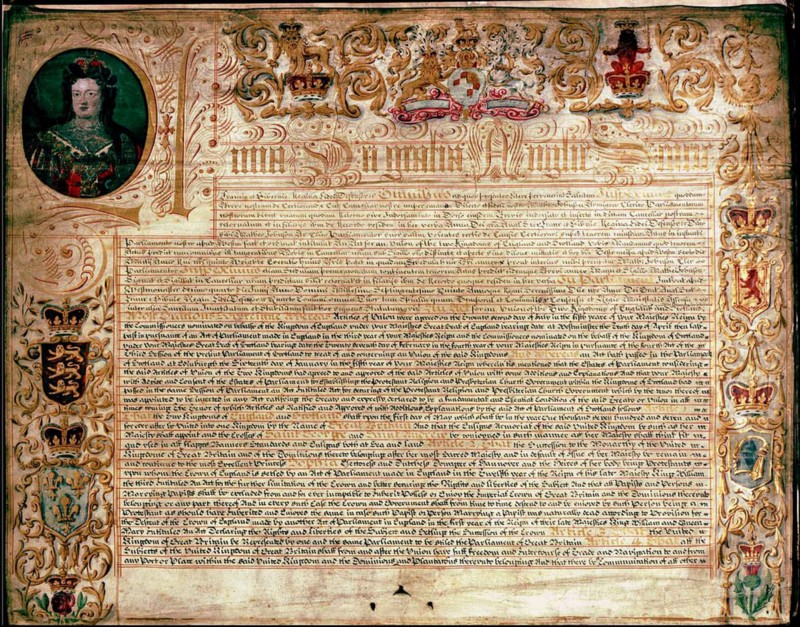
Scottish exemplification of the Treaty of Union. Public domain: sourced from Wikimedia Commons

One way or another, devolution as an idea and a reality has a long history in the United Kingdom. The issue of Irish Home Rule pushed the UK’s constitutional norms to its limit (and far beyond in Ireland). Devolution had an unhappy 50-year history in Northern Ireland until 1972. Calls for a Scottish legislature surfaced many times before one was finally created.

Nonetheless, Scottish (and Welsh) devolution in 1999 was a radical act with radical implications. Some who wish to keep the UK together regret it, at least within Great Britain. The devo-sceptics often paint it as an ahistorical rupture. But the historical backdrop to devolution is far from the most important sense in which it reflects a unionist tradition. And their objections miss both the need for a democratic expression of Scottish distinctiveness and two of the hardest challenges the Union faces now.

A new variation on an old theme

Britain was built upon a bargain. Scottish politicians secured Scotland’s distinctiveness in religion, law and administration, along with free trade throughout the new kingdom and its colonies. It was an incorporating union, with one parliament at Westminster. But it was altogether unlike the Tudor Laws in Wales Acts. The legislation of 1536 and 1543 incorporated Wales into the Kingdom of England. The Union of 1707 created a composite state, with a composite nation grafted on over time. Britain in its modern sense was forged in an Anglo-Scottish crucible.

That fact has expressed itself in different ways at different times. In the eighteenth century, the Church of Scotland, the Convention of Royal Burghs and local elites played their parts. The old Scottish Office was set up as far back as 1885 and expanded as the years went by. The Church of Scotland Act 1921 effected a compromise between an anti-Erastian Kirk and a sovereign Parliament. The UK never really had one National Health Service. The Tories stood as Unionists in Scotland until 1965. (They fought elections in the 1950s pledging to protect Scottish distinctiveness against socialist centralisation.)

Legislative devolution is different, because it creates an autonomous centre of political power. But it’s still in a long line of accommodations between the British state and the Scottish nation. It’s also a balance to English preponderance within the Union. It isn’t different because British politicians made a terrible mistake. It’s different because it’s a response for a democratic rather than an oligarchic age.

I doubt Britain could ever have avoided giving Scottish distinctiveness democratic expression. (And I don’t think it should. Devolution made good democratic sense.) But two consequences are, in my view, particularly underappreciated.

Shrinking, but not improving, the British state

First, unlike previous measures, devolution does nothing to make how the British state itself operates more appealing to Scots. It only reduces the scope of its activities. But despite the role of Scottish MPs, British politics became less Scottish over time. Devolving more powers often made sense in policy terms. But it also took up all the political space marked ‘reducing Scottish discontent’.

UK governments show little interest in recognising a devolved role at the centre. The Welsh Government’s call for a UK Council of Ministers falls on deaf ears. They show no sign of, say, thinking creatively about our second chamber. (Why, unlike almost any other state with a territorial challenge, don’t we even discuss some extra seats for the smaller nations in a reformed Lords?) And the current UK Government seems determined to undermine the conventions on which devolution rests.

Pushing the Union’s balancing act into the limelight

Second, as a new political system within the UK, devolution means politicians — and political noise. It has made the balancing act on which the Union of 1707 relies conspicuous outwith Scotland. That hasn’t been the case most of the time. But whether devolution is ‘fair to England’ is now a live question, with major consequences.

A century before the Union of the Parliaments, James VI’s Scottish courtiers attracted the ire of some English MPs. The spasm of Scotophobia surrounding Britain’s first Scottish Prime Minister is well-known. ‘Into our places, states, and beds they creep/They’ve sense to get, what we want sense to keep’ was only its most famous expectoration. But that kind of thing declined as the Union bedded in. And England mostly paid little attention to how Westminster acknowledged Scotland’s distinctiveness. That has clearly changed.

Symmetry versus balance

Anyway, reforming a democratic UK so the devolved nations feel they have more of a stake needs proper consent in England. As a result, tackling the first problem means facing the second head-on. And the view that fairness lies in symmetry — embodied in ‘English votes for English laws’ — will crash headlong into the view that the UK needs to balance England’s size.

Neither view is objectively wrong. But taken to their logical conclusion, the two are incompatible. Many in Scotland take too little account of the fact that the rest of the UK is not a mere backdrop for Scotland’s debate. But most people in England — understandably, as almost no one has suggested otherwise — don’t grasp that the debate involves them too.

One way to look at the American Revolution is to say the British and their colonists were each confronted by the other’s real view of their relationship. The British idea of parliamentary sovereignty over the Empire and the colonial view of their legislatures’ rights within it had diverged. And pitted against each other, they proved incompatible.

There is a risk of something similar nearer home. But I don’t believe the gap between English and Scottish understandings of the state we share can hold forever, unarticulated and unaddressed, in a democratic era. Any modern Union bargain for Scotland will have to combine a high degree of self-rule with a fair degree of shared rule. Those are core features of federalism, whether the UK can ever be remade into a federation or not.

I don’t know whether the people of England would agree to anything like that or what they might want in return. But in the long run, the survival of the Anglo-Scottish bargain may depend upon their answer.

This post was originally published on Medium.com on 21 February 2021.

Every man for himself?

The EU was partly built to check its members’ worst instincts in dealing with each other. But that only holds within its ranks

By Hofphotograph: Own work, CC BY-SA 4.0.

The world’s scientists have worked together to find ways to fight Covid-19. Its governments have proven less collaborative so far. From backbiting over the quality of each other’s regulators to warnings of a moral failure by the developed world in the scramble for vaccines, fraternity seems in short supply. It’s dispiriting — but, at the risk of proving a cynic, unsurprising.

So I can’t say the EU’s claims that Oxford/AstraZeneca vaccines currently intended for British use should be diverted surprise me much. Those claims seem to carry little weight: at the time of writing, it seems the UK was, for once, ahead of the game. Having signed a UK contract early, AstraZeneca had time to iron out problems in its supply chains. The EU dithered before signing on the dotted line, AstraZeneca had less time to deal with its version of the same problems, and here we are.

From an EU perspective, this is a row with AstraZeneca: the fact that UK supply is involved is secondary. But you have to be a pretty monomaniacal sort of pro-European not to find the 27-country version of ‘vaccine nationalism’ highly unattractive. I wish we hadn’t left the EU. I also have little sympathy for the idea that Britons should want for vaccines due to our neighbours’ logistical failures. I profoundly hope it doesn’t come to that.

But many of the EU’s critics (who have lots of justice on their side here) miss the point, even as they point their fingers. When it comes to vaccine nationalism specifically, the EU displaying its own version isn’t the striking thing. We would behave no better in their shoes. The striking thing is the extent to which it’s curbed it between member states.

Intra-European solidarity has frayed a bit, and is fraying further. Germany’s bilateral deals have ruffled feathers, some countries are buying up spares, and irritation with the Commission is mounting. The EU has never completely lived up to its aspirations. Nonetheless, the idea behind a joint programme was to rein in the beggar-thy-neighbour tendency, use EU purchasing power and support poorer as well as richer member states. Only an ideologue would hold the end result up as a shining success, but some pooling and sharing did result.

The furore says something both good and bad about the EU. Its institutions and rules were built to keep nation-states’ worst impulses in check. From trying to take state competition over coal and steel out of commission onwards, an awareness and a fear of what untrammelled nation-states could do played a vital part in building Europe. The idealistic element of the European project is real. But it’s idealism for the fear-haunted, not the starry-eyed.

The creation of a single market reflects that view of the state. The EU’s members don’t trust each other out of a warm, fuzzy sense of Europeanness. They trust each other, to a point, because rules exist to keep them all in line and because institutions have a reasonable ability to make sure they’re being stuck to at least tolerably well. Has that extended to a wider definition of ‘us’ than a nation-state outside the club can manage? Yes, but there are limits.

Most of those rules and institutions don’t exist when the EU looks beyond its borders. It tends to try to replicate them, of course — partly out of self-interest, partly out of self-belief, and partly because what you are shapes what you do. The European Economic Area is one of the most radical examples of regulatory-Europe-for-export; the Northern Ireland Protocol is another. But without them, it doesn’t behave all that much better than a nation-state when it has the power and when the chips are down.

No one should be surprised to find that out. The EU has found ways to make the definition of ‘us’ extend beyond the nation up to a point — but only up to a point, and overwhelmingly within its borders. It doesn’t just happen outside them. Solidarity between nations doesn’t come easily. If it were as easy as all that, why was Europe ever built?

This post was originally published on Medium.com on 28 January 2021.

Politics and the peerage

You’ll never get politics out of the Lords, and nor should you. The problem isn’t including politics — it’s excluding voters

The House of Lords: not all that much more democratic than it looks. UK Parliament, CC BY 3.0.

Lords appointments have been something of a (slow-burning and highly secondary) theme over the past few months. A number of Boris Johnson’s appointments have raised eyebrows. Notably, the Lords will now include Claire Fox — a former supporter of the IRA’s terror campaign who remains unrepentant, and whose inclusion remains unexplained and suspect. A number of Jeremy Corbyn’s final nominations were rejected. And today, Keir Starmer’s choice of peers has also attracted controversy.

Using peerages as patronage is nothing new

The appointment of Claire Fox is unusually egregious. Consistent commitment to our democratic process seems a pretty minimal requirement for life membership of our Parliament. (Even a show of repentance would be something.) But there’s nothing new about prime ministers appointing legislators-for-life for unedifying reasons. 58% of Margaret Thatcher’s appointments to the Lords were Conservatives, even in a chamber still hereditary-dominated and Tory-skewed. Controversy periodically dogged Blair’s Lords appointments. The speed at which the Coalition expanded the House made experts tear their hair out.

None of this is surprising. The House of Lords ultimately plays second fiddle to the Commons. But it’s still a lawmaking body, and governments often make concessions to it. Lords appointments are a huge source of power — but peers don’t get anything like the same scrutiny as MPs. Voters tend, in the main, to forget or at least deprioritise the Lords. As a result, there’s every incentive to put your people in, even if the appointments do the House no credit, and little downside to doing so.

The Lords became more influential in the New Labour years. It continued to be more assertive under the Coalition. And since 2015, the Conservatives have had their first experience of single-party government with no particular advantage in the second chamber. Their tendency to menace it whenever it gets a bit uppity shows they don’t like it one little bit. But on the whole, the surprise isn’t that unedifying appointments get made: the surprise is that prime ministers show any restraint at all.

Nominations mean patronage, and mitigation is hard

We could do a bit to reduce the problem. We could agree a formula for sharing out Lords appointments, taking the partisan makeup of the House out of prime ministers’ hands. We could beef up vetting by the House of Lords Appointments Commission. The Wakeham Commission on Lords reform even envisaged the Commission appointing party-political, not just independent, members of the Lords (except for a few elected members). Labour rejected this at first: it came round in 2007, before moving (in theory) to an elected second chamber.

It should be a no-brainer that prime ministers shouldn’t be able to skew the makeup of the second chamber. And few would object to tougher vetting of peers, if we take it as read that we the people get no say in their appointment. The first would be a real step forward; the second might at least help address some of the most egregious appointments.

But how far can vetting go? What is our working definition of ‘improper’ beyond the most egregious cases? If we want it to tackle the wider issue of political patronage, then how? Is the Appointments Commission meant to assess if Johnson, or indeed Starmer, is giving too many peerages to his factional allies? If we exclude politicians and their advisers, how many members with no political history and capacity to serve can parties rustle up? And do we actually want that anyway? Post-Brexit Britain will need to get better at lobbying EU institutions now it’s given up its voice in them. Do we really want to ban former MEPs from the Lords?

Going further and letting the Appointments Commission choose party as well as Crossbench peers may or may not prove tenable. I very much doubt a less deferential age would take its bona fides on trust. The experience of the ‘people’s peers’ hardly inspires confidence in the public credibility of any such model. Britain’s parties have enough difficulty respecting the independence of the judiciary. I doubt they’ll defer to a quango telling them who will represent them in the Lords with no recourse.

A House of Experts: tricky in practice, dubious in principle

Of course, you might try and remove parties altogether. In Canada, Justin Trudeau’s Liberals are trying to do just that. Their aim is a non-partisan Senate, with an independent Board to advise (though not bind) prime ministers on appointments. The idea is to restore the Senate’s role as a chamber of ‘sober second thought’, with a less partisan and more independent-minded approach than the Commons.

Some accounts do suggest this has partly happened. Individual Independent Senators are often distinguished. But fairly or unfairly, their independence from the Liberals remains disputed. (Some Senators left the Independent Senators Group over this question.) The Government had to create a caucus of of three to handle its Bills. Ex-Liberal Senators formed their own Progressive Senators Group, which some Independents have joined. The Conservatives continue to oppose the principle. Whether it’ll bed down I don’t know. I think we can already say it won’t quell (admittedly ill-fated) calls for wider Senate reform.

In any case, I’d argue the whole concept is dubious in democratic principle. This is especially true if all members are non-partisan, denying voters any say over the makeup of the Lords. On what basis should a politically unaccountable body have such power over policymaking in the round? How should it decide how much weight to accord diplomacy, defence, development, law, economics, business, trade unions and welfare?

Weighing these things up is exactly what we have politics for. It’s not just that the Lords never will be a dispassionate chamber of experts: it actually shouldn’t be. Parliaments need politics, lawmaking isn’t an academic seminar — and frankly, the whole notion reeks of anti-politics to me. Independent appointments seem manageable for 20–25% of peers, whether or not you approve. It’s quite different if a quango decides which policy priorities we get to hear in half the legislature.

Patronage with or without a public say: take your pick

The House of Lords plays far too big a role in our legislative process to be removed from the political arena, even if such a thing were desirable. More radical Lords reformers are often charged with a lack of realism. But those who believe the Commons will up its game enough to remove the need for an active second chamber any time soon must be more utopian still.

In practice, that means there’s a fairly clear-cut choice. Parties will seek to get their people into both chambers of Parliament. The way they do that can involve the voters, or it can exclude them. If you opt for the latter, then yes, you may get some experts you wouldn’t get if they had to go on the campaign stump. You’ll also get MPs who’ve lost their seats, party leaders’ favoured sons and daughters and others who offend your sensibilities. And you will be able to do nothing about it.

I admit it: for me, no one should sit in Parliament unless the voters put them there, as a matter of principle. I want the second chamber to provide a stronger check on government and a balance for the smaller nations in our (imperilled) union state. So I was never attracted to some sub-Platonic chamber of experts anyway. But I also think it’s a pipe dream. If you reject letting the voters decide, then in the main, party leaders will decide for you.

This post was originally published on Medium.com on 16 August 2020.

‘This is not a debate’

Sometimes you can say that once you’ve built a settled consensus. Otherwise, you’ll lose the debate you tried to spurn

© Can Stock Photo / vlatko2002.

I only discovered Tom Robinson Band’s ‘Glad to be Gay’ a few years ago. I didn’t know the song was from 1978. With the blitheness of a gay man born in 1986, I assumed it was a high-camp affirmation and not my aesthetic at all. It’s actually a sharp, caustic protest, skewering the homophobia of 1970s Britain.

So sit back and watch as they close all our clubs
Arrest us for meeting and raid all our pubs
Make sure your boyfriend’s at least 21
So only your friends and your brothers get done
Lie to your workmates, lie to your folks
Put down the queens and tell anti-queer jokes
Gay Lib’s ridiculous, join their laughter
‘The buggers are legal now, what more are they after?’

The Sexual Offences Act did an imperfect job of making ‘the buggers … legal’. It proved a huge step forward in the long run. But it came into force in a society which still disapproved, applied by a state which shared that dislike. Arrests of gay men went up for years following 1967. Sex ‘in private’ was defined to exclude, say, a room in a house if your landlord was in another room. The Earl of Arran made the score quite clear, even as he supported the Bill:

Any form of ostentatious behaviour; now or in the future, any form of public flaunting, would be utterly distasteful and would, I believe, make the sponsors of the Bill regret that they have done what they have done.

The law in Scotland only changed in 1980. Despite the Revd Ian Paisley’s best efforts to ‘save Ulster from sodomy’, Northern Ireland finally followed suit in 1982, the UK’s hand forced by the European Court of Human Rights. The tone in which the Government introduced the change is instructive:

The Government recognise the very strong feelings held in Northern Ireland on issues pertaining to sexual morality. … However, the court did not accept these arguments. The Government therefore have to deal with the verdict of the court, which imposes an obligation on the Government to change the law.

From cringe to confidence

By 1994, as MPs argued over whether to reduce the age of consent for sex between men to 18 or 16, advocates sounded bolder. Even then, some described their opposition in terms I won’t include here. (And 18 won that time. Equality had to wait until 2000: the House of Lords had to be overruled under the Parliament Acts.) But Tony Banks made the point — pretty basic, we’d say now — that homophobia was homophobes’ fault, not gay people’s:

… the Wolfenden report says that those young people would be set apart from society. Does that not say something about the discrimination that society holds against young gay men? It is a problem of society, not of those young men.

In power, New Labour sometimes acted at Strasbourg’s behest or by halves. But it did a lot: from the age of consent to civil partnerships, from LGBT people in the military by the time it left office, LGBT rights had advanced hugely. That a Conservative Prime Minister could sincerely support equal marriage in 2013 (admittedly in a minority among his MPs) — and that LGBT-inclusive relationships education could pass as a matter of near-consensus among MPs last year — shows how far attitudes have come.

From making the argument to trying to ban it

But all of these changes had to be argued for. Their advocates had to deal with their critics — in the media, in Parliament, and among the public at large. Which is why I was struck by the social media reaction when the House of Commons Petitions Committee tweeted to seek views on banning the practice of so-called conversion therapy a few weeks ago. (A petition to ban it had received enough signatures for a debate, but coronavirus has put paid to Westminster Hall debates for the time being. The Committee sought views to inform its report on the topic.)

Myself, I don’t need any convincing that conversion therapy is quack science which can do great damage to people who undergo it and which is rooted in viewing sexual orientation as some sort of disorder. Nor do medical professionals: the Royal College of Psychiatrists has made its opposition clear for many years and has supported the principle of a ban for quite some time. Countries from Malta to Taiwan have restricted or banned it to varying degrees.

I am sure the argument that we should be working to end it and that a ban has a role to play in doing so can be won. Indeed, the Government has notionally been committed to it for some time. But the Petitions Committee — which has asked for views on other inquiries during the pandemic — didn’t end up in hot water for inattention. It ended up in hot water because it had asked for views on whether conversion therapy should be banned.

Some of the outcry came from the plain ill-informed. Some thought the Petitions Committee was ‘the Government’ (which seems to include more than one journalist, to judge from media output). Some felt the tone was off. But most of the anger stemmed from a view that the Committee shouldn’t be framing this as a debate in any way.

Twitter thought debating the issue was very bad.

This, to put it mildly, poses a challenge when a Commons Committee is conducting an inquiry into a proposed change to the law. It would become even more of a problem if some kind of ban came before the Commons, probably following a Government consultation. The change will have to be debated: that is how laws are passed. And asking whether a ban should be put in place and what difference it would make plays a role in making that happen.

Changing the law is complex

The point becomes even clearer when you look at the details of different conversion therapy bans. Vancouver in Canada has one of the widest-reaching bans: its bylaw bans businesses from offering conversion therapy at any age. Germany’s ban only covers minors and adults where consent was obtained by coercion, threat, deception or error. The German Greens called for an age of 26; the Left Party wanted 27. Taiwan’s ‘ban’ stems, in effect, from a letter from the Ministry of Health clarifying that conversion therapy is not a legitimate medical treatment meaning existing criminal law applies to its provision. This seems to draw a similar line to Germany’s.

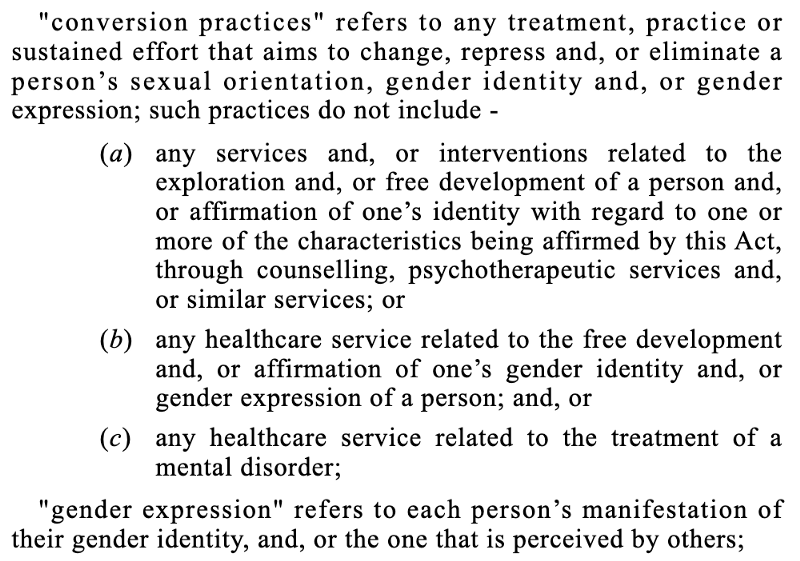
Malta was hailed as the first country to ban conversion therapy — but again, this is limited to minors and ‘vulnerable’ individuals. The Maltese Act offers some good examples of the other issues: it deals with what does not, for these purposes, come within a ban. A brief consideration of the potential content of wholly legitimate counselling sessions leads quickly to the conclusion that where the line is drawn will need some thought.

‘Conversion practices’ as defined in Maltese law.

I support some mix of these sorts of restrictions throughout the UK. But I can see that the details, and where exactly the line should fall, need discussion. I can also see, whether I relish the prospect or not, that when proposing to ban something those who don’t want a ban have the right to make their case. That includes religious arguments for which I usually have little time. It also includes arguments about parents’ rights which I think we should dismiss.

You can’t close a debate down before you win it

Judging from the hue and cry, lots of people thought MPs should enact their demands in silence, sackcloth and ashes. I’m afraid that isn’t how representative democracy works. Parliament hasn’t seen fit to change the law yet, and I suspect most people haven’t thought about the issue very much. Like it or not, the discussion is not over.

Of course, few people believe absolutely everything needs to be up for debate. To state the obvious, incitement is beyond the pale. We also no longer need to have a debate about whether women are intellectually inferior to men. It’s no business of the criminal law, but we don’t need to indulge it as a legitimate debating point. In the public realm, we can dismiss it as arrant sexist prejudice, shut it down and move on.

Societies can also remain oppressive without oppressive laws. A society where homosexuality was legal but talk of its ‘repulsiveness’ was rife would be pretty miserable for people like me. ‘A sin but not a crime’ may or may not get the law off your back (people dealing with ‘crime’ may well read it in the light of ‘sin’). It won’t stop your visible existence serving as grounds for censure.

But a conspiracy of silence didn’t get us past that point. Quite the opposite. People had to insist on being seen and challenge the people who wanted them kept invisible. Saying ‘this is not a debate’ in the 1970s would have suited homophobes much better than gay people. It would have fitted the Earl of Arran’s opposition to ‘any form of public flaunting’ to a tee. Now we can say ‘this is not a debate’ when faced with generic expressions of disgust. Because we had those debates, or rows — in all kinds of fora — and won them.

You can say ‘we’ve had the debate’ if you want. But you don’t have the power to decide whether we’ve finished on your own. And if you try, you may well lose it by default. Progressive aversion to talking things out can make for a censorious mood in progressive circles. It can make them lose the argument with everyone else too.

This post was originally published on Medium.com on 25 July 2020.

State aid and the union state

Defending the Union is not the same as owning the Nats. Tory disdain for devolution post-Brexit endangers it even further

Constructing a UK internal market needs time and attention too

Some nationalists claim the United Kingdom has no such thing as an internal market. Granted, it has no formal project branded ‘UK single market’. But its four parts have sent MPs to Westminster longer than modern regulatory states have existed. Britain built an integrated domestic market long before it joined the then EC. Until 1999, EU law played no specific role in preventing divergence. And the UK has an unusual lack of internal barriers for a large state.

The problem is real, but the end doesn’t justify the means

When devolution arrived, a mix of reservations to the UK Parliament and EU law served to keep it together. That EU framework ceases to bind the UK from 1 January 2021, leaving our internal market vulnerable to erosion. In areas which are within devolved competence but constrained by EU law, ever more barriers could result.

As Canada shows, states can easily end up with major internal economic barriers, which you then have to try to negotiate away. In the UK this would do great economic damage, at least outside of England. Scotland, Wales and Northern Ireland all have the rest of the UK as their main external market, and we are all deeply integrated.

Data from the Scottish Government, Northern Ireland Statistics and Research Agency and UK Government Internal Market White Paper. Figures do not add to 100% due to rounding. Flag images from Wikipedia.

So the issue is serious, as all three devolved administrations say they accept. It’s hard to see how you address it without action at a UK level. So far, so reasonable: hence a White Paper. It’s also true that even with common frameworks, many areas currently regulated at EU level will fall entirely to the devolved legislatures.

Nonetheless, powers devolved within an EU framework aren’t the same thing as reserved powers. Constitutionally, the UK Government wants to reserve some things which are currently devolved. The Sewel convention is clear: the UK Government shouldn’t do this without consent. That convention is core to making devolution work. Parliamentary sovereignty and decentralised power don’t easily mix. Sovereignty needs self-restraint for them to rub along.

Further, the EU doesn’t work in the same way as the UK. EU lawmaking is far more consensual and member states are part of the process. EU law is also likely to give member states more room for manoeuvre than UK replacements. The UK has no equivalent to directives as opposed to regulations, for instance. UK institutions are likely to be far more single-minded and far less prone to compromise. That means an ‘equivalent’ reservation in any given area could well mean less devolved autonomy in practice.

The principle of agreeing common frameworks with the devolved administrations isn’t new or controversial. Reserving subsidy control (state aid) makes sense in policy terms — though that doesn’t let us off the constitutional hook of consent. But the White Paper proposes new cross-cutting constraints on devolved policy:

the Government now proposes a Market Access Commitment, which will enshrine in law two fundamental principles to protect the flow of goods and services in our home market: the principle of mutual recognition, and the principle of nondiscrimination.

I don’t necessarily oppose some version of this. But it has major implications, depending on how it’s drafted and which sectors are excepted. It could well mean major new constraints, over and above EU-derived ones, in devolved areas. We’ve always had regulatory divergence within the UK in some areas. Building regulations differ in Scotland and England, for instance. Will changes now be subject to a market access test?

The White Paper also takes a profoundly asymmetrical approach, with policy in England as the implicit norm. The legal market access commitment will only apply to devolved policy. But policy in England (or England and Wales, or Great Britain) in the same areas could create market barriers too. How far will the UK Government constrain its own approach, and proposals to Parliament, in these areas? Could ministers at least have to certify whether such proposals discriminate against other parts of the UK, for instance?

Would this mix — some EU constraints gone, some powers reserved, a new general constraint — mean more or less de facto power for devolved institutions? I don’t know. I don’t think anyone can know without seeing the actual drafting. Even that’s not enough to gauge how the market access commitment will pan out in practice. I do know that it has huge implications for how devolution works. It’s a big constitutional change: it merits proper discussion. And in our system, convention is quite clear that consent is required.

So the Scottish and Welsh Governments have every right to be outraged by the idea of imposing it upon them. And to consult upon it for a mere four weeks (a third of the time to consult on a reformed judicial pension scheme, for instance) is outright farcical. The problems with devolution and our home market have been discussed for over four years. And the Brexit cliff-edge on 31 December is of the UK Government’s own (perverse) making. Yes, the SNP always takes any excuse to invent grievances. That doesn’t make it right, or good for the Union, to give them real ones.

This isn’t a first, either. Since 2016, the Sewel convention has been ignored several times, and not just for Scotland. Whatever you think of the arguments for an exception in any given case, it’s becoming a pattern. Among multinational states, the UK seems unusually willing to just override devolved competence. At the same time, secession is unusually — possibly uniquely — easy to seek. In a union state where a British nation overlaps with several other, older nations, that’s a strikingly unstable mix.

Voice, choice and consent

The mix is particularly dangerous to the Union in Scotland. Much of independence’s appeal comes down to agency — speaking to a view that Scotland has no real say in Britain. In response, UK governments yo-yo between ever-looser union and centralising confrontation. Neither works. On the one hand, there’s a limit to how far you can or should devolve within a state. On the other, preserving the Union and owning the Nats are not the same, though a certain sort of Tory seems unaccountably convinced that it is. If you don’t want the UK to break up or become a constitutional God of the gaps, you need to make its central institutions more legitimate in Scottish eyes.

Brexit has damaged support for the Union in Scotland. But it offered a chance to grapple with a more shared approach to governing the UK. The Welsh Government is the most sensible and least heard of the four administrations on constitutional issues. It made proposals for a UK Council of Ministers to decide on common frameworks. More recently, it has called for the successor to state aid rules to be enforced by a neutral body.

Whatever the detail, the principle is clear. Devolved governments need a real say in this area, and the UK Government can’t be both party to and arbitrator of shared rules. Yes, that will slow some UK decision-making down. It would be no bad thing if some UK decisions had to take some more time and be a bit more considered. But for good or ill, it’s part of the price of sustaining a complex union state.

The internal market debacle provides a good example of a core problem with how the Union currently works. Federal systems usually involve some element of shared rule as well as self-rule. The UK, unless and until it finds ways of dealing with the English Question and dividing legal sovereignty, can never be a true federation. But in practice, devolution often raises federal questions, and so does Scottish discontent.

When required to think about Scotland, English commentators often get worked up about money. In doing so, they miss the point about voice. Somehow, the British central state has to find a way to make itself more palatable north of the Border. It has to satisfy enough Scots that Britain as a state isn’t England-Plus with unreliable Scottish opt-outs.

If it can’t, the end of the Union of 1707 is only a matter of time. The Conservatives may think they’re standing up to the SNP. They’re actually dancing to its tune.

This post was originally published on Medium.com on 18 July 2020.

Public good

The Cummings farrago exposes a government which doesn’t grasp its own role

Wars give us enemies with faces. Coronavirus does not. Social media delights in both putting war metaphors up and shooting them down, but I suspect the lack of a clear enemy makes national cohesion harder. And as we start to talk about exit strategies, whose interests come first and when may well divide us further.

Dominic Cummings has, if nothing else, given many people’s fury a face. And many have written already about how offensive his conduct — and his disdain for explaining himself — has been. But the defence of his conduct betrays a basic failure to grasp the purpose of government, which I think deserves a closer look.

Family first?

When push comes to shove, of course people care about their own children more than anything. But an unpalatable truth is that much of what the state does aims at keeping that impulse from running riot. One of the biggest challenges in education is stopping monied parents elbowing less fortunate kids out of the way in the interests of their offspring. Fair admissions, access to higher education, school funding formulae: keeping loving parents at bay is the bread and butter of education policy.

When politicians put their kids’ education first — as Diane Abbott and Tony Blair both found — we tend to censure them for it. Sometimes, as in Abbott’s case, that’s mainly about hypocrisy. But it reveals a deeper truth. We may nod as politicians say any parent puts their families first, but we don’t like it when they actually do. Because they set the rules which keep that truth in bounds.

Coronavirus poses a wider, sharper, harder challenge. The vast majority of us are vanishingly unlikely to die from it. We are asked — instructed — to act against our own and our loved ones’ interests (at least our immediate interests) every day. Do my friends gain or lose when I can’t help look after my nephew-in-all-but-name? Do children gain or lose from missing months of classes in favour of the trench warfare we call home school? Do families gain or lose from not having loved ones at funerals?

‘Parents always want to do what they think best for their kids’, ministers say. Of course. Why do ministers think we have laws?

Following instincts?

As maxims go, ‘follow your instincts’ may well be beloved of start-ups. It’s also precisely what the coronavirus rules try to prevent. Humans are deeply social animals. We want to see friends and family in groups, we want to hug people and not voice-project at two metres, we want sex. But all these things can transmit coronavirus.

So the state took draconian measures to get us to suppress our instincts. I don’t dispute the need for them: I merely observe that they remain draconian. After a shaky and ambiguous start, we were told to stay home, protect the NHS and save lives. And it broadly worked. Possibly it overshot: the British are now among the most cautious of nations, and UK ministers (rightly or wrongly) are struggling to coax them out.

But to judge from the Prime Minister’s press conference, many ministers think we’re mugs. Having demanded a national effort, having given a simple instruction, having thanked us all for the sacrifices we’ve made, yesterday Johnson said Cummings ‘followed his instincts’. But people who didn’t attend loved ones’ funerals, let their children roam freely or see lonely family members resisted their instincts. From Grindr to grandparents, we built an edifice to contain a pandemic by keeping our instincts at bay.

As Johnson says, Cummings did what lots of us would naturally do. Why does he think we have rules?

Public demands

There’s something inhuman about what government — in truth, the policy world — requires. To work in policy, you have to be the kind of person who knows most government choices can kill. You have to embrace choosing whose lives and whose futures to put first every day. Most people don’t want to do it for a reason.

Most people don’t have to acknowledge that up front and they don’t like it when they hear it. So politicians often have to pay lip service to human instincts when half their task is to constrain or countermand them. Yes, it’s hard. And they’re allowed to say it’s hard. But what they cannot do is cite it as a defence when they put their private interests before what they say the public good demands.

On the evidence of the past few days, ministers and advisers neither recognise a higher public good nor care to pretend otherwise. That does not just constitute a culpable failure in public office. It constitutes an intellectual failure to understand what public office is for.

Unless and until they realise that ‘Wouldn’t you have done the same?’ is not just inadequate, but irrelevant, we will have no reason to believe they grasp the point of their own jobs. And even if we ignore every other issue, for that reason alone, Dominic Cummings must go.

This post was originally published on Medium.com on 25 May 2020.

Crowning complexities

I used to be a convinced republican. I’ve concluded it’s more trouble than it’s worth

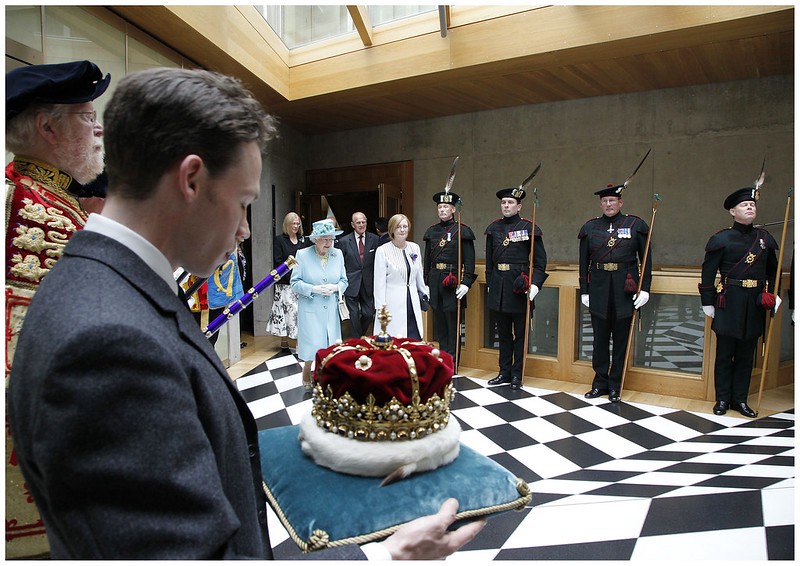
The Crown of Scotland on display as the Queen opens Holyrood. Scottish Parliament, CC BY 2.0.

I’ve had republican instincts for a long time. A hereditary monarchy is inherently questionable if you’re on the left. The symbolism of choosing a head of state by inheritance challenges egalitarian values. As a constitutional reformer, the Crown seemed to be the apex of a system in need of reform from root to branch.

As I got older, I became an ever-lazier republican. And without quite noticing when it happened, I’ve accepted I’ve become a pragmatic monarchist. I’ll never be an enthusiastic royalist. But I’ve come to accept that the constitutional, diplomatic and national consequences of abolishing the Crown are too tricky.

The Crown is a constitutional conduit: replacing it is a big deal

Most people think of the Queen as a ceremonial figurehead — a symbol without any power. Some republicans (and other reformers) see her as holding enormous and unaccountable power. The better view, I think, is something else again. The Crown is a conduit of authority: a human valve through which much of the business of the state flows.

When and on what grounds the flow can be blocked — rarely, but not never — exercises lawyers and scholars. British monarchs have never actually refused formal advice in modern history. Sometimes the Brexit process raised the question of where the line might be. Governors-General in other countries have exercised reserve powers. The most (in)famous is Australia’s Dismissal of 1975.

The system would change if its office-holders’ views of their legitimacy changed. The Queen knows her limits. Inserting someone with a democratic mandate into the same system could turn it into something quite different. But if the Prime Minister hired and fired our head of state, that would neuter our ultimate constitutional longstop.

Having a monarch as our constitutional longstop rather than proper safeguards is not ideal. But I have given up on hoping British politicians will ever tackle our constitution in the round. And if they won’t, I don’t want to create a semi-presidential system by mistake. Nor do I wish to remove the only hard check, in extremis, upon a Prime Minister with a majority.

Other Commonwealth Realms would face a constitutional quagmire

She lives in the UK, but the Queen is head of state in 15 other countries. In Canada, Australia and New Zealand, one Crown became several over time. The newer Realms started with separate monarchies. The last one to become a republic was Mauritius, in 1992; since then, three have voted against doing the same.

It’s not surprising that the Crown is a more contentious institution outside of the UK. Elizabeth II and Emmanuel Macron are the only heads of state of more than one independent country. Heads of state are national symbols: most countries have their own for a reason. Still, whether due to inertia, divisions over the alternatives or affection for the Queen, we’re likely to share our head of state for years to come.

If we became a republic, Australia and New Zealand would stay monarchies unless they chose otherwise. Most Realms would face a paradox: a head of state with a succession set by UK law which no longer provided for it. (Canada occupies an intermediate and contentious position.) Resolving the issues would usually be tricky. In Canada, all provinces would have to agree to abolish the office of the Queen and/or Governor General. Australia requires a referendum with a majority of people and states (which would have to move to republican models too). Papua New Guinea needs a two-thirds majority of its National Assembly. And so on.

These are all Westminster systems and their Crowns are a conduit of authority like our own. Deciding how and whether to preserve a similar balance raises the same sorts of questions as it would in the UK. (It can raise others. The balance of power between the Australian Commonwealth and states is one example.) In the end, we have the right to decide how we choose our head of state. But I don’t relish creating 15 constitutional nightmares for others to deal with.

What’s in a name? If you’re pro-Union, you’d be surprised

When Charles III accedes, I suspect we’ll be startled by how long it takes us to get used to the shift in everyday speech. ‘God Save the Queen’, Her Majesty’s Government, Queen’s Counsel, the Queen’s Speech, the Queen’s English, ‘By appointment to Her Majesty’, ‘Boris lied to the Queen’: our form of government courses through our language.

The problem runs deeper still. Forty-four independent states have monarchies, but only the United Kingdom of Great Britain and Northern Ireland’s sole undisputed name depends on keeping one. ‘Great Britain’ is clearly incorrect. We argue about whether ‘Britain’ denotes the British state, Great Britain or either. And as for replacing ‘United Kingdom’, ‘United Republic’ (deeply clunky), ‘Commonwealth’ (repellent to Irish nationalists) and ‘Union’ (oddly syndicalist) all feel wrong. Cutting it to ‘Great Britain and Northern Ireland’ makes us sound like a longer (and just as temporary) version of the old Serbia and Montenegro.

This matters, because our fuzziness is a function of our formation. Britain stems from a quirk of inheritance: James VI of Scotland became James I of England in 1603, and when the Union of the Parliaments took place in 1707 Scotland was in a position to negotiate. The Anglo-Scottish bargain produced a British rather than a greater English polity. There’s no way to know how a greater English polity would have related to Ireland, in particular. But our Britishness relied on a Scottish dynasty acceding to an English throne.

As a result, our monarchy provided vital scaffolding for state-building. The potential rows over why non-English heads of state win so (in)frequently display the upside of a monarch in our multinational nation. It’s not a coincidence that we’re the last European country to continue with coronations. It’s also striking that over half the world’s monarchies had some link with the British.

Not all absurdities are worth unpicking

The UK and Japan are the developed constitutional monarchies for whom the shock of republicanism would prove most profound. There was a time when I’d have seen that as the point. For me, the appeal of republicanism remains the egalitarian principle and looking at our constitution in the round.

I remain, generally, a reformer. I want a proportional House of Commons and a democratic second chamber. I want an end to local councils where one party wins every seat. I’d like to see more checks and balances in our constitution. I’d still like core aspects entrenched to protect them against an overweening executive.

Perhaps I’ve got older, or the past few years have made me more aware of what you can lose as well as gain. But I’ve concluded that, for better or worse, the monarchy underpins too much of our basic structure for fundamental tampering to be worth the risk. If someone can avoid either creating a powerful head of state or abolishing a constitutional check, forestall a 16-fold diplomatic quagmire and prevent picking at the bonds between the home nations, I’ll listen. Until then, I’ll leave the Crown alone.

This post was originally published on Medium.com on 23 February 2020.