Trashing the BBC comes at a price

Progressives should defend public service broadcasting. Flirting with the anti-BBC lobby has helped imperil it

Hatgate: one of the more ludicrous pieces of anti-BBC hysteria.

For a certain sort of Brit, the NHS and the BBC have long been at or near the top of their list of things to be proud of about their country. They’re both big public institutions which everyone in the UK knows. Their existence speaks to some of the core values of the left. They show that not everything should be left to the market, shared institutions matter and public provision can be popular.

The BBC produces a huge amount of high-quality content of all kinds — news, drama and TV. It makes lots of stuff I’d never want to hear or watch, and quite right too: it’s not supposed to just appeal to me or people like me. But because it’s not driven by market imperatives, it produces things I doubt I’d ever get to see or hear without it. It provides common coverage across England, Scotland, Wales and Northern Ireland — a pan-UK public arena. It supports local journalists around the country. It’s an enormous soft power asset for the country and a news source people in dictatorships have listened to in secret. I’d be horrified to see it go.

Governments always have an uneasy relationship with the BBC. That’s natural enough: journalists are meant to be a thorn in governments’ side. One of the licence fee’s plus points is that it’s not general taxation, so the tension’s reduced a bit: it’s not a direct case of biting the hand that feeds you. But rows about what the BBC does, how it does it, whether it reports fairly and so on are nothing new.

What is new is a government as determinedly hostile to the BBC as Boris Johnson’s. Their hostility extends to public service broadcasting more generally and fits a wider pattern. Today’s Conservatives seem hostile to scrutiny and independent institutions in a way which goes beyond the norm. Threatening Channel 4’s licence in retaliation for empty-chairing the Prime Minister and the ongoing boycott of the Today programme both set an unnerving tone. Proposing to decriminalise non-payment of the licence fee has far more to do with an anti-BBC agenda than its (dubious, in my view) policy merits.

Faced with the possibility — hinted at before the election, floated by the former Culture Secretary and trailed in this week’s Sunday Times — of actually moving towards a subscription model and slashing the BBC to the bone, the Opposition should be rallying to its defence. Frankly, if Labour can’t even defend the world’s best broadcaster and one of our great public institutions, I’m not sure what the point of it is.

Sadly, most of its would-be deputy leaders haven’t got the memo. Ian Murray was an honourable exception. But Angela Rayner said she was ‘no big fan of the BBC’. Richard Burgon referred to the BBC ‘misreporting’ the news. And reaching the real nadir, Dawn Butler said ‘in a way, I thought “OK, that will teach you”’. They all went on to support the principle of a public broadcaster. But it’s more than a little reminiscent of Jeremy Corbyn’s ‘seven, seven and a half out of ten’ response on how strongly he felt about not leaving the EU.

You don’t have to claim the thing you’re backing is perfect. But in politics, you can’t sound lukewarm about which side you’re on when the chips are down. Rebecca Long-Bailey’s comments on a ‘People’s BBC’ this weekend were equally unhelpful. For a start, electing BBC ‘top brass’ is an atrocious idea. It’s a recipe for a hideous battle of obsessives and special interest groups in an inevitably low-turnout election. It’s also a road to politicising the BBC — the exact opposite of what it needs and the public wants.

It used to be mainly the right which trashed the BBC — their self-interest is clear, given a print media far more congenial to its views. Many Scottish nationalists joined in with vim after 2011 — and as the BBC’s very existence embodies the British public space they want to abolish, that’s not too surprising either. But Long-Bailey’s wheeze (not without precedent: a number of Corbynite politicians mutter about ‘democratising the BBC’) and would-be deputy leaders’ curmudgeonliness fit a pattern.

Triggered by the hard left but abetted by much of the soft left, Labour and many of its members have sounded increasingly hostile to free media per se. It’s gone far beyond reasonable discussion of concentrated ownership — booing journalists, the harrying of Laura Kuenssberg, bringing up media reform as a reaction to unfavourable coverage. And with a characteristic blend of zest for public control and suspicion of the actually-existing public realm, the BBC has become a bête noire. The self-parodying row over whether the BBC doctored the appearance of Jeremy Corbyn’s hat to make it look ‘more communist’ was a case in point.

Faced with a pincer movement like this, you’d think the centre and centre-left would be loud in defence of a core public institution. They should fear what wrecking one of the last bulwarks against a retreat to rival echo chambers might mean. And in fairness, the Liberal Democrats have been clear where they stand in recent weeks. But far too many self-defining centrists have not, usually as a result of Brexit. Dawn Butler’s ‘that’ll teach you’ has its counterparts. Andrew Adonis advocating a subscription model and even calling for the BBC to be in court for giving Brexiteers a platform) is a case in point. AC Grayling offers a daily exemplar.

Together with a stonking Tory majority, the result is a better climate for an assault on public service broadcasting than ever before. Britain is not Twitter, of course: plenty of Conservative voters value the BBC. Unease is spreading on the Tory benches. It’s not a foregone conclusion at all. But Opposition parties — and campaigners — need to stop making the Government’s job easier.

Yes, the BBC can merit criticism. I think it’s too inclined to juxtapose factual claims rather than evaluate their truth. I think it struggles to deal with a level of political dishonesty and bad faith we mostly haven’t had to deal with until fairly recently. I sometimes roll my eyes at solecisms in policy areas I know about. At the last election, I think it was too quick to frame an initially much more multiparty contest as a battle between the big two. Its reaction to Samira Ahmed’s totally justified complaint was dire. Some of its journalists should probably just tweet less.

But there’s a difference between constructive criticism and wholesale trashing. Criticise the BBC’s calls on election coverage: don’t say it ‘decided not to be impartial’. Argue for it to be bolder in challenging factual untruths: don’t call it the Brexit Biased Corporation. And recognise that a public service broadcaster’s job involves giving space to views you don’t like, not just playing your worldview back to you.

Because if the BBC becomes a British PBS for lack of champions, Britain will be far poorer for it. The scrutiny of government will weaken. And if you’re on the left or in the liberal centre, you really won’t like the media world you’ll get once the BBC’s brought low.

This post was originally published on Medium.com on 17 February 2020.

Hard choices

The SNP should debate whether a separate Scotland should join the EU post-Brexit. But all their options are bad
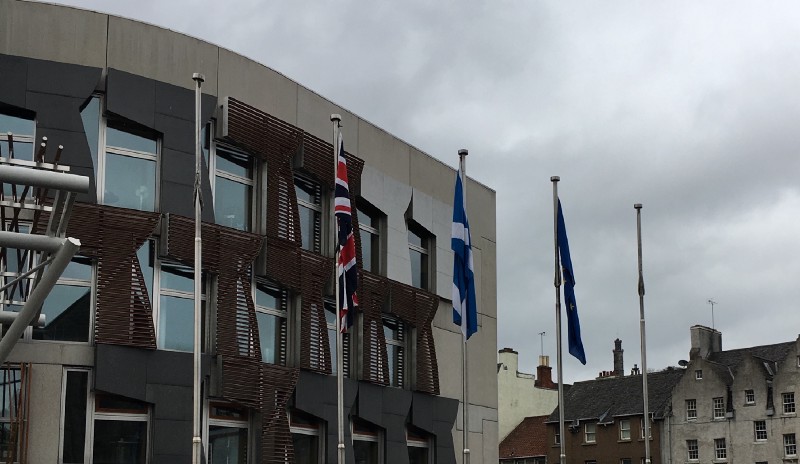
We often forget the SNP campaigned against the Common Market in 1975. But ‘Independence in Europe’ has been an SNP rallying cry for quite some time now. The European Union creates an unusually benign home for small states. To the SNP, the EU also promised continued economic integration with the United Kingdom after secession. The SNP claim that Scotland could carry on in the EU automatically was almost certainly spurious, but that didn’t stop them.

Brexit changes that. It makes the SNP’s political case more appealing, but its practical case harder. It creates sharper dilemmas for a separate Scotland. So it makes sense that some in SNP ranks are raising the question of Scotland’s future EU relationship. Most still back EU membership, including Nicola Sturgeon herself. Some look to the European Economic Area — the so-called Norway model. Are there any good options?

A hard border in Great Britain?

Many Scottish nationalists use Northern Ireland as Brexit grievance fodder. It’s an ugly gambit: Scotland is a country which voted to stay in the UK very recently, not a post-conflict region with a contested land border. Nonetheless, Theresa May’s backstop and Boris Johnson’s frontstop for Northern Ireland show what you need to keep a border open.

Scotland wouldn’t just need to align with the UK on customs and rules of origin. Not joining the Schengen Agreement would avoid checks on people, but still wouldn’t suffice. Scotland would need to align on goods, VAT and sanitary and phytosanitary standards (SPS) too. Joining the EU prevents that, unless the UK aligns with the EU or the EU exempts Scotland from some EU rules.

In the EEA but outside the EU, Schengen, VAT and the EU Customs Union wouldn’t pose an obstacle. But goods regulation remains, as does SPS: EEA members don’t have free trade in agriculture, but apply plenty of EU food safety rules. And being outside the EU Customs Union doesn’t avoid the need for customs checks and rules of origin between Scotland and the UK. And a customs union with the UK is hard to square with joining the European Free Trade Association — required for a non-EU EEA member.

Liechtenstein manages, but Scotland is not a microstate

Granted, one EEA member has an open border with a non-EEA neighbour. Liechtenstein has had a customs union with Switzerland since 1923. It also applies Swiss VAT law. They planned to join the EEA together, but the Swiss rejected joining in a referendum. Switzerland pursued bilateral agreements with the EU instead.

This delayed Liechtenstein’s EEA entry until 1995, but it managed in the end. Both Swiss and EEA goods circulate via so-called ‘parallel marketability’. The authorities monitor goods ‘in the market’ to keep EEA-only products out of Switzerland. Where EEA goods attract tariffs in Switzerland but not Liechtenstein, Swiss customs reimburses importers to Liechtenstein. (This isn’t too far from the plans for Northern Ireland.)

This is much easier for Liechtenstein than it could ever be for Scotland. Switzerland aligns with the EEA for most goods and applies EU SPS rules. It’s in EFTA, along with Norway, Iceland and Liechtenstein. All but Switzerland joined the EEA, reducing the scope for friction due to other trade deals. Furthermore, Liechtenstein is tiny — and so permitted to be anomalous.

Scotland, by contrast, would have the EEA’s largest EFTA population. The UK plans to diverge from EU norms far more than Switzerland. We don’t know how its new trade deals will go, but it shows no interest in joining EFTA. Switzerland has a long history of cooperation with its small, sovereign neighbour. The UK would be asked to help Scotland carve a niche to advantage it against itself.

Cake from London, Brussels, Oslo, Reykjavik and Vaduz? No chance

Only EU membership could grant Scotland a proper vote on EU rules. Overall, though, being a giant Liechtenstein might well be better for an independent Scotland than EU membership. But it’s not going to happen. Neither EU nor EFTA countries will cut corners to keep the Scotland-UK border open. Doing so would mean 49% of the EEA’s non-EU population lived in an anomaly next door to a far trickier neighbour than Switzerland.

Yes, the EU bent some rules for Northern Ireland. Scotland will not get the same offer. It was required for Northern Ireland because Ireland, a continuing EU member, had a vital national interest at stake. Perhaps excepting a Schengen opt-out to preserve the Common Travel Area, Ireland has no such interest in helping Scotland.

Nor would the UK have much interest. It wants to be able to diverge from the EU. It will want to secure the integrity of its regulatory order. And Scotland would be an important trading partner, but not as important as the EU. The UK left the EU to avoid pooling sovereignty: it wouldn’t re-pool it with Scotland for much less economic gain. Any deal would mean Scottish rule-taking and UK decision-making.

Breaking up is hard to do

So Scottish secession means a hard Border unless Brexit softens or the UK rejoins the EU. Joining the EEA would allow fewer barriers with the UK in some areas (eg agricultural tariffs) if the UK agreed. Nonetheless, EEA membership would remain a choice to dealign from the UK.

Still, the scale of Scotland’s UK trade means even this flawed compromise might beat EU membership on economics. A separate Scotland would have two main trading partners: the UK and the EU. But those two partners are far from equal: UK trade dominates.
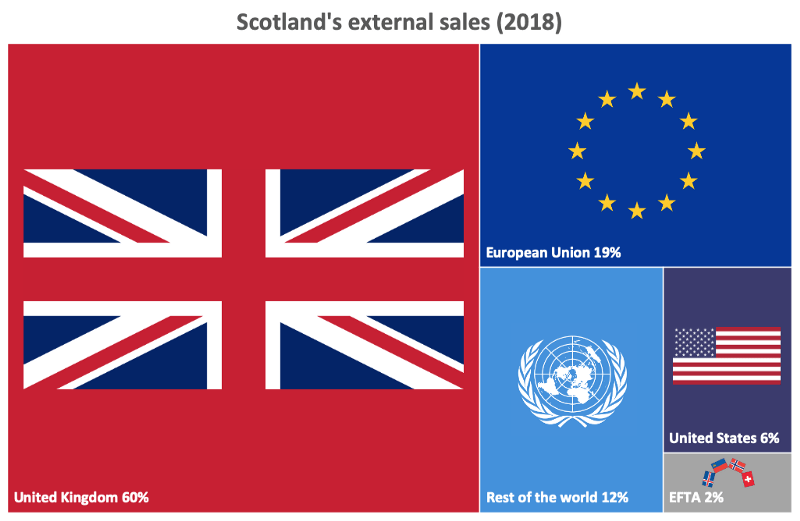
Data from the Scottish Government. Figures do not add to 100% due to rounding. Flag images from Wikipedia.

For now, Scotland sells to the rest of the UK within a far more integrated market too. There’s a reason the Commission keeps battling to complete the single market. From digital services to hairdressing, from the limits of EU mutual recognition to the UK monetary and fiscal union, sharing a state goes much deeper than joining the EU.

For both reasons, the shock of leaving the British home market — whether for the EU, the EEA or neither — would dwarf leaving the single market. This matters. UK fiscal transfers are crucial, but not the biggest economic question about Scottish secession. The bigger question is: how far would growth exceed or fall short of growth within the Union?

Nationalists make heroic assumptions here, cherrypicking small states and copying countries whose growth isn’t higher than the UK’s. Above all, they don’t factor in the true cost of their political project.

Secession will hurt. So tell Scots what you think they’re paying for

The economic arguments against Brexit apply in spades to breaking up Britain. Scotland’s biggest economic interest lies in its home market with most of its trade. Economic gravity, crucial in Europe according to the SNP (and they’re right), still applies within the UK. If Scotland secedes, the closest possible alignment with the UK would be its least damaging option.

But such close alignment with the UK isn’t realistic. It can’t be: the point of Scottish secession is rejecting the neighbours. Shared EU membership could have cushioned that shift, but not now. Unsure voters will back major pain for radical change, the SNP still wants to sell separation as safer than the Union. But that’s a worse lie than anything from Vote Leave. And the SNP leadership are far too intelligent not to know it.

Breaking up Britain is a far bigger leap of faith than Brexit. It would pull Scotland away from its main market and closest neighbours and the people with whom it shares most. Its rationale is ideological and nationalist, not practical or economic. The least the SNP could do is own its costs.

This post was originally published on Medium.com on 10 February 2020.
Acceptance

I knew Remain might very well lose the EU referendum. Truth to tell, for most of June I thought we would. I forced myself to believe we wouldn’t in the final week, a feat of denial I’m not usually much good at. I was coordinating Stronger In and Labour In activities in addition to a full-time job: I doubt I’d have had it in me to go through the last week of the campaign if I hadn’t.

I was, if I’m honest, more surprised by the campaign for a second referendum than by losing the first. It never occurred to me people wouldn’t regard it as final. Naively, in retrospect: equally Scottish and English myself, I should have looked north of the Border. Nonetheless, I never expected a second referendum to be held. I never thought it would be won if held. And democratically, I thought the first one should be upheld.

I’d also always guessed that if we lost, Brexit would end up much harder than many thought. In 2016 and 2017, I hoped my government would prove me wrong; in 2018 and 2019, I believed MPs should take the Leave-tilted compromise on the table for fear of something worse. I despaired of the competing fundamentalisms and the pincer movement to destroy any possible middle ground. Once it was gone, Johnson’s Brexit was too much for me to swallow, for the sake of Northern Ireland above all, but I had little hope it wouldn’t go through.

So I’ve never had a comforting period of denial, never really thought the clock could be turned back. I understand something fundamental happened on 23 June 2016. Having spent years fearing No Deal, tonight’s tragedy is, in fact, a little less bad than many of my predictions. Drained by three and a half years of political hand-to-hand combat and schooled in grim realism, I thought I might be less grief-stricken than most Remainers. But it turns out that even if it’s the hope that kills you, a lack of hope isn’t much of an antidote.

I don’t care about the European Union so much just because I like economic integration, or even because I like to see fewer rather than more fences in the world. I believe in the political project and always have done. I believe in a project built to tame the fears of a terrible past, which shifts the basis of relations among Europe’s nations from power to law — a dream never quite fulfilled, but gradually inched towards in Council meetings and arguments over shared rules. I believe in the potential of Europe to bolster liberal democracy and the rule of law —which means I worry more about Poland and Hungary than I do about the euro.

In short, I believe in a project which pools sovereignty for its own sake. Not as a pragmatic means to an end; not even as a generic expression of liberal internationalism. And my countrymen and women do not. They never have. Even many continuity Remainers don’t really support it as it truly is. The fact I understand that is one reason I haven’t supported overturning the referendum result. It’s also the main reason 23 June 2016 was the worst loss of my political life.

I won’t give up on my country as a result. I know the United Kingdom forms a multinational union of its own, as well as a nation, and I know that’s a precious thing. The Union Jack is still my flag; the British people are still my people. I want us to go forward and prosper, in friendship with our neighbours and the wider world. I want to see us mitigate the damage of Brexit and take such opportunities as exist. Leavers aren’t my enemies: they’re friends and family. My grandfather voted Leave by post a few days before he died: I love him no less for it.

I know there’s a perfectly respectable case for leaving the EU. Some people believe democracy should be brought nearer home, even if it comes with an economic price. Some people would rather steer a dinghy on their own, even if the waves are choppy. Some believe laws made abroad corrode the ties between people and politics, even if we have a say in making them. I do not damn anyone for believing all of that.

And to an extent, I hope they prove me wrong. I don’t say ‘to an extent’ because I want Britain to do any less well. I say it because the EU, for all its faults, embodies many of my most cherished beliefs. For as long as it lasts, I expect it always will do. And for Europe’s sake, I want it to succeed. I doubt we ever will, but I hope we take our place in the EU again one day — properly, this time: understanding what it’s truly for.

Until that day, if it ever comes, I understand we must make the best of Brexit. I hope we do. On Monday I’ll try to focus on how to do that, to the small extent that matters. But part of me will always mourn it. I’ll always be a European by conviction, even if not by citizenship. And tonight, I will grieve.

This post was originally published on Medium.com on 31 January 2020.

Fellow Remainers, wise up

We’ve had three and a half years to make our peace with Brexit. Let’s make better use of the next three and a half

In the last parliament, MPs who opposed a hard Brexit were in the majority and had real power. Sadly they squandered it, and now they have little or none.

There turned out to be no concrete option they could agree on. Theresa May’s Brexit was too hard for almost all Labour MPs and too soft for many Tory MPs. As a result, an admittedly Leave-tilted Brexit compromise fell, as did the prime minister who negotiated it. She was, predictably, replaced by a far more hardline successor.

Boris Johnson pivoted from No Deal in all but name to a Deal — abandoning regulatory alignment and dropping May’s promises on the Union. Then Tory MPs had to choose between Northern Ireland’s unionists and a hard Brexit for Great Britain. Meanwhile, referendum-sceptic Labour MPs were confronted with the price of their inconsistencies. As a result, a narrow majority emerged for a much harder Brexit. And thanks to last year’s election, that majority is now beyond doubt.

So now opponents of Boris Johnson’s Brexit have to rely on embarrassment and political pressure, not hard political power. There’s no point pretending: they have far less chance of changing policy as a result. But keening and wailing until perhaps we rejoin the EU one day isn’t much of a policy, and parliamentary democracy needs an effective opposition.

So given where we are now — leaving in a week, like it or not — what should opposition MPs and campaigners do?

1. Don’t fight the last war

In 2015, a narrow majority of seats and votes went to parties who backed a referendum on EU membership. The 2016 referendum delivered a narrow but clear vote for Leave. In the 2017 election, both major parties pledged to deliver some form of Brexit. And in last year’s election, ‘get Brexit done’ secured the largest parliamentary majority since 2001.

We don’t have to change our minds about Brexit. I still think it’s a historic tragedy and an enormous policy error. But while people have every right to campaign for whatever aims they choose, the wise thing is to recognise the parameters the voters have set for us on three separate occasions and work within them for now. (Yes, 52% of voters backed pro-referendum or pro-revocation parties. But voters are not stupid. If it had been their priority, more of them would have voted tactically. They didn’t.)

No one should assume the EU will be in any hurry to radically renegotiate by 2024, even if Labour finds a compelling political project in time. It’s also a pretty good bet that most voters will think they never want to hear the word ‘Brexit’ again by then. (In fact, they’re already there. They essentially voted to get Brexit off TV on 12 December.)

That means the future EU-UK relationship may well be fixed, in outline if not in detail — life outside the EU is a constant negotiation — for years to come. Like it or not, the national interest requires the government to make a success of Brexit — or, more likely in my view (but I hope I’m wrong), the best of a bad job. The sooner Remain MPs and parties recognise that, and make it clear they do, the sooner they might get a hearing. Labour and Lib Dem MEPs’ decision to vote against the Withdrawal Agreement next week — when they know the consequence of it falling would legally be a No Deal crash-out at 11pm next Friday — is not a good start.

2. Don’t pick every battle

I get why people do this. Really, I do. The Big Ben bong saga, Union Jacks flying down the Mall on Brexit Day, commemorative coins, blue passports: they all feel designed to aggravate. And I expect they often are: cries of irritation from ‘Remoaners’, refracted through social and tabloid media, are part of the point.

As a rule, though, if your opponents want you to do something, you should pause before going ahead and doing it. The current government won its majority on the back of the other side of the culture war. Playing along energises parts of its voter base. It makes it harder to get real issues across. And fairly or unfairly, it fits a ‘Remoaner’ stereotype we need to shake off.

So when faced with such things, ask yourselves a basic question: do they actually matter? If the answer is ‘no’, try to ignore them. Does it matter whether Big Ben bongs next week? No. Does it matter if we have Union Jacks on the Mall? No. Does it matter if we see a 50p coin with an unattractive typeface reminiscent of Monotype Corsiva once or twice? No. Does the colour of our passports matter? No. Let Leavers have them and focus on something which does.

3. Don’t kick away ladders ministers might climb down

One of the most important pieces of soft power an opposition has is deciding when not to oppose. In a system whose adversarialism engenders juvenility, it’s easy to reject proposals, mock U-turns and point gleefully at climbdowns. That’s par for the course in British politics. But given the stakes, the priority shouldn’t be finger-pointing. It should be making it easier for the government to do sensible things and harder for it to do stupid things.

For the most part, this principle was nowhere to be seen in the last parliament. Far too often, MPs sniped at May’s government in both cases. For instance, Labour said it wanted a softer Brexit for most of the last parliament. So why did a party which said it wanted a customs union object to the fact that May’s backstop included a customs union?

The most urgent question is whether Boris Johnson will U-turn on extending the transition period in time for the legal deadline of 1 July. After that, the question is whether we find a fudge or face a fall on 31 December. In the unlikely event that Johnson changes his mind, it will be hard not to crow. If he panics in the autumn and we scrabble for a fudge — perhaps referring to the transition in a new, basic FTA as the status quo ante from which we’re moving and, by including ‘implementation’, extending it in all but name — the urge to expose it will be hard to resist.

Nonetheless, MPs, campaigners and others who want to blunt the edge of Johnson’s hard Brexit should resist. A decent deal takes time. We need the government to buy it. The last thing we should do is join with the most extreme Brexiteers in begrudging the purchase. If we borrow ‘dynamic approximation’ from Ukraine’s DCFTA, or agree to align with parts of EU law, the same applies. If you prefer a softer Brexit to a harder one, don’t scream about disguised rule-taking if you get some of what you want.

4. Don’t dismiss every possible opportunity

The European Union is a great European achievement. It has done more than any other organisation in human history to change the way European states relate to each other, to place them on a basis of law and not just power. Its economic, geopolitical and human achievements are remarkable. Part of the tragedy of Brexit is that pro-Europeans only made a case against Brexit, not a case for the EU, until far too late.

Nonetheless, European integration is a set of institutions and a body of law. It is not the organisational equivalent of Sir Galahad. It has faults. EU membership has downsides; there are some positive features of life after leaving. The far larger number of downsides (in my view) doesn’t mean they don’t exist. Not even the most starry-eyed British pro-Europeans think the Common Agricultural Policy and Common Fisheries Policy are great European triumphs, for instance.

Above all, Brexit may at least return some issues to the arena of democratic discussion. I am not saying the EU has no democratic aspects. It does, and I always thought we should have done more at home to make use of them and to up our own democratic game. But formal institutions can’t substitute for public engagement. And British people rarely identify with or follow the European Parliament on a day-to-day level.

For the first time in decades, trade, agricultural subsidies, fisheries management — and EEA/Swiss immigration — will be on the democratic table at UK level. That means people on all sides can make their case for their view of how we should do things. For instance, I’d love to see the UK lead the world in how its parliament scrutinises trade negotiations. I don’t actually know where exactly I think the balance between open trade and food security should lie: I’d welcome a proper debate about it. Don’t let mourning for EU membership close off any thought for how we do things in future.

5. Don’t make yourself sound like you despise the country

The most tone-deaf continuity Remainers and the most zealous Corbynites have very few nice things to say to each other. But sometimes they have more in common than they care to admit. And they share a certain tone towards the country in which they live and whose people they want to win round to their way of thinking.

However they voted in 2016, most people in Britain have an affection for the land they call their own. As it’s Britain, what that land is varies depending on where you are. For most of us, which one we’re talking about depends on when you ask us. And it’s not necessarily a demonstrative or performative thing. Nonetheless, ‘we are useless, everything we make and do is useless, vote for me’ is not a winning message for people to hear — even if it’s not what you really think.

You don’t need to paint Britain as a benighted disaster zone to say a harder Brexit is worse than a softer one. You don’t need to label the British people the most prejudiced in Europe — they really aren’t — to call out the Home Office. You don’t need to sneer at British manufacturing to defend its just-in-time supply chains. You don’t need to see the Union Jack as an affront to see yourself as a citizen of the world. You don’t need to disdain Britain’s distinctive voice to want it to join the choir.

Our aim is not to stop an awful country from becoming the rainier version of the apocalypse. Our aim is to get the best or least-worst outcome for a good country which isn’t being well-served by its government. Other countries’ pro-Europeans always twin the flag of Europe with their national flag. Learn from them.

Grown-up opposition

Brexit has always been too serious an issue to treat as a normal political football. Sadly and unsurprisingly, that didn’t stop many politicians. And it turns out that in the battle of the anti-compromisers, the hard Brexiteers held the most cards.

I hope progressives can do better in the next three and a half years than they did in the last three and a half. I am too much of a realist to expect them to revolutionise policy. But they can start to re-earn a hearing. They can try to soften government policy and encourage more rather than less sensible government strategy. They can look to the future — and maybe they can avoid exacerbating the wounds in our body politic. I hope they manage.

This post was originally published on Medium.com on 24 January 2020.

Give the voters credit

Don’t disdain the voters if they focus on character and credibility more than any single policy. They’ve got a point

They say the first step to recovery is recognising you have a problem. Perhaps it’s unsurprising, just before Christmas, that much of Labour hasn’t got there yet. More strikingly, much of Labour has decided that it’s other people who have a problem instead. For some it’s the media; for others it’s Brexit; for still others, increasingly, it’s the voters themselves.

But actually, even if we ignore the truism that the voters are never wrong, they deserve more credit than many are willing to give them. And looking at the early indicators of why they demurred, the reasons seem thoroughly fair. Labour would do well to start by recognising as much.

Fitness to govern

Challenged on Corbyn’s political record, many Labour supporters asked: ‘which Labour policies do you disagree with?’ That’s reasonable as far as it goes. The left places a great deal of weight on what manifestos say. It often dismisses those who focus on the character of those who seek to govern. They can sometimes ignore their own hero-worship in the process (this includes moderates, by the way). But more importantly, they miss the point of elections if they treat leaders as mere channels for manifesto delivery.

In every term, governments have to make decisions they never even considered before the election. They wield a great deal of power independently of Parliament. They usually set the agenda to steer through Parliament. And Prime Ministers have to take ultimate responsibility for all of that — and personal responsibility for decisions in a supreme national crisis. That makes a Prime Minister’s character, background and personal beliefs supremely relevant.

So it was entirely reasonable for voters to ask whether Corbyn was more or less fit to govern than Johnson. It is widely agreed that Corbyn’s personal stock was badly hit by the Skripal affair before the election, and that’s completely fair enough. People were murdered on British soil. Voters had good reason to question whether a man who suggested getting Russia to verify the Novichok it deployed could be trusted on national security.

Credibility

Many Labour people say their manifesto policies were popular. Ultimately, well-received Labour manifestos don’t end up producing large Tory majorities. But it’s true to say voters seemed to like a lot of Labour’s policies, in isolation and in theory. In combination and in practice, it’s a different story. And again, whether you agree with their judgment or not, the voters’ point is a fair one.

Basic common sense — or experience of trying to run any project — will tell you people have limited capacity. The same applies to a state — especially given that the British state’s capabilities have declined a great deal since 2010. So it’s not just understandable if lots of voters say they support a raft of Labour policies and then worry about their ability to deliver. It made good sense for voters to worry.

Similarly, whatever you think about the costings of Labour’s manifesto — regarded pretty dubiously by many — the way it behaved in the campaign made voter doubts very reasonable. Labour threw a £58 billion pledge (for the WASPI women) into the middle of an election campaign after its manifesto was launched. There seemed to be (because there was) no sense of prioritisation from Labour. According to YouGov, voters tended to say Labour had a lot of policies which didn’t seem to be thought through. And voters had good reason to be sceptical.

Leadership

I would have preferred a Brexit compromise to the fight to the finish we ended up with. I found Johnson’s ultra-hard Brexit too much to live with and disliked the Liberal Democrats’ pledge to simply revoke Article 50 (even if I knew it was just a symbol). So in 2019, while I doubted what kind of Brexit they proposed and the timescales in which they proposed to work, Labour’s policy was my least-worst option.

Except for the part where Corbyn refused to say which side he was on. I found it irritating, but it looks like the voters cared about Corbyn’s unwillingness to pick a side more than I did. It looks like it reinforced their pre-existing view of his inadequacy as a leader — more than taking either side would have done. And again, voters were right about the choice facing them. Labour didn’t want to take a clear Remain- or Leave-aligned position. Its leader didn’t want to tell them what he thought. That reluctance was where its policy position ultimately came from.

Leave voters were right to think that if they wanted to ensure Brexit happened, then the Tories were the party to do that. Remain voters were right to think the Labour leadership’s heart wasn’t in its Remainier pledges — but that probably mattered less in practice. Not unreasonably, Labour Remainers were much more likely to stay loyal than Labour Leavers.

Ethics

Antisemitism’s impact on Labour’s fortunes seems harder to pin down than broader fitness to govern, lack of credibility and obfuscation on Brexit. But anecdotally, more than one Labour candidate reported that it did real damage. Anna Turley reported: ‘what they said was, “My parents or my grandparents — they fought the war over this.”’

This was reasonable and right. Under Corbyn, two female Jewish MPs were driven out of Labour, antisemitic incidents soared and Labour found itself investigated by the EHRC for institutional racism. Corbyn himself was (rightly) challenged for antisemitic tropes he’d used in the past. Corbyn’s antisemitism became a point of near-consensus in the Jewish community.

Did the voters as a whole go so far? Possibly not. But doorstep unease suggests a lot of ‘less-informed’ voters deserve a lot more credit than some very well-informed people who found excuse after excuse to avoid the obvious. Frankly, the latter could do with learning from the former. Voters who recoiled at the Corbynite record on antisemitism were absolutely right.

The voters had a point

Blaming the voters, who cannot after all be deselected, never gets you far in a democracy. But even leaving that pragmatic reality aside, Labour will do itself no favours by ignoring their overall message. You might be appalled by the alternative (and I’d agree with you), but Labour’s thumping was richly deserved, and the voters’ main apparent objections to their offering were right.

The voters neither trust nor much like Boris Johnson. Labour shouldn’t rail against them for looking at their man and deciding he was even worse. It should, instead, take a long, hard look at how they came to put the public in a position where they came to that conclusion.

This post was originally published on Medium.com on 24 December 2019.

Decency

London’s my home. Our ‘leaders’ making capital out of an attack on it, whether to play tough cop or to berate the West, repels me

London Bridge happens to be my hub station. A good friend of mine lives walking distance away. I’ve got a favourite pub there (Mc & Son’s — it’s a properly good Irish pub, it plays good live Irish music, the Thai food’s not bad). There’s a great Indian nearby (the Mango Indian — not cheap, but good). It’s very much on my day-to-day map.

Most of us tend to get a bit more of a shiver running down our spine when something terrible happens near us. But my reaction wasn’t quite the same on Friday as in 2017, when London Bridge was also attacked. Two years ago, I was shocked as well as saddened: I still had it in me to be shocked. This time, I still felt despairing, but deadened — no longer shocked, because now I’ve come to expect such horrors from time to time. I profoundly wish I hadn’t.

That both the two victims were former students at an event marking a programme which gave students and prisoners a chance to study together to help reduce reoffending — and that while one prisoner was the attacker, another tried to stop the attack — feels particularly heartrending. The decency and principles of both Jack Merritt and Saskia Jones come through. And Mr Merritt’s response shows the kind of principle most of us wonder if we could ever manage to display, were that sort of tragedy ever to crash into our lives.

So there’s something particularly repellent in the sight of Boris Johnson, less than 48 hours after the crime, making hay out of the horror for partisan gain. Politicians have no duty to agree with the policy prescriptions of victims, of course. But sometimes the Prime Minister should act as Prime Minister, not just a party leader. The BBC gave way to Johnson’s demand to be interviewed by Andrew Marr this morning without agreeing to be interviewed by Andrew Neil for that very reason. They deemed it, in a quixotic triumph of hope over expectation, ‘in the public interest’. For all her faults, in Theresa May’s case that might have been true. Her successor makes for a sad contrast.

Johnson took a traditional ‘lock ’em up and hang ’em high’ approach. Would a different sentencing framework have produced a different outcome? Would the attacker have persuaded the Parole Board had that been required? What were the merits of the Court of Appeal’s decision to replace a sentence of detention for public protection with an extended sentence? Does the current sentencing framework (under which the attacker was not sentenced) need reform? My instincts are liberal, but I won’t try to answer here: others will do so and it’s not my point. The point is that the Prime Minister has chosen to inflame and divide, to use a national tragedy and families’ heartbreak for partisan advantage. It insults families, disgraces his office and demeans us all.

The Leader of the Opposition’s speech today was somewhat less blatant. For the avoidance of doubt, I don’t presume to know the foreign policy views of those affected on Friday. Nor do I dispute that foreign policy is a legitimate matter for national argument. But terrorist attacks aren’t an excuse to make that argument. Jeremy Corbyn did, in fairness, say ‘The blame lies with the terrorists, their funders and recruiters.’ But his next sentence was ‘But if we are to protect people we must be honest about what threatens our security.’ And as is so often the case, this was a classic example of being able to discard everything before the ‘but’, implying that in some sense the West brings this on itself.

Corbyn made a longstanding argument against Western foreign policy and intervention in almost any circumstances. Is there some causal connection between Western foreign policy and attacks in the UK, or at least a probabilistic connection? Would an already-existing fundamentalist ideology have kept away from our shores, unlike other countries which didn’t take part in most interventions, had we and the US taken a different foreign policy stance? Where does an ideologically anti-interventionist policy leave the people of Syria, Kosovo or Sierra Leone? My instincts are qualifiedly interventionist, but again, that’s not my point. The point is that the Leader of the Opposition used the immediate aftermath of Friday’s horror as a chance to push anti-Western foreign policy.

There was a time when we could have expected the Prime Minister and the Leader of the Opposition to put partisan politics aside for at least a few days when it came to national tragedies. It wasn’t all that long ago. As I’ve said, Johnson is not May. And while Corbyn has form from 2017, Ed Miliband would have known better. This is a recent debasement.

I expect it will continue. But families have lost loved ones and the city I call home and the country I love have suffered a further attack. I don’t expect any better from either ‘leader’, but I should be able to. Mr Johnson, Mr Corbyn: shame on you both. A plague on both your houses.

This post was originally published on Medium.com on 1 December 2019.

Take votes seriously

We’re treating the whole electoral process as a partisan football, and it’s bad for democracy

Today the House of Commons will vote on, and probably reject, an early general election under the Fixed-term Parliaments Act 2011 (FTPA). It will do so for a range of reasons. A lot of Labour MPs fear the verdict of the electorate. Some MPs still want a second referendum on EU membership before any election. And others are arguing about the date and the format.

I accept that elections are the core of politics. Inevitably, they’re subject to politicking. But we should expect some basic seriousness about what needs to be in place for the public to have confidence in them. This is, obviously, true of all sides. But oddly, much of the worst ignorance and indifference is currently coming from those keenest to dismiss the legitimacy of the 2016 vote.

A referendum is not an on-off switch

Many still argue that a referendum should be held before an election (or perhaps on the same day). Some still pursue the chimera of a caretaker government. Others seem to think that Parliament can, as it did with two extension requests, legislate to impose one on the current government.

It’s painfully clear that this government would not play ball. The idea that a second referendum can happen without a government which will is absurd. This is not the Benn Act. The European Union Referendum Act 2015 was a much more complicated piece of legislation (67 pages long), related to the Political Parties, Elections and Referendums Act 2000. There were also 132 pages of conduct regulations made by ministers under the Act. The Electoral Commission tested the question set out in the Referendum Act and did some proper research, at the government’s behest.

If you doubt that these things matter, look at the row between Scottish nationalists who want a Yes/No question and Scottish unionists who prefer Remain/Leave. Who is going to ensure any question in a second referendum is scrutinised properly with no government willing to refer it? Who is going to deal with the conduct regulations? Are they all going to be in statute? Will a new Act delegate another group of MPs to play government without civil service backing?

The Constitution Unit suggested 22 weeks as a ‘bare minimum’ timetable. I might add that both the 2014 and 2016 referendums won express election mandates before being held. I would argue a rerun would benefit from a similar mandate. But to suggest a rushed six-week timetable for a new vote, steered through in a panic and with none of the consultation, lead-in or public information in the last one will be seen as legitimate by whoever loses it is farcical.

We do not have a government willing to cooperate with a second referendum. It is abundantly clear that we are not going to get one in any reasonably foreseeable circumstances in this parliament. Unless Labour decides that someone apart from Jeremy Corbyn can lead one and unless whipless Conservatives suddenly decide they prefer a referendum to Johnson’s Deal, the whole thing is a parlour game. Worse, it could be a route to a botched and illegitimate referendum.

The franchise is not a plaything

Most mutterings about changing the franchise before the next general election are probably excuses not to vote for one, in the main. Nonetheless, more than one parliamentarian has suggested that any one-line Bill to allow a general election could be amended to extend votes to 16-year-olds. Commentators have speculated about doing the same for EU nationals. I dislike the idea of a one-line Bill to get around the FTPA in any event: I think it sets an unpalatable precedent. But this would be a wholly different level of bad behaviour.

Franchise extensions are reasonable things to support in principle. I’m mildly in favour of votes at 16 and I haven’t made up my mind about the nationality question. But the idea of trying to change either in less than two months is absurd. For a start, 16- and 17-year-olds are not currently on our registers as enfranchised voters. Some are registered as attainers (soon to be but not yet eligible to vote). But even with that caveat, you are talking about registering over a million people in weeks with no public information campaign.

EU nationals don’t raise any new registration issues. They should already be registered for local, devolved and European elections, though this has not been problem-free in the past. But again, you can’t deliver the sort of public information campaign you need in time. There are reasons the OECD recommends a lead-in of at least a year for changes to electoral fundamentals.

Democracy is not a process to be tampered with lightly

To their credit, the Liberal Democrats (co-sponsors of the one-line Bill approach) have made clear they wouldn’t support changing the franchise in this way. But too often, because they’re playing British politics for such high stakes, MPs risk forgetting the need for a sense of basic political self-restraint.

Democracies cannot thrive if politicians have no respect for the rules of engagement. That’s especially true for a country like the United Kingdom, where we have so few formal protections and rely so much on good behaviour. We, more than most, need our governments and our legislators to draw the political line for themselves. For the most part, I’ve been sympathetic to Parliament asserting its power against a government which treats it with contempt. But there’s a limit.

In the end, MPs who want a second referendum — or, indeed, anything but Johnson’s Brexit — are going to have to face the voters in a general election very soon. They will have to do so under the existing rules for elections. They should recognise that, engage seriously and make their choice. And they should stop salting the democratic earth just to put off the evil day for a few more weeks.

This post was originally published on Medium.com on 28 October 2019.

Not all Brexit Deals are alike

On balance, I supported Theresa May’s Deal. I can’t support Boris Johnson’s

The United Kingdom voted to leave the European Union just over three years ago. I did not. Those three years feel like many long, weary lifetimes in politics. Throughout that time, I’ve felt we should accept the result and work with it. I was open to a variety of different moderate Brexit outcomes and I never wanted to embitter our politics even further with a second referendum.

I made the argument for Theresa May’s Deal with a heavy heart. I feel grimly vindicated in making it. May was succeeded by Johnson, contemptuous of constitutionalism and unfit for high office. A deal which essentially included a customs union and a fairly high level of alignment with the EU was replaced with a Brexiteers’ Brexit. We now face a far worse choice than before, having badly damaged our democratic norms in the process.

But when I supported May’s Brexit, I made a judgment on a particular package. And as someone who takes the Union seriously, as a social democrat, and as someone willing to accept a reasonable but not brutal Brexit, Johnson’s goes too far. I confess I didn’t expect him to strike a deal by now. I also thought he would only agree one if he had the DUP on board. And I knew the EU would happily adopt a Northern Ireland-only backstop, but I didn’t think they would make so many concessions on its details. But almost all the changes are greatly for the worse and the balance of risks has changed.

The new Northern Ireland backstop: consent without convergence

The reasons for a backstop are well-rehearsed. Brexit forces a series of hard choices upon Northern Ireland — soon, by default, to have a land border with the EU. That border is historically contested, logistically impossible and politically fraught. Border communities have been abundantly clear they will not accept checks and controls. And regulatory and customs divergence means checks and controls.

The EU proposed that Northern Ireland align with Border-relevant parts of EU law and that controls be carried out between Great Britain and Northern Ireland. That cut across unionists’ links to the rest of the United Kingdom, with significant (and likely to grow) barriers to most of its trade. Northern Ireland would also take rules shared with Ireland with no say in them. This differed fundamentally from North/South cooperation by agreement between the two jurisdictions.

Theresa May fought hard to secure a limited UK element to the backstop. Great Britain would have been in a customs union with Northern Ireland and the EU. She also accepted that to keep Great Britain and Northern Ireland close, Great Britain would have to stay close to the EU. Faced with a choice between regulatory freedom and the economic cohesion of the Union, she chose the Union. Boris Johnson chose the opposite. He returned to the Commission’s original backstop, changed its provisions on customs and secured new ones on consent.

Theresa May’s customs partnership has been reborn for Northern Ireland alone. Northern Ireland would legally be outside the EU customs union and in the UK’s customs territory. However, the EU’s customs border would be administered at Northern Ireland’s ports. Some goods bound for Northern Ireland would be exempted from EU tariffs from the start. Others would either need to pay tariffs and claim rebates or have tariffs effectively waived by the UK Government up to a limit. This means Northern Ireland can benefit from such trade deals as the UK negotiates.

Meanwhile, the new consent provisions mean the backstop stands or falls through votes by members of the Northern Ireland Assembly. The backstop would come into force at the end of the UK transition period. After four years, the Assembly would vote. Support from a simple majority of MLAs would keep the backstop in place, with another vote four years later. With a cross-community majority, the next vote would be after eight years. If the backstop is rejected, we would have two years to identify alternative arrangements for the land border. Whether the Assembly ever rejects it probably depends on the Alliance Party’s electoral fortunes. It is unlikely, but not impossible.

May’s backstop, in my view, made it likely that Great Britain would remain aligned to Northern Ireland and major new barriers between the two would not arise while protecting goods trade with Ireland and avoiding a hard land Border. Because Great Britain couldn’t lower tariffs below the EU’s, a radically different trade policy wasn’t on offer. That removed the point of rules on goods which differed from the EU and Northern Ireland. The hard choices Brexit forces on Northern Ireland would have been, more or less, avoided. Nationalist alienation would have been reduced and Border communities’ way of life would have been preserved. And even unionists should recognise that without acquiescence from people of a nationalist background, the prospects for the Union would be poor indeed.

I judge that Johnson’s backstop poses a far starker, potentially destabilising choice for Northern Ireland. Great Britain will, over time, move away from the EU if he gets his way: that is the whole point of the exercise. I do not believe that can happen without growing barriers to trade between the two. We should remember that most of Northern Ireland’s trade is with Great Britain. Clearly this backstop also gives Northern Ireland a competitive advantage over Great Britain in EU trade. I have yet to see hard economic evidence that this outweighs major divergence from its largest market. The likelihood is a significant economic realignment over time, to which most unionists do not consent and which has major political implications.

The institutional provisions are deeply worrying too. I welcome a consent mechanism in principle. But I fear an Assembly vote every four years (not even in line with the Assembly’s five-year electoral cycle) will polarise Northern Ireland’s politics still further and make it even harder for its institutions to work. Do we want every Assembly election to be overshadowed by whether the the region will align with Great Britain or Ireland? Every Border constituency voting on whether MLAs risk bringing back a hard Border? Every core unionist constituency voting on whether they remain aligned with Ireland?

From a unionist perspective, Johnson’s backstop trades the substance of close alignment with both Great Britain and Ireland for the formality of consent which is unlikely to be withdrawn — and which could only be withdrawn at an enormous price. At least as importantly, from a cross-community perspective it raises the temperature of Northern Ireland’s politics indefinitely and undermines its institutions. May’s backstop was, especially if combined with alignment by Great Britain and mechanisms for input in the longer term, liveable. Johnson’s is better than No Deal, given how disastrous that would be for Northern Ireland. But Northern Ireland deserves better than either Johnson’s Deal or No Deal.

The UK’s new Brexit destination: no compromise, no safety net

The new backstop doesn’t just let Great Britain diverge from Northern Ireland. It removes the elements which nudged the whole UK towards a closer relationship with the EU. Those elements made Theresa May’s concessions to Labour MPs more credible. The backstop also included a level playing field, to prevent a race to the bottom between the UK and the EU. This covered aspects of tax, social and labour standards, the environment, competition and state aid.

I’ve called the Political Declaration on the Future Relationship a very solemn press release before. I broadly stand by that: it’s the EU’s starting point for negotiations, and assuming our government stays the same it will also be the UK’s. Given recent history, it is entirely possible that the UK will again find itself in political paralysis, in which case the Political Declaration’s default may be more influential than we think. First drafts often shape outcomes: look at the Commission’s original backstop.

Still, it’s not binding. The level playing field is still in Johnson’s Political Declaration and name-checks the same categories as in May’s backstop. But while it makes clear that how far the UK agrees not to try to undercut the EU and how much market access it gains are linked, it can do no more than that. I accept that, while the UK legally needed EU agreement for Great Britain to exit the backstop, such agreement would not have ultimately been refused. But it makes at least some core protections ‘stickier’ and it nudged us towards a more moderate Brexit.

Ultimately, the whole structure of Johnson’s Deal points to a much harder Brexit than May’s. Whether you described May’s Deal as Jersey Minus or a cross between Turkey and Ukraine, its logic pointed to a fairly high level of alignment in goods. May believed arrangements would be found to let the UK out of a customs union. In reality, I am sceptical the new customs arrangements for Northern Ireland would have been on offer any time soon.

But where May most likely offered a Brexit which was neither soft nor hard, Johnson offers a very hard Brexit indeed. Disruption aside (obviously a huge ‘aside’), it’s probably not all that much better than No Deal in the long run. May’s Deal was a compromise — from a Leave starting point (they did, after all, win), but a compromise. Johnson’s Deal is a compromise with the EU, but it effectively tells Remainers to knuckle under and be grateful they don’t have to eat turnips.

Johnson is riding roughshod over a country which only voted narrowly for Brexit, where two out of four constituent countries voted Remain. He also risks fuelling the cause of Scottish secession from the UK. As a matter of policy, a harder Brexit makes for a far sharper choice for a separate Scotland. Realigning away from the UK and towards the EU would be an immensely painful undertaking. And few would relish checks and controls on the Tweed or Solway.

But as Brexit makes very clear, people don’t always vote on economics. I am British. I am the child of a Scottish father and an English mother. I am not going to risk throwing my country away willingly just so Boris Johnson can ‘get Brexit done’ on his terms alone.

What are the risks?

I am not willing, if I have a viable choice, to see this passed without further reference to the people. But not being a fan of turnips or gambles, the question follows: what are the risks of voting the deal on the table down in the absence of a referendum?

I take a different view to the one I took in March. Unlike then, if a deal is not approved by MPs by the end of today, the Prime Minister is legally obliged to seek an extension under Article 50. Even if we wish to pass this Deal, that is self-evidently in our interests. The idea of trying to pass something as significant and complex as a Withdrawal Agreement Bill in 10 days, with trench warfare in Parliament, is farcical. Legislating for Maastricht took over a year. In the interests of basic democratic scrutiny, we should want an extension now.

No Deal on 31 October is therefore not a legal option as a UK policy choice. In my view, the courts will make short work of attempts to claim otherwise. Of course, no UK Act can prevent the EU from refusing an extension. But though our colleagues’ exasperation is evident and readily explicable, I think outright refusal is a very unlikely scenario.

The choreographed warnings from Juncker, Macron and Varadkar make political sense. And if Brussels forces our hand by refusing an extension, then clearly we will have to accept the Deal as it is. The warnings are not, however, categorical. And revealed preference indicates that while the EU will want any extension to be for a reason, it does not wish to force a No Deal exit. The election which would inevitably follow gives a chance of breaking any political deadlock, which gives the EU an incentive to facilitate one if it becomes clear this Deal will not pass.

Johnson has thrown himself behind his Deal. It now seems overwhelmingly likely that if blocked, he would seek an election on a platform of passing it. He may very well win a clear majority on that basis. If so, there is at least an electoral mandate for the government to proceed. I doubt his odds of outright victory are higher than they’d be after ‘getting Brexit done’. Given these scenarios, it seems to me that there is little to lose.

There is a line

I backed May’s Deal with a heavy heart. Perhaps oddly, I oppose this Deal with a heavy heart too. Politically, I am exhausted by the last few years. I am tired of the polarising ferocity of the Brexit process. I fear what we have done to ourselves and to each other in this country and I fear what we will carry on doing. I wish MPs had compromised when there was a real compromise on the table.

But if this is now the only Brexit on offer, then — having wished for, argued for and supported compromise — I feel forced into preferring a second referendum to see if Johnson’s Brexit is a price people are truly willing to pay. I am far from sure Remain can get one and I am far from confident Remain would win one. Frankly, my gut instinct is that the campaign would go against them. But it is clear to me that not enough people are willing to compromise on a reasonable Brexit.

And if there is a second referendum and if Remain wins, I am under no illusions. At best, we will have restored the threadbare legitimacy of EU membership to which David Cameron referred in 2013. There will be a heavy price to pay and a daunting task ahead in patching that legitimacy up over years. I am far from sure we would succeed.

But there has to be a line. And for peace process, unionist, social democratic and Remain-voting reasons, I have reached mine. So be it. One way or another, let the people choose.

This post was originally published on Medium.com on 19 October 2019.

Special cases

Northern Ireland is a post-conflict region with a unique border challenge. Don’t use it as a grievance or a rhetorical trick

As discussions about a revised Northern Ireland backstop in all but name intensify, calls for other parts of the UK to get a look-in have unsurprisingly resurfaced. In fairness, this time round it’s come from commentators more than politicians. But the line resurfaces far too often and deserves to be called out properly.

Three parts of the UK voted to remain in the EU: Scotland, London and Northern Ireland. But the EU is not willing to treat Northern Ireland differently because of its referendum vote. It is willing to treat Northern Ireland differently because Ireland, a continuing EU member state, deems it a vital interest. Ireland regards a backstop as crucial to its view of the Belfast/Good Friday Agreement, its full place in the EU and its strategic autonomy vis-à-vis the UK.

Others, notably most Northern Ireland unionists and the current UK Government, dispute Dublin’s view of the 1998 Agreement. The competing merits aren’t my point here. However, it is hard to dispute that a clear majority in Northern Ireland want to avoid a hard border. And opposition to a visible land border, checks and controls is overwhelming among border communities. This border raises challenges rooted in lived experience, logistics and deep-rooted ties which don’t exist anywhere else in the UK.

The economics of different backstops vary. May’s probably would have minimised barriers between Great Britain and Northern Ireland in practice as well as protecting North/South goods trade. It might even have provided an advantageous niche for Northern Ireland with access to EU and UK markets, though claims of a bonanza have been more asserted than evidenced. A Northern Ireland-only backstop — meant to allow Great Britain to go its own way — is much more likely to raise barriers to trade as divergence grows.

There is, however, no serious case for a different Scottish EU relationship within the UK. 60% of Scotland’s external sales went to the rest of the UK in 2017, compared to 18% which went to the EU27. Exports to Ireland weigh in at somewhat under 2%. There is no equivalent to the challenges of Northern Ireland’s trade with Ireland. The economics of Scottish independence are dire — but diverging from the rest of the UK without leaving causes a lot of the economic damage and offers less democratic say in the relevant rules.

The backstop is, furthermore, designed to prevent a visible land border. Treating Scotland (or Wales, or London) differently would create one. The Anglo-Scottish border does at least make some geographical sense — hammered into shape through wars between kingdoms. Unlike the Anglo-Welsh border, it wasn’t finalised when creating 13 counties in an act of administrative incorporation. Unlike the border on the island of Ireland, it didn’t spring from a bitterly-contested hiving-off of six counties. Far fewer people live beside it than the other two.

Nonetheless, creating checks on the Tweed and barriers to most of Scotland’s trade in return for fewer checks in the North Sea and less than a fifth of its trade is the kind of thing you want because of ideology, not practicality. It’s also moot. The EU is obviously not especially enamoured of the UK at present. Its members are, however, considerably less enamoured of giving other separatist movements ideas. Spain (including Catalonia and the Basque Country), Belgium (Flanders) and others have no proactive interest in setting precedents.

Further, Brussels has no reason to make special arrangements outside Northern Ireland. The EU is a membership club, and the interaction between its rules and Ireland’s stated interests, modified a bit to try to get it past the UK, is the source of the backstop. No EU member has a vital national interest in helping tweak EU rules for Scotland, whether via a ‘Scottish backstop’ or the kind of Liechtenstein solution the Scottish Government mooted in 2016.

So ‘If Northern Ireland, then what about Scotland?’ fails on logistics, economics and geopolitics. The same applies elsewhere in Great Britain. I’ve focused on Scotland in this piece, largely because its case is the one most fleshed out since 2016. But that isn’t entirely fair, partly because the other cases are even weaker and partly because ‘If Northern Ireland, then what about us?’ has spread a bit. We’ve seen it as a rhetorical trick from some in London. We saw it when Adam Price said any deal for Bangor, Northern Ireland must apply in Bangor, Wales.

And that, for the most part, is what all this is: a rhetorical trick. It’s using Northern Ireland as leverage in other political battles — Remain vs Leave and Yes vs No. It may well often be thoughtless rather than calculated. Either way, Northern Ireland’s case deserves to be considered on its own merits. The region is not an excuse for Scottish (or Welsh) nationalists to whip up grievance against Westminster. Nor it is a chance for Remainers to claim unfairness to Great Britain.

Northern Ireland is uniquely harmed by leaving the EU. There is a powerful argument for trying to stop Brexit on that specific basis. But too many people died in conflict, and the settlement built to resolve it is too important, for it to be used as a grievance or a tool. Politicians and commentators elsewhere should stop doing it.

This post was originally published on Medium.com on 14 October 2019.

Legitimacy’s limits

Parliament has the right to cancel Brexit without a referendum. That doesn’t make it wise

As the Brexit debate drags on, so it polarises. There was a time when calling for a second referendum caused some controversy within the Liberal Democrats. Few, if any, considered a No Deal Brexit a viable choice for the United Kingdom.

A mix of prime ministerial escalation, Leaver radicalisation, Remainer entrenchment and parliamentary paralysis — apportion blame as you see fit — has changed everything utterly. The public seem less polarised than the politicians, but many also just want it all over one way or another. So I can see why simply revoking Article 50 and cancelling Brexit, as the Liberal Democrats now promise if they win a majority, is attractive to some.

There is a case for that rooted in representative democracy. Our current stalemate stems from a failure of direct democracy — a blunt mandate with no government behind it and no one obliged to see it through. Most of our representatives backed Remain and are trapped with a mandate they deem a mistake. Parliament cannot agree on any deal. The question on any referendum ballot paper will be fraught. It is far from certain that enough voters would accept losing this time around. Better, the argument goes, for Parliament to face its responsibilities, reverse a decision and be judged by voters.

I still think MPs made a grave mistake in not ratifying the Withdrawal Agreement before it was too late. In my view, we will all pay a heavy political price for that failure. I dislike referendums’ reductiveness and fear their divisiveness. They should be held rarely and with care. The prospect of another referendum campaign evokes something near to dread. And yet, if MPs wish to stop Brexit, the idea of doing so with no direct mandate from the people fills me with more foreboding still.

Referendums give discrete answers to discrete questions. By their nature, a question with only two answers produces a majority outcome. In the UK, we have used them arbitrarily, whether to paper over the cracks within a party or to lock in a decision for the future. But so far, we have accepted the results of referendums authorised by Parliament as politically binding, though usually not legally effective on their own.

General elections, meanwhile, raise a slew of questions and produce elected individuals. The question asked of voters has as many answers as there are candidates. Given our voting system it is rare indeed for the government of the day to reflect a majority of the popular vote in any sense; with a more proportional system, any such majority would still result from negotiation and not directly from elections. The Liberal Democrats — the party of fair votes as they (and I) see them — ought to see a problem with cancelling a 52% referendum result on a voteshare somewhere between 35% and 40%.

They, and others tempted by their policy, should also consider the risk of reversal. The idea that referendums solve difficult issues is something of a bad joke in Britain today. It is not obvious, however, why lowering the threshold for such major political change will add any great sense of finality. Quite the opposite: if one government can revoke Article 50 without a referendum, its successor can trigger it too.

Unionists should also steer clear of that precedent. The Scottish referendum may have poisoned Scottish politics, but there was a time when the SNP argued a majority of Westminster seats would be enough. Some say the same about a majority in Holyrood. To her credit, Nicola Sturgeon has resisted those voices. And of course, it is clear that the end of the Union is not in the Scottish Parliament’s legal gift. Nonetheless, some examples are better not to set. I have no wish to pave a road to Catalonia.

But above all, advocates should consider whether it is democratically tenable to seek to reverse a referendum without a referendum. ‘Undemocratic’ is a very strong term, and not one I will use. But such a course pits parliamentary against direct democracy with a starkness which is unwise. Its democratic legitimacy can reasonably be questioned, far more so than a second referendum mandated (like the 2016 one) by a general election. And it is dangerous in any democracy to get too far out of line with what huge swathes of voters deem legitimate.

It also privileges an overly narrow sense of a representative’s role. Ultimately, direct democracy is a periodic add-on and representative democracy is an essential. Those of us who mainly emphasise the latter often cite Edmund Burke’s famous speech to the electors of Bristol:

Your representative owes you, not his industry only, but his judgment; and he betrays instead of serving you if he sacrifices it to your opinion.

I believe in that maxim. The retort that Burke lost holds little water: it was for him to make his judgment and for the voters to make theirs. But ‘judgment’ and ‘opinion’ are different things, and they only partly overlap. In a modern democracy, MPs’ judgment must balance many factors. Of course personal opinions must be included in that balance. But so must party policy (parliamentary democracy needs parties), what might command a majority in Parliament, constituents’ opinions — and, yes, referendum results.

Representatives are not delegates, but nor are they philosopher kings. They should have played that role better and found a compromise before our politics became this poisoned. But if parties seek to reverse Brexit rather than meet the other half of the country halfway, better by far to recognise the enormity of that shift and at least present it for ratification.

This post was originally published on Medium.com on 16 September 2019.