Brexit and a balanced backstop

Anyone who thought about Brexit should have known the border between the UK and Ireland would be a knotty and crucial issue to solve.

The common travel area allows British and Irish citizens to cross borders freely. We also share a customs union, regulatory framework and VAT/excise arrangements. These remove the need for sea or land border checks between the UK and Ireland. Brexit puts an end to the customs, regulatory, VAT and excise arrangements, with huge social, economic, political and constitutional implications. Ireland has made the land border its priority, and the EU26 back them to the hilt.

A combination of its red lines and hubris, Northern Ireland’s needs, Ireland’s strength of feeling and the EU27 position on the single market presents the UK with a huge problem. We have to have an agreement, and so we have to agree a backstop. But an economic border with Great Britain violates the spirit of the Belfast/Good Friday Agreement at least as much as checks on the land border. I am not sure Brussels understands what undercutting unionists like that might mean. I’m not even sure Dublin (very much alive to nationalists’ concerns) fully grasps the implications. (And you don’t have to let London, which remains primarily responsible, off the hook to say so.)

The main practical elements of the border problem are:

  • the EU customs union
  • the EU VAT area
  • EU arrangements for excise duties
  • the EU acquis in goods — including agricultural and fisheries products, together with sanitary and phytosanitary rules (but not the CAP or CFP).

Is there any way to square the circle? Below I suggest a possible way through. I’m not saying it’s foolproof, or necessarily right. But it might help us pick our way through.

Customs, VAT and excise: the UK follows the EU

The first step would be to agree an all-UK customs union, as well as the UK adopting the EU’s rules on VAT and excise duties. These aren’t seen as part of the single market and so don’t breach the EU’s ‘four freedoms’ red line.

The EU doesn’t object to an EU-UK customs union in principle. The UK would need to accept the common external tariff for all goods and the full Union Customs Code. That’s fine: we’ve basically conceded it for backstop purposes anyway. The Commission claims Article 50 cannot extend it to Great Britain, but the EU would probably agree to it via some legal means.

The harder question is whether the EU27 would be willing to treat VAT and excise similarly. No non-EU state has secured this except Monaco (thanks to its special relationship with France). The role of the CJEU (note that the EFTA Court doesn’t deal with the acquis in VAT or excise) would need clear protection. But it doesn’t breach the EU’s position on the four freedoms.

Goods regulation, part one: Northern Ireland follows the EU, but what about Great Britain?

The toughest issue is regulatory alignment in goods. So far, the EU27 have said the single market cannot be cherry-picked for goods and the four freedoms cannot be split.

The first concern is that the UK could deregulate its services, produce goods more cheaply and then exploit its single market access. But this is essentially a question of getting ‘level playing field’ issues right. These are mainly state aid, employment, health and safety and environmental standards, and they can also be addressed in any backstop. Indeed, the Commission’s draft backstop does cover them for Northern Ireland.

That leaves the divisibility of the four freedoms. For the final deal, the UK hopes to end free movement of persons by forgoing free movement of services. Its position implies something similar for the backstop. In public, the EU27 have consistently rejected the idea. Whether, and to what extent, public pronouncements match private reality remains hotly disputed. In any event, banking on such a climbdown to square the backstop is quite the risk.

Goods regulation, part 2: Great Britain follows Northern Ireland, and checks are selective

Still, we might be able to pick our way through the Commission’s Northern Ireland-only backstop and the Government’s view that it should be UK-wide. The Commission says alignment between Great Britain and Northern Ireland is for the UK to deal with. Now, I think that’s pretty disingenuous in the context of a Northern Ireland-only backstop. Both sides need to agree that standards, customs, VAT and excise are similar enough to avoid border checks.

The Commission’s choice of words offers a possible clue. A couple of stories have suggested the UK is exploring whether ‘parallel marketability’ might help solve this problem. Parallel marketability has already entered the Brexit debate (for Scotland and Northern Ireland). It’s how Liechtenstein squares EEA membership with its customs union with Switzerland. Goods made to either EEA or Swiss standards can circulate there. Liechtenstein then has to take steps to keep goods which attract Swiss tariffs or don’t meet Swiss standards out of Switzerland.

This system works for a principality of 38,000 with one open border. (The Austrian border is checked.) Major divergence would probably test it to destruction if Northern Ireland accepted goods made to both EU and UK standards. There’s a land and a sea border, both politically fraught and one with a long tradition of smuggling. But if the whole UK forms a customs union with the EU and adopts EU rules for goods, VAT and excise, many concerns fall away. There would be no divergence in goods standards to monitor. The UK would apply the common external tariff, so tariff differences wouldn’t be an issue.

So if Great Britain aligns in full, could parallel marketability avoid systematic checks on the land and sea border? We would still have checks between Great Britain and the EU26. (Whether we’d have them between Great Britain and Ireland or between Northern Ireland and the EU26 is an open question.) The risk would now be one of principle, not practical impact.

Could we make it work?

The volume of trade between Great Britain and the EU26 would make major trade diversion via Northern Ireland fairly obvious. (That holds, to a lesser extent, for trade between Great Britain and Ireland.) The current draft protocol includes a specialised EU-UK committee to oversee it. In this model it could monitor reported traffic flows, receive reports from UK and EU/Irish authorities, and require action. Spot checks could be carried out within Great Britain, Northern Ireland and Ireland, and on a intelligence-led basis at ports and on land. VAT records could also help track some re-routing of goods.

Legally, the Commission claims Article 50 can be used for a Northern Ireland backstop, but not a UK-wide version. I think that’s dubious. EU-UK relations cover more than the contents of a backstop, so I don’t think it pre-empts the conversation about those relations. The idea that the EU’s Article 50 competence is geographically limited also seems weak. (The Belfast/Good Friday Agreement argument that Northern Ireland can be covered, but not the whole UK, rests on a one-sided assessment of that accord in my view.)

But the EU27 can’t be persuaded on the law, is there another option available? Could the backstop in the Withdrawal Agreement could include a commitment to amend it via Article 218? This is the legal basis the Commission cites for UK-wide elements. We could publish those amendments with the Withdrawal Agreement and ratify them during the transition.

Why should anyone do this?

For the UK, this option beats the current backstop. It addresses the Northern Ireland issue. We’ve already accepted a customs union for any fall-back arrangements, so we don’t lose much from a global trade point of view. In practice we’d adopt most EU goods standards anyway. Border checks would still exist for Great Britain unless a wider deal scraps them, but shared standards and no rules of origin helps business.

For the EU, this squares a tricky circle, delivers for Ireland and upholds its stated principles on the single market pending a wider deal. The UK aligning in goods, not services, works nicely for a union which is a net exporter of goods and a net importer of services vis-à-vis the UK, so long as level playing field rules are robust. The UK will be seen to pay a price. And it forestalls a regulatory competitor in goods, where the single market is most developed.

And overall?

We’d have a UK-wide backstop framed to fit the language of the Joint Report. The whole UK would align with the EU on customs, VAT and excise. Northern Ireland would align with the EU on goods. Great Britain would align with Northern Ireland on goods. And the EU27 would do the minimum required to avoid borders between Northern Ireland and either Great Britain or Ireland.

It’s not ideal for anyone. But the backstop is supposed to be a last-ditch solution. We’re seeking tolerable imperfection. This might fit the bill.

This post was originally published on Medium.com on 6 September 2018.
Red lines

I should probably start this piece by apologising for writing it. There have been too many leaving Labour blogs already. But I’ve told many people to vote Labour over the past few years. I’ve spent a lot of time and energy fighting for decent Labour since 2015. I have many friends I’m leaving behind politically (though I hope not personally). I feel I owe them an explanation.

I understand the people who stay to try to fight. Anyone who thinks this is an easy choice hasn’t thought about it enough. You will get no attacks on people trying their best to hold back the hard left tide from me. But this is why I felt I had to draw a line.

Anti-Semitism

In Corbyn’s Labour, each new anti-Semitic incident follows a pattern. Despicable views and behaviours emerge. The alarm is raised. Corbyn supporters blame it on attempts to undermine the leadership. The leadership delays. Corbyn claims to oppose anti-Semitism — in delphic terms which avoid telling anyone to do anything about it. Incidents are dealt with reluctantly, kicked into the long grass or ignored altogether.

The left had a problem with anti-Semitism before Corbyn rose to prominence. The problem went beyond the hard left, too. But it was always strongest there, because the hard left has specific susceptibilities to anti-Semitism. Suspicion of capital lends itself to tropes about Jewish capital. Conspiracy easily shades into international conspiracy. If your politics are formed in an ‘anti-imperialist’ crucible with Israel as the ultimate enemy, people who hide their racism under an ‘anti-Zionist’ carapace will be willing and eager to stand beside you.

Corbyn comes from that world, and both he and his inner circle are deeply and personally culpable. This is a man who spent years in a Facebook group filled with vicious anti-Semitic rhetoric. This was a group he’d commented in, for which he’d organised events, whose organiser he knew personally: a group spewing hate he can’t possibly have failed to see. This month, we found out he suggested ‘the hand of Israel’ was behind terrorist attacks in Egypt in 2012. There was no evidence — just a shadow conspiracy speculation (‘theory’ is too grand a word) involving the world’s only Jewish state. And this week, we discovered this gem about ‘Zionists’: ‘having lived in this country for a very long time, probably all their lives, [they] don’t understand English irony’. I am a British Zionist. Corbyn was not talking about me.

Corbyn’s record proves he will at the very least live with anti-Semitism to promote ‘anti-imperialism’. Worse, he has repeatedly used anti-Semitic tropes himself. He will do nothing serious about anti-Semitism on the left: to do so would be to damn himself. It is no surprise that Chris Williamson’s sharing platforms with Assad apologists and belittling the anti-Semitism crisis merited a vague pledge of investigation, while Margaret Hodge and Ian Austin were threatened with disciplinary action for calling anti-Semitism out. It is frankly untenable even to think Margaret Hodge was incorrect.

A Labour Party led by Jeremy Corbyn will never tackle anti-Semitism, because to Jeremy Corbyn Jews are dispensable. I will not tell voters he’s a consistent anti-racist. I can’t even say I don’t believe he’s an anti-Semite. And a man who, so far as I can tell, most British Jews regard with disgust, anger and sometimes fear would be utterly unacceptable as prime minister.

Anti-Westernism

Commitment to your country’s security should be a political prerequisite for running it. Corbyn has worn his hostility to the West on his sleeve throughout his career. He opposed defending the Falklands in 1982. Falklanders didn’t want to submit to a military junta, but the UK had to be in the wrong. He opposed enlarging NATO after 1989. Eastern Europeans wanted to join the Atlantic world after decades of Soviet oppression, but NATO had to be in the wrong. He described the Russian invasion of Crimea as ‘not unprovoked’. Ukrainians wanted to move towards the EU, and the EU had to be in the wrong.

The man who called for NATO to be shut down in 2014 campaigned on a 2017 manifesto which supported NATO membership. But it’s a bad faith pledge he undermines at every turn. He has never once committed to defending NATO members under attack. Instead, he dodges the question. He thought the run-up to Donald Trump (a fellow NATO-sceptic) becoming US President was the moment to suggest demilitarising our allies in the Baltic (never mind their views on the topic). Corbynites might say this displays an admirable preference for exhausting peaceful avenues first. I suggest Vladimir Putin would say it meant NATO’s second military power was no longer committed to collective security.

This year, we had yet more proof that Corbyn’s first instinct remains to blame the West and excuse our enemies. People were murdered with chemical weapons in Salisbury. All the evidence pointed to Russian responsibility — Moscow didn’t even offer a plausible lie in response. Corbyn allowed Seumas Milne to imply that rogue elements in MI5 might be trying to blame Russia and raised the possibility of mafia involvement (despite experts’ view that this sort of chemical attack required state-level involvement). He only acknowledged the likelihood of Russian responsibility through gritted teeth. Most recently, on tougher sanctions against Russia he said: ‘We cannot just have a building up of tensions on both sides of the border.’ It seems responding to the murder of our citizens makes us the ones ‘building up … tensions’.

I do not believe a man who has hated the West all his life has had a Damascene conversion. Jeremy Corbyn’s promises on NATO aren’t worth the paper they’re written on. I believe in international solidarity quite as much as he claims to. But my international solidarity includes Estonia. I believe in a Europe whole and free. I oppose people who think imperialism is best opposed by consigning free democracies to some Russian sphere of influence.

I will not tell voters they should trust the Labour leader with the UK’s or the West’s security when the chips are down. Everything we know about him, and his circle, shows they cannot.

Anti-parliamentarism

Corbyn’s hostility to the West has deep roots on the hard left. So does his acolytes’ intolerance of dissent and their contempt for parliamentarians’ link to their voters.

Corbyn has a populist appeal I never foresaw. Still, the Corbynites’ democratic centralist understanding of the world doesn’t lead to a ‘let a thousand flowers bloom’ approach to politics. It produces a politics of bullying, intimidation and heresy-hunting. MPs and Haringey councillors can attest to that. (So can I. I’ve been in the meetings.) It subverts MPs’ accountability to their constituents in the name of subordinating them to their local General Committee. It takes power away from voters and moves it to self-selecting activists.

John McDonnell exemplifies the hard left’s contempt for parliamentarism. This is a man who joked about lynching a (female) political opponent. This is a man who saw ‘students kicking the shit out of Millbank’ as a positive, exciting thing; a man who saw fit to give speeches about how ‘sometimes you feel like physical force — you feel like giving them a good slapping’. More recently, this is a man who wanted mass demonstrations to force early elections mere days after the last one.

Meanwhile, Seumas Milne was a ‘tankie’, deeply involved with the Communist Party of Great Britain — with a long history of minimising Stalinist crimes, of mourning the demise of the USSR and East Germany, of defending or equivocating over every odious regime so long as it hated the Americans. When the Council of Europe condemned the crimes of communism, Milne said: ‘For all its brutalities and failures, communism in the Soviet Union, eastern Europe and elsewhere delivered rapid industrialisation, mass education, job security and huge advances in social and gender equality.’

I do not believe that these people have changed their views after a lifetime of extremism. And I cannot stand behind them. I believe political power derives its legitimacy from our elected Parliament. I believe politicians have no business trying to rouse the streets to eject democratic governments. I believe in liberal constitutionalism and the rule of law. And I do not trust Corbyn, McDonnell or Milne to guard them. Their worldview is profoundly anti-parliamentary and would be dangerous if it ever controlled the state.

I cannot and will not go on doorsteps and pretend that a government with Jeremy Corbyn in 10 Downing Street, John McDonnell next door and Seumas Milne whispering in his ear would leave our democratic culture uncorroded. The fabric of our democracy already feels thinner than it did: a Corbyn Government would pull more threads out.

Standing by, not standing up

The decent left should be casting Corbynism out. Instead, Corbynism is being normalised. Like latter-day DDT, the levels of poison in our political bloodstream are building up as we swim along.

In a banal but crucial sense, it’s true that ‘centrists’ lack answers and complaining about Corbyn isn’t doing the job. Moderate politics is clearly failing to persuade people it can tackle their problems. Disliking Jeremy Corbyn, Jacob Rees-Mogg or Brexit does not make a programme for government. (Corbyn doesn’t have one either, but leave that aside.)

But the trope also shows how decent people can make the unconscionable unremarkable. Suppose centre-left politics is bloodless, soulless and visionless — technocracy plus tax credits. Do people who dislike Corbyn but think we’re complaining too much about him honestly believe enabling anti-Semitism is better? Are we even going to put them on the same moral plane?

People say that ‘we don’t like Jeremy’ isn’t enough. OK, it’s not a manifesto. But anti-Semitism alone should be enough to rule ‘Jeremy’ out. Much of the non-Corbynite left is forgetting that in the name of boxing clever. I want to reassert it.

Power and principle

People should think long and hard about the consequences of a hard left government. The UK has far fewer checks and balances than the US under Trump. We have no written constitution, veto-wielding second chamber or federalist constraints upon central government.

Only Labour MPs could prevent disaster if Corbyn won a majority. And having watched most of them kowtow most of the time since 8 June 2017, I am not sure they will resist his worst impulses. Anyway, backbenchers can’t make Corbyn’s word his bond on collective security: it would be too late by the time they acted. And the intimidatory style of politics — mob dressed up as movement — which characterises Corbynism could be much more dangerous with the state behind it.

So of course I don’t want Jeremy Corbyn to be Prime Minister. Of course I don’t want Seumas Milne advising in Number 10 or John McDonnell at the Treasury. The idea sends shivers down my spine. It must not happen. I will not help to make it happen. And if it’s the price of getting rid of the Tories, it’s a price I cannot pay.

That leaves me no choice but to resign from the Labour Party. Someday, I hope there will once again be an anti-racist, internationalist, reliably constitutional social democratic party worth joining.

This post was originally published on Medium.com on 24 August 2018.

Exciting vision or doctor’s mandate? The problem for the centre-left

I wasn’t at the Progress Conference on Saturday. I’d promised my friends (and myself) a broadly non-political weekend after the past couple of months. But it seems that at least parts of the Conference were in ‘tell hard truths to our own side’ mode. In particular, Stephen Bush’s speech has attracted much comment:

There’s clearly plenty of truth in this. It is indeed wearing to hear social democrats talking about being divisive as if that were the issue. Quite clearly it isn’t. The issue is that we dislike Corbynite politics and want something different. Some allowance needs to be made for moderates’ exhaustion from trying to hold the hard left off. But to return Labour to its mainstream tradition, you need to persuade and inspire people who currently like Corbyn. Alternatively, you need to get people in to outnumber them. And no, Labour moderates can’t easily shout about electability in our current state.

But I’d make two main points in return. First, the Corbynite left can cross lines social democrats can’t. I’m not calling for a naive form of ‘straight-talking, honest politics’. (Bush is quite right there. Note to self: stop doing it.) But it’s hard to counter an entire prospectus based on the pretence that middle-class corporatism equals redistribution, sums we know don’t add up and a foreign policy which sells parochialism as ‘peace’ once people have bought into it.

If people believe fantasies, they’ll always sound better than messy trade-offs. In that case, how do you pit realism against the big lie mode of politics and win? I’m sure a sufficiently charismatic and inspiring leader could do a great deal to address that. And no doubt much more can be done to frame the issues differently. It’s still a huge problem.

The second problem is the unappealing truth of where we find ourselves. The UK faces several crises which we need to address, with limited state bandwidth to devote to them. Fortunately for all of us, I have neither any prospect of becoming Prime Minister nor any desire to try. But were I in charge, I have a rough idea of what I’d prioritise.

I’d need to find a substantial amount of money just to keep core bits of the public realm from falling over. The NHS, social care, councils, welfare and the justice system desperately need cash. To be clear, the cash injection wouldn’t even be to make things (much) better: it’d mostly be to stop them from getting worse. As we’re talking tens of billions of pounds of current, not capital, spending (and we’d better have some room for manoeuvre to prop the economy up if Brexit goes disastrously wrong), this means broadly-based tax rises. By all means try to hit the very rich too. But there’s a reason social democratic paragons have higher VAT than we do, not just higher top rates of income tax.

I would, of course, try to minimise the damage from Brexit. This means delivering the softest version compatible with electoral acquiescence and political reality. Unfortunately, a Brexit with a severely constrained trade policy and free movement probably won’t stick. If that’s true, it gets worse. The least-worst Brexit is different in Great Britain and Northern Ireland — but the consequences of substantial differentiation between the two are unacceptable. And it may well be that neither of these least-worst options can be agreed. Whatever the result, the question is how much worse off we end up — not what we gain.

I’d also look to our east and west and conclude we as Europeans were dangerously exposed. We have a currently indifferent hegemon across the Atlantic and a dangerous revanchist at the other end of the North European Plain. Democratic Europe should be planning for a real security crisis in which Washington abandons it. It shows little sign of doing so. The UK is of course one of Europe’s best defence and security performers. That doesn’t make it anywhere near good enough, and the 2% of GDP floor has ceased to be high enough. Unfortunately, we are in no position to advise others on pan-European policy and expect to be listened to. But Europe needs to make a start. To get anywhere, the UK will need to commit serious additional resources of its own.

I am well aware both that climate change is rapidly reaching a tipping point, if it hasn’t already, and that the UK can do little on its own to turn things around. We’ve long since reached the point where we need to talk frankly about adaptation and mitigation. This includes our responsibilities to the wider world, most of which got much less than we did out of the emissions which created the crisis. By all means try to push the wider world towards keeping climate change in bounds. But don’t bet the mortgage on the wider world responding.

I’d look to bolster our institutions and our constitutional safeguards. When the extremes seem on the rise and more and more politicians seem happy to pull threads out of our liberal democratic fabric, this is now urgent. There are many possible ways to do this. We could have a stronger and more democratic second chamber, no longer vulnerable to prime ministerial packing or easy charges of illegitimacy. It could have a power of veto over amending certain key statutes. (Better yet, we might try to require a parliamentary super-majority of some sort to do so.) Ideally the Commons’ voting system would make it harder for one party to control it, if reform could pass a referendum. (It wouldn’t. I know better than to try to hold one now.) But frankly, even a reliable defence of the roles of the BBC and the judiciary would be a start.

And finally — the one potentially cheery thing on the list — I’d want to start doing something about the housing crisis. That might mean planning reform, dropping the ‘every sperm is sacred’ approach to every acre of the Green Belt (can we all please note the M25 is in the Green Belt and stop confusing it with AONBs, by the way?), major capital investment in housebuilding (a much better use for public money than renationalising water and creating public option energy companies), untying local authorities’ hands and a dash of statist ‘use it or lose it’ when it comes to land banking. We could even tie a land value tax (or a property tax of some kind) to providing ongoing revenue for housebuilding.

The problem is obvious. This is a daunting list, quite possibly more than any government can realistically manage in five years while keeping everything else ticking over. It’s also a pretty cheerless prospectus, with one significant but deeply divisive exception. (Let’s not kid ourselves that the voters are going to hear ‘property tax’ and think ‘a home for my kids’.) Essentially, it amounts to ‘stop things from falling over, implement a bad decision tolerably and try to protect ourselves in a dangerous world’. But right now, I honestly think a sensible government needs to play doctor more than visionary.

Clearly, Labour members and quite a few British voters want to be inspired. Unfortunately, damage limitation doesn’t have much of a heroic arc. I’m not sure the centre-left has often, if ever, managed to win a doctor’s mandate. And I’m not sure there’s an obvious way to square the circle. Can the centre-left make making the best of things sound hopeful?

This post was originally published on Medium.com on 8 May 2018.

Labour’s despairing dissenters

Anyone who’s tried to hold the political or moral line in Corbyn’s Labour knows the drill. Criticise Jeremy and you definitely get nowhere. Cite something Jeremy’s said to back your argument and you probably get nowhere. Draw a pragmatic line and the Corbynites call you unprincipled (except on Brexit, which is of course completely different). Draw a principled line and the Corbynites think you’re hiding a conspiracy under a moral carapace.

Much ink is spilled about how moderate Labour messed up its response to Corbynism. I’m sure that’s true in many ways. Yes: from moaning about McDonald’s to a premature leadership challenge, moderate Labour messed up on plenty of counts. Yes: moderate Labour should realised that Labour members wanted clear red water, at least in rhetoric. (It turns out they’re much less fussed about actual redistributive policy, but I digress.)

That’s all perfectly true. It’s also beside the point. Because people who think sorting all that would be enough for the median Labour member now are kidding themselves. It’s far, far worse than that.

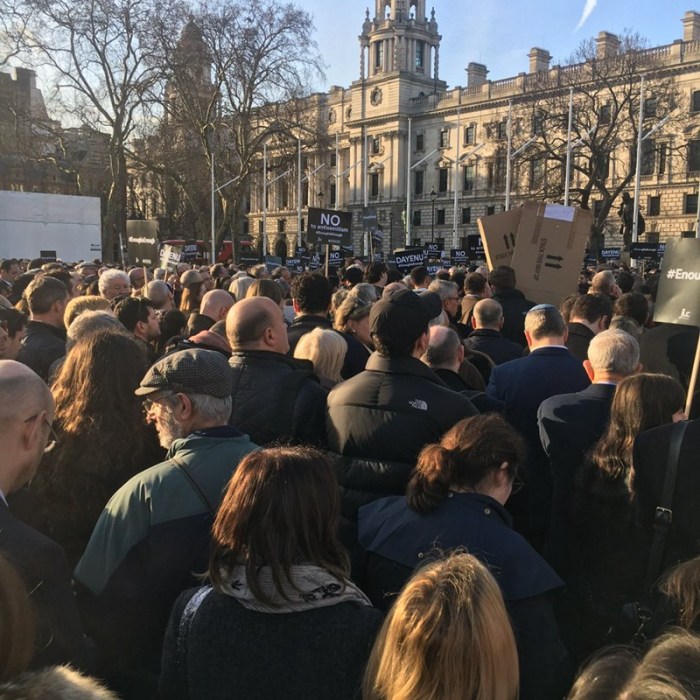
If we’re honest with ourselves, today’s terrible poll just confirms what we already knew. Only 19% of Labour members could bring themselves to answer that their party faced a serious problem with anti-Semitism which needed urgent action without equivocation. 30% of members actually seem to believe that, even though the main representative body for British Jews has effectively declared Corbyn beyond the pale until things improve, Labour has serious no anti-Semitism problem and it’s all being hyped up to undermine him and/or stifle criticism of Israel.

Some cite the fact that 47% think it’s a genuine problem, but deliberately exaggerated to damage Labour or Corbyn (or, again, to stifle criticism of Israel), as comfort. Quite which bits of the problem anyone can seriously deem exaggerated is, frankly, hard to tell. But I suppose it’s less bad than outright denial. I suppose some people will be new to the issue and won’t have fully processed the scale of the crisis. I suppose some will have read ‘exaggerated’ as ‘leapt upon by others’ and not quite clocked what they’ve signed up to. (None of this excuses failing to see the age-old ‘shadowy conspiracies’ trope lurking in the middle option, but there we go.)

Even discounting generously, it’s a grim figure. And 61% think failing to even call for Christine Shawcroft to stand down from the NEC counts as handling the issue well. In short, a comfortable majority of Labour members seem OK with how this is being handled.

That is damning. It also places Labour dissenters in an impossible bind. When I stood in solidarity with British Jews on Monday, I hoped this horror might at least be a turning point, that more people who claimed to believe in equality might put it before loyalty to Jeremy Corbyn. For a few hours I even kidded myself it felt different this time. But if you’d asked me before last Sunday, I’d have said dissenters would make themselves more unpopular for speaking out. And now I’ve seen the poll, I’m not really surprised by the results.

Corbyn loyalists: if you think Labour dissenters are acting from calculation, put it from your mind. So far as I can see, talking about Labour’s moral crisis makes our internal position worse, not better. But so long as we stay, we have no choice. How can we keep our heads down and live with ourselves? We have to think about the long game. But we also have to look at ourselves in the mirror. (No, I don’t have a game plan. There was a time when I hoped someone cleverer, preferably with some actual influence, might have one.)

So, yes: when certain lines are crossed, some Labour dissenters stand up. This time they’ve exploded in rage because Corbyn’s personal enablement of anti-Semitism was exposed once too often. And it makes most members angry. And they dig in deeper. And the dissenters’ plight gets worse.

Short of leaving, what else can they do?

This post was originally published on Medium.com on 31 March 2018.

Dear sensible Conservatives …

I’m not just writing this with liberal Conservatives or Conservatives who voted Remain in mind. I’m thinking about all of you who know that politics involves trade-offs, opposition matters in democracies and disagreement with the Government is not treason to the country.

Your views on the current Government vary. A few of you are quietly or openly miserable. Many see Theresa May as one of the sensibles at heart, trying to keep the diehards within the tent. Others think her Brexit policy is broadly tolerable. But I imagine you all look across the political divide, see what’s happened to moderate Labour and think it could be much worse for you internally — even as you fear losing to Corbynite Labour.

Labour pains (and possibly precedents)

It certainly could be much worse for you. I’m a Labour moderate: I know what ‘worse’ looks like. But in some ways, your situation feels like a much more extreme version of Labour’s 2011 or 2012. At the time, we had a leader whose basic priority was to keep Labour’s internal coalition more or less on board. We also had a groundswell of feeling in, around and sometimes in complicated opposition to (combined with a sense of ownership of) the Party. In our case it was driven by a mix of being in Opposition and the sheer scale of Government cuts to the most vulnerable. And we had a longstanding hard left element of the Party — a small one in Parliament and a larger one in the country.

The soft left and many who now identify as moderates liked lots about this state of affairs— not wholly unreasonably. Ed Miliband went on the March for the Alternative in 2011. New Labour was self-consciously disavowed — either as too centrist, or as an outdated response in new circumstances, or both. Labour started to sound more critical of business, less keen on markets in public services, less interventionist in foreign policy. All of which was well within the mainstream of politics, whether you agreed with it or not.

On the side, sources like Another Angry Voice became quite well-liked and read by much of the left. Owen Jones was read and shared with sympathy by many social democrats. They were clearly to the left of the leadership — how far wasn’t too clear to many at the time. Organisationally, the unions had been shifting left over years. CLPs were moving that way too, with an inevitable impact on candidate selection. It’s not surprising that the 2015 intake had a significantly larger share of genuinely Corbynite and would-be-Corbynite-if-we-could-get-away-with-it MPs than the rest of the PLP.

We also tend to forget that nasty incidents relating to anti-Semitism and foreign policy predate Corbyn’s leadership. Under Miliband, three Labour MPs saw fit to invite Raed Salah to the House of Commons — and of the three, only Jeremy Corbyn was on the hard left. During the Gaza offensive in 2014, a shadow minister cheered the fact that protesters forced a Sainsbury’s to close — and yes, she apologised, but how did we ever get there in the first place? When an MP’s language called a Jewish Ambassador to Israel’s loyalty to the UK into question, it took a week for Labour to get him to apologise.

Meanwhile, Miliband tended to nod to the left of the soft left in his rhetoric, even when policy remained pretty resolutely social democratic. By 2015, when Jeremy Corbyn borrowed the same rhetoric and most of the policies too, Andy Burnham and (to a lesser extent) Yvette Cooper found themselves struggling to tell Labour members why they shouldn’t vote for him apart from saying he couldn’t win an election. Liz Kendall was the only candidate who consistently said Corbyn was wrong on policy as well as tactics. And the moral case against Corbyn was only made by a very few. The rest is history. Whether social democratic Labour will ever reassert itself against left-populist and hard left Labour I don’t know. But our parlous state is obvious to all.

Conservatives and the nationalist right

I see parallels with the Conservatives and the nationalist right now. Theresa May is no liberal and in many ways she’s an anti-liberal — a true Home Secretary turned Prime Minister. But she isn’t a zealot at heart. And most of the Cabinet is trying to keep the zealots onside en route to a Brexit which I would deem moderately hard, but would probably include a lot more regulatory co-operation and alignment (UK rule-taking in disguise) than said zealots actually want. But in so doing, too many of the sensibles are aping their language and assumptions.

May herself did it repeatedly. Her attempt to portray differences of view as somehow threatening to the nation when she called this year’s election was a case in point. Somehow we had reached a point where political division in the House of Commons — in an adversarial assembly! — was supposed to be a problem. She drew on the language of conspiracism as well as the nationalist right in her absurd claim that the EU was trying to influence the UK election. Earlier, her ‘citizen of nowhere’ remarks played into the same sort of rhetoric and language.

Boris Johnson, whose patriotism is so all-consuming he probably decided whether to back Brexit solely on the basis of his own personal advancement, has played the same game. (I normally disapprove of blanket cynicism about politicians. However, every now and again the evidence requires exceptions to be made.) Our born-again patriot Foreign Secretary recently declared himself ‘troubled with the thought that people are beginning to have genuinely split allegiances’. One assumes his convictions are of recent origin as he only renounced US citizenship this February.

Even more recently, David Davis — also a Brexiteer, but probably more pragmatic than many of his fellows — wrote to demand Labour MEPs have the whip withdrawn for voting in favour of a European Parliament resolution. The relevant section ran as follows:

The European Parliament … is of the opinion that in the fourth round of negotiations sufficient progress has not yet been made on citizens’ rights, Ireland and Northern Ireland, and the settlement of the United Kingdom’s financial obligations …

I think the UK national interest is served by recognising our weak negotiating hand and a) settling on citizens’ rights rapidly and in good faith, b) settling as much as possible on the Irish Border while pointing out that the extent of EU-UK divergence will dictate the nature of border management and c) agreeing the broad outline of a financial formula. As far as the money is concerned, getting a decent final relationship is worth virtually any amount. British MEPs also have a duty to their constituents’ interests as they see them (including, I might add, non-UK EEA nationals when it comes to citizens’ rights). They have every right to use their votes to nudge the UK Government towards reality as they see it.

You might disagree with me on the merits of that view. But it is not unpatriotic to hold it. It is not “acting against your country” to advocate it. The national interest is a contested thing, which is one reason we elect people with a responsibility to adjudicate upon it. To call on opposition parties to withdraw the whip for “voting against the national interest” is as toxic as it is disingenuous. It’s not all that far from “enemy of the people” as applied to judges. And “enemy of the people” wasn’t all that far from “traitor”.

This sort of rhetoric has made far deeper inroads into mainstream Conservatism than the hard left equivalent managed in mainstream Labour before autumn 2015. It’s a dangerous game to play. And if I can’t persuade you it’s wrong in principle, think on this: if you don’t want a total car crash in March 2019, at some point you will have to disappoint the people who actually believe this stuff.

You will have to compromise on the Brexit bill. Your deep and comprehensive free trade agreement will involve copying large parts of EU law in all but name. Even after any transition ends, the European Court of Justice will — though probably not directly — continue to have influence over law in the UK. You will probably find your two-year transition period isn’t long enough. You will discover that immigration can’t be cut to tens of thousands without damage you won’t be willing to tolerate.

Do you think the obsessives on the nationalist right will spare you when you try to bring them back to Earth? Philip Hammond was sympathetic to Brexit not that long ago. He backed Remain in the end, but he was distinctly eurosceptic. He is implementing a policy of leaving the single market and not forming a customs union. He still has Brexiteers baying for his blood now. What is it about the record of lifelong europhobic obsessives which makes some of you think they can ever be appeased? What happens when you have to tell them Utopia doesn’t come wrapped in a Union Jack?

So if I were you, I’d draw some lines in the sand sooner rather than later. I’d resist the temptation to define disagreement as unpatriotic. I’d remind myself that pragmatists can’t control zealots forever. I’d get ready to fight sensible, moderate conservatism’s corner. And I’d remember that if you co-opt the zealots’ language and instincts for too long, you’ll have nothing to defend yourself with if they come for you.

For the good of the country — though of course your zealots would deny my right to say such a thing — please learn from Labour’s social democrats. Given the chance, the hard left turned on us. Given the chance, the nationalist right can turn on you in turn.

This post was originally published on Medium.com on 28 October 2017.