Political religion

The blurring of tolerance for personal belief and acceptance of political positions is not an accident

What equal marriage really boils down to for the people it affects.

Same-sex relationships only received legal recognition in the UK within my adult lifetime. Equal marriage in Great Britain had to wait until I reached my late 20s; Northern Ireland held on until my early 30s. By the time it was delivered, it felt long overdue. That it commands such support, and that Britain is now (in the main) so relaxed about people like me, is an extraordinary political and social shift.

Still, a minority of opponents remains. The fact that Scotland’s Finance Secretary is among them is no surprise. The real surprise is how many of her erstwhile backers seem surprised. In any event, we now know she would have voted against equal marriage had she been an MSP. We also know she would do the same again today — though we are assured she won’t actively seek the chance to do so.

Opposing her on this basis would, you might think, be as reasonable a ground as any. Some tell us equal marriage is a settled issue and so we shouldn’t worry. But a politician’s opinion on one issue often gives a clue to how they might act on something else. We know Kate Forbes would ideally restrict the right to marriage. What would Kate Forbes as First Minister say about LGBT inclusion in schools? How would she approach conversion therapy (on which she already sounds distinctly evasive)?

More generally, we don’t usually accept ‘it’s a settled issue, so you shouldn’t worry’ when it comes to equalities. You could also describe equal pay legislation as a settled issue. I doubt ‘I would vote against equal pay today, but it’s a legal right and so I would uphold it’ would wash with anyone at all, quite rightly. And yet, a striking number of people seem happy to argue that position here.

I suspect some treat this differently for two distinct but intertwined reasons. First, there is still more room for open dislike of homosexuality than many other protected characteristics. Second, Kate Forbes’ view on the legal right to marry — not just on religions’ freedom not to perform it — is determined by her theology. Because most religions traditionally regard same-sex relations as sinful, some see her view on gay and bi people’s marriage rights as a matter of private conscience.

Sir Tom Devine said, ‘If Kate Forbes is hounded out of the opportunity to obtain high office in our country because of her personal beliefs we can no longer be seen as a tolerant and progressive nation.’ One might note that being the Scottish Finance Secretary is hardly a junior role. Even setting that aside, this is absurd. First, declining to vote for or endorse a candidate you disagree with is the very stuff of politics. Second, Kate Forbes’ personal beliefs, properly understood, are not the real risk to her ambitions. The real risk is that, given the chance, she would vote to shape the law according to her beliefs on private morality, at least some of the time.

A vote in the Scottish (or any other) Parliament is not, by definition, a private matter. In voting on a Bill, MSPs legislate for the whole of Scotland. Even when passing motions, they send a message from the Parliament to and on behalf of voters. When Kate Forbes says she would vote against equal marriage today but uphold current legal rights, she is not making a personal statement. She is making a political calculation that this is a fight she cannot win. She has given gay and bi people good reason to doubt her support for their rights, now and in future. Anyone who cares about that has every right to say as much and vote accordingly.

Does there have to be some compromise from gay people in the name of religious freedom? Yes, of course. We accept religions’ right to discriminate in who they marry, and often in who they appoint. We accept safeguards in hate crime laws to protect their right to denounce our specific sins. Bluntly, in many contexts we afford a level of courtesy to beliefs we would otherwise label rank bigotry when affirmed in the name of God.

That is tolerance in action. Do I think the belief in a requirement to follow the Word is a defence against the charge of homophobia? Frankly, no. But I accept, in the name of rubbing along together and the rights of others to live freely, that it is often better not to spell that out. And if a politician is a religious conservative, but has no wish to give that legal force, we should accept that. Forbes’ views on sex outside of marriage are personal: she does not wish to force them on the rest of us. The same goes for Tim Farron, who should have been treated more kindly, and equal marriage.

Forbes’ defenders, however, ask more of me. They imply I should, in the name of tolerance, give a politician a pass on the civic rights of people like me — to treat opposition to those rights more gently than I otherwise would when affirmed in the name of God. But whether and how far religion should shape the law on private morality is political. The claim that opposing a candidate when they cite their faith to justify their policy is somehow ‘intolerant’ is also political. It demands some deference to politicians’ views if, and only if, they cite a religious basis for those views. It is not a call for tolerance: it is a call for religious privilege.

Neither religions nor their adherents can have it both ways — though plenty will try. Those Anglicans in England who express horror when MPs step into their Church’s rows over sexuality, but want to keep their bishops in Westminster and their special status in law, are playing a similar trick. Where politicians want to legislate in the name of God, they place His relevant dictates in the political realm. Yes, secular atheists should be more careful to respect the place of private conscience. But the religious have no right to turn that into political impunity in disguise.

This post was originally published on Medium.com on 25 February 2023.
‘This is not a debate’

Sometimes you can say that once you’ve built a settled consensus. Otherwise, you’ll lose the debate you tried to spurn

© Can Stock Photo / vlatko2002.

I only discovered Tom Robinson Band’s ‘Glad to be Gay’ a few years ago. I didn’t know the song was from 1978. With the blitheness of a gay man born in 1986, I assumed it was a high-camp affirmation and not my aesthetic at all. It’s actually a sharp, caustic protest, skewering the homophobia of 1970s Britain.

So sit back and watch as they close all our clubs
Arrest us for meeting and raid all our pubs
Make sure your boyfriend’s at least 21
So only your friends and your brothers get done
Lie to your workmates, lie to your folks
Put down the queens and tell anti-queer jokes
Gay Lib’s ridiculous, join their laughter
‘The buggers are legal now, what more are they after?’

The Sexual Offences Act did an imperfect job of making ‘the buggers … legal’. It proved a huge step forward in the long run. But it came into force in a society which still disapproved, applied by a state which shared that dislike. Arrests of gay men went up for years following 1967. Sex ‘in private’ was defined to exclude, say, a room in a house if your landlord was in another room. The Earl of Arran made the score quite clear, even as he supported the Bill:

Any form of ostentatious behaviour; now or in the future, any form of public flaunting, would be utterly distasteful and would, I believe, make the sponsors of the Bill regret that they have done what they have done.

The law in Scotland only changed in 1980. Despite the Revd Ian Paisley’s best efforts to ‘save Ulster from sodomy’, Northern Ireland finally followed suit in 1982, the UK’s hand forced by the European Court of Human Rights. The tone in which the Government introduced the change is instructive:

The Government recognise the very strong feelings held in Northern Ireland on issues pertaining to sexual morality. … However, the court did not accept these arguments. The Government therefore have to deal with the verdict of the court, which imposes an obligation on the Government to change the law.

From cringe to confidence

By 1994, as MPs argued over whether to reduce the age of consent for sex between men to 18 or 16, advocates sounded bolder. Even then, some described their opposition in terms I won’t include here. (And 18 won that time. Equality had to wait until 2000: the House of Lords had to be overruled under the Parliament Acts.) But Tony Banks made the point — pretty basic, we’d say now — that homophobia was homophobes’ fault, not gay people’s:

… the Wolfenden report says that those young people would be set apart from society. Does that not say something about the discrimination that society holds against young gay men? It is a problem of society, not of those young men.

In power, New Labour sometimes acted at Strasbourg’s behest or by halves. But it did a lot: from the age of consent to civil partnerships, from LGBT people in the military by the time it left office, LGBT rights had advanced hugely. That a Conservative Prime Minister could sincerely support equal marriage in 2013 (admittedly in a minority among his MPs) — and that LGBT-inclusive relationships education could pass as a matter of near-consensus among MPs last year — shows how far attitudes have come.

From making the argument to trying to ban it

But all of these changes had to be argued for. Their advocates had to deal with their critics — in the media, in Parliament, and among the public at large. Which is why I was struck by the social media reaction when the House of Commons Petitions Committee tweeted to seek views on banning the practice of so-called conversion therapy a few weeks ago. (A petition to ban it had received enough signatures for a debate, but coronavirus has put paid to Westminster Hall debates for the time being. The Committee sought views to inform its report on the topic.)

Myself, I don’t need any convincing that conversion therapy is quack science which can do great damage to people who undergo it and which is rooted in viewing sexual orientation as some sort of disorder. Nor do medical professionals: the Royal College of Psychiatrists has made its opposition clear for many years and has supported the principle of a ban for quite some time. Countries from Malta to Taiwan have restricted or banned it to varying degrees.

I am sure the argument that we should be working to end it and that a ban has a role to play in doing so can be won. Indeed, the Government has notionally been committed to it for some time. But the Petitions Committee — which has asked for views on other inquiries during the pandemic — didn’t end up in hot water for inattention. It ended up in hot water because it had asked for views on whether conversion therapy should be banned.

Some of the outcry came from the plain ill-informed. Some thought the Petitions Committee was ‘the Government’ (which seems to include more than one journalist, to judge from media output). Some felt the tone was off. But most of the anger stemmed from a view that the Committee shouldn’t be framing this as a debate in any way.

Twitter thought debating the issue was very bad.

This, to put it mildly, poses a challenge when a Commons Committee is conducting an inquiry into a proposed change to the law. It would become even more of a problem if some kind of ban came before the Commons, probably following a Government consultation. The change will have to be debated: that is how laws are passed. And asking whether a ban should be put in place and what difference it would make plays a role in making that happen.

Changing the law is complex

The point becomes even clearer when you look at the details of different conversion therapy bans. Vancouver in Canada has one of the widest-reaching bans: its bylaw bans businesses from offering conversion therapy at any age. Germany’s ban only covers minors and adults where consent was obtained by coercion, threat, deception or error. The German Greens called for an age of 26; the Left Party wanted 27. Taiwan’s ‘ban’ stems, in effect, from a letter from the Ministry of Health clarifying that conversion therapy is not a legitimate medical treatment meaning existing criminal law applies to its provision. This seems to draw a similar line to Germany’s.

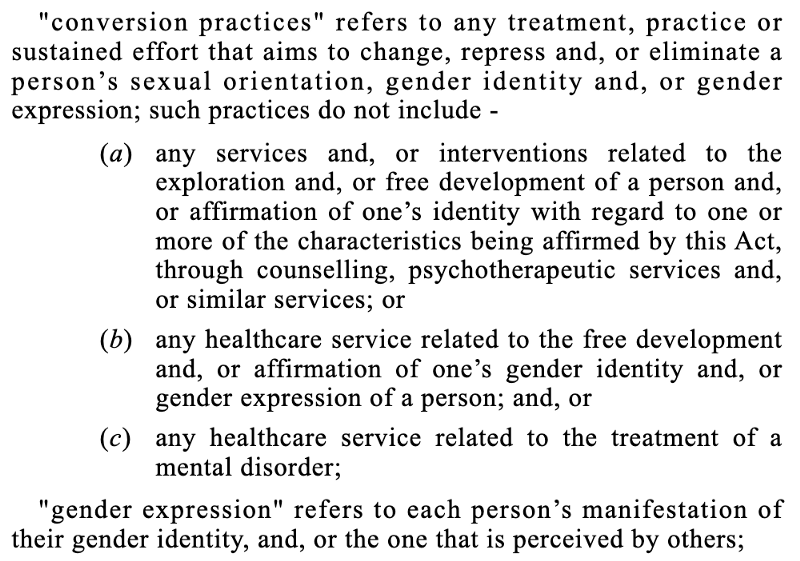
Malta was hailed as the first country to ban conversion therapy — but again, this is limited to minors and ‘vulnerable’ individuals. The Maltese Act offers some good examples of the other issues: it deals with what does not, for these purposes, come within a ban. A brief consideration of the potential content of wholly legitimate counselling sessions leads quickly to the conclusion that where the line is drawn will need some thought.

‘Conversion practices’ as defined in Maltese law.

I support some mix of these sorts of restrictions throughout the UK. But I can see that the details, and where exactly the line should fall, need discussion. I can also see, whether I relish the prospect or not, that when proposing to ban something those who don’t want a ban have the right to make their case. That includes religious arguments for which I usually have little time. It also includes arguments about parents’ rights which I think we should dismiss.

You can’t close a debate down before you win it

Judging from the hue and cry, lots of people thought MPs should enact their demands in silence, sackcloth and ashes. I’m afraid that isn’t how representative democracy works. Parliament hasn’t seen fit to change the law yet, and I suspect most people haven’t thought about the issue very much. Like it or not, the discussion is not over.

Of course, few people believe absolutely everything needs to be up for debate. To state the obvious, incitement is beyond the pale. We also no longer need to have a debate about whether women are intellectually inferior to men. It’s no business of the criminal law, but we don’t need to indulge it as a legitimate debating point. In the public realm, we can dismiss it as arrant sexist prejudice, shut it down and move on.

Societies can also remain oppressive without oppressive laws. A society where homosexuality was legal but talk of its ‘repulsiveness’ was rife would be pretty miserable for people like me. ‘A sin but not a crime’ may or may not get the law off your back (people dealing with ‘crime’ may well read it in the light of ‘sin’). It won’t stop your visible existence serving as grounds for censure.

But a conspiracy of silence didn’t get us past that point. Quite the opposite. People had to insist on being seen and challenge the people who wanted them kept invisible. Saying ‘this is not a debate’ in the 1970s would have suited homophobes much better than gay people. It would have fitted the Earl of Arran’s opposition to ‘any form of public flaunting’ to a tee. Now we can say ‘this is not a debate’ when faced with generic expressions of disgust. Because we had those debates, or rows — in all kinds of fora — and won them.

You can say ‘we’ve had the debate’ if you want. But you don’t have the power to decide whether we’ve finished on your own. And if you try, you may well lose it by default. Progressive aversion to talking things out can make for a censorious mood in progressive circles. It can make them lose the argument with everyone else too.

This post was originally published on Medium.com on 25 July 2020.