How I voted for the Labour leadership

My reaction to the disastrous result in May was unequivocal. ‘Dear Labour: please do whatever you have to do to win in 2020. I will swallow whatever compromises I must. Just win.’

That was, of course, simplistic. I don’t apologise for being desperate to see the back of the Tories, but I want to see the back of them for a purpose. I want Labour to reduce the inequality of income, wealth, health, housing, lifespan, education and enjoyment of life in Britain today – through redistribution, good public services and supporting people to act themselves. I also want a competitive, prosperous economy, with better jobs for people – well-paid, skilled and fulfilling. I want my government to face checks and balances, to respect the liberties of the citizen and to protect human rights – including (in fact, especially) refugee rights. And I want it to act on the environment, too.

Abroad, I believe in internationalism. I am a passionate pro-European; I support our membership of NATO; I believe in a world governed by rules. But I also suspect a multipolar world will probably be more insecure rather than less, and I want my government to have an answer to what we do if the US ever decides to walk away from our defence. I want a hard-headed approach to Russia and China, but I want to work with them on climate change.

I am a liberal-minded social democrat, in short. But we almost certainly can’t deliver everything I want at once. Resources are limited; a policy can deliver one aim and undermine another; the UK cannot make other governments do what it wants; and change almost always takes time (it’s hard enough to change an office tea-making rota, never mind the NHS). So if Labour disappoints me from time to time, it’s because you can no more govern a country than win an election without trade-offs. Those trade-offs are worth making.

Jeremy Corbyn

It follows that I would prefer any of Andy Burnham, Yvette Cooper or Liz Kendall to Jeremy Corbyn. I’ve written about some disagreements I have with his pitch; there are many others. Quite aside from political realism, I have a fundamental problem with referring to members of Hamas as friends, tacitly equating the British Army with the IRA, arguing against allowing democracies to decide their future because Russia dislikes it and many other things besides.

Electorally, the evidence is overwhelming: a Jeremy-led Labour Party would have a headlong collision with the British public. We’re told that only 37% of voters voted Conservative, but 13% voted UKIP. An absolute majority of voters voted for the right. We gained an extra seven points from the Liberal Democrats this time, and still lost. Sections of the left have spent years adding Labour and Lib Dem votes together, pointing out that the total was over 50% and calling it a progressive majority. Well, the social democrats vote Labour now, and the theory has been tested to destruction. There is no automatic progressive majority: there never has been. We cannot win without persuading people who voted for the right.

The TUC’s survey data is clear: people who considered voting Labour, but didn’t in the end, were not generally looking for a more left-wing offering. Their biggest three factors were fears that Labour would spend too much and couldn’t be trusted on the economy, make it too easy for people to live on benefits and be bossed around by the SNP. (Non-voters are not a way around this: the evidence does not suggest they would turn out for radical socialism.) There is little evidence to suggest the public are likely to be swayed by the Corbynite big picture: when asked, respondents preferred ‘concrete plans for sensible changes’ to ‘a big vision for radical change’ by 74% to 15%. The research done for Jon Cruddas depicts an electorate which does want a fairer deal for most people, but wants to know the economy will be OK and the books balanced first.

Scotland is no better an argument for Corbynism. Social attitudes surveys are clear that there is either no skew to the left in actual Scottish attitudes, or only a very small one. The SNP knows this perfectly well and has governed accordingly. ‘Austerity’ was not the driving force behind the SNP surge: voters’ referendum decision was the defining divide, as shown by the British Election Study. If anything, the depth of Labour’s problems in Scotland means we have to reach even deeper into England to win next time. Anyway, even if Labour had held every Scottish seat in 2015, we would still have a Tory majority government.

The British are, mostly, a ‘safety first’ electorate. A very vocal minority would love Jeremy’s pitch – but as the Scottish referendum and the British general election have shown, loud minorities usually lose at the polls. A Corbyn pitch would scare off far more people than it would attract– and the people it would win over are disproportionately in safe Labour seats. With UKIP challenging in the north, the Liberal Democrats making a centre-left pitch under Tim Farron, the SNP dominant in Scotland and the Conservatives pitching to natural Labour voters, we would face disaster.

Andy Burnham, Yvette Cooper and Liz Kendall are all moderate, pragmatic politicians; all of them have acknowledged some of the issues which Labour needs to face up to if it wants to win a general election. I prefer any of them to the self-destructive diversion of being led by Jeremy Corbyn, and gave all of them a preference.

Liz Kendall

Liz Kendall is the only candidate who has been telling the electoral hard truths, facing us with facts we’d rather not – but must – confront.

It is also clear what Labour would do under her leadership. It would make it clear from day one that it took sound finances seriously, identifying what it could and couldn’t pay for. It would prioritise: not lower tuition fees for the middle-classes, but support for the early years. It would be clearly pro-business and in favour of good jobs: and in return, it would support a living wage society and workers’ representation on boards. It would take devolution seriously, rather than simply advocating a larger central state. In short, it would aim to persuade people who could vote Labour, but (usually) voted Conservative or UKIP in 2015, that they can trust us on the economy and the public finances, while delivering social democratic values.

Liz is less experienced than the other two moderate candidates. Her media performances can be excellent, but they have varied. Her instincts are right: her implementation can be mixed. However, only she and Jeremy have been clear and consistent about where they would take the Labour Party.

Yvette Cooper

Yvette Cooper is tough, experienced and competent. When she took Jeremy on, she did a brilliant job – the most forensic exposition of why Jeremy’s policies would be wrong for the country, combined with passion and policies which inspired me. Her focus on families and on childcare could, I believe, appeal to the country in 2015. Her focus on new jobs and technological change could be important. I also believe she would correct many of Ed’s mistakes: his relationship with business, in particular. There is a very powerful case for her as leader.

However, I would have liked more clarity on her strategy for Labour in this parliament. I understand she wants to broaden Labour’s support – no one will argue with that. But her preferred hard choices have, until very recently, been almost invisible. They remain less defined than Liz’s. She mounted a brilliant challenge to Corbynism – but very late: possibly too late. Finally, she remains ambiguous about fiscal policy: and whatever line we take, we need a clear one.

Andy Burnham

Above all, I want to maximise Labour’s chances of victory in 2020. The polling generally points to Andy Burnham as the most appealing candidate when a straight question is asked. He is probably the most immediately personable of the candidates. He’s right that many former Labour voters have lost their emotional connection with the Party. Like Liz, he takes a clearer position on Labour’s fiscal record than Ed.

But I worry about how he’s already put forward a number of unfunded major spending commitments. We lack fiscal credibility: there is little point in saying so, only to commit to billions of pounds’ worth of spending on the back of a commission to work out how to pay for it all. His tone on the EU worried me, though it’s improved recently: point-scoring against the Tories more than making the case for Europe could endanger the referendum result (and make Labour look less credible). His tone on immigration risks sounding like we’re promising things we can’t deliver. I think the British people voted against our message, not just our messenger, in 2015: it is not clear enough to me how Andy would change that message in 2020.

Conclusion

I gave my first preference to Liz, because I think her electoral analysis is right. The British people didn’t trust us to manage the economy or balance the books, and we have to acknowledge that loud and clear. Further, any government would be fiscally constrained right now, so we have to decide what matters most. Actually, that’s always true: ‘the language of priorities is the religion of socialism’. For instance, Liz is right not to prioritise cutting tuition fees and to put money into early years services: you make the most difference at the beginning of childhood, not the end. She has done more than any other candidate to marry social democratic values to a genuine engagement with why we lost, and that deserves support.

I gave my second preference to Yvette, in the full knowledge that she is much more likely to make the final round than Liz. She has not been as clear on strategy, and it took her a long time to take Jeremy on. But when she did, it was passionate, forensic and convincing. I think that many of the areas where she is radical – childcare, in particular – are areas where we can gather widespread support. She would correct many of our 2015 failings and put us in a stronger position in 2020.

I seriously considered putting Andy second on tactical grounds. His speech two weeks ago decided me against it. I believe we have to draw a clear line between moderate Labour and Corbynism: Liz and Yvette are much more likely to do so. But whatever the result, the centre and right of the Labour Party need to engage with many who are considering Jeremy this time: and I understand why Andy is trying to win them over. I gave him my third preference.

I want a credible Labour Party to make Britain more equal, open and tolerant, playing a full and constructive role in Europe and the world. We can only do that in government: so we have to face up to why people rejected us and address their fears. I hope the Labour Party will remember that when we make our choice.
The case for gradualism (or why it’s worth taking Nuneaton with you)

One of the most infuriating memes of this leadership election is the claim that three out of four candidates are ‘Tory-lite’. The fact that the gap between Jeremy Corbyn and David Cameron is titanic doesn’t mean the gap between Liz Kendall and David Cameron doesn’t exist. It’s real and it’s large: and people’s lives are transformed or wrecked within that gap. Jeremy came into the contest saying he wanted a broad debate: his supporters do nothing to help that by claiming that anyone to the right of Jeremy is the same as David Cameron.

Like Jeremy, the other contenders for the Labour leadership want to steer the ship of state in the opposite direction to David Cameron and George Osborne. They are talking about universal childcare, more rights for employees to influence the direction of their workplace, supporting union rights, supporting further education and finding money to protect tax credits. They want to both use state power and support others to narrow the gap between rich and poor in every sense: income, wealth, health, horizons, quality of life. They did not, however, go into politics just to wave a placard, or protest against a right-wing government, or preach the gospel to their activists and leave the public cold.

They’re right in that – partly because you can’t do anything if the voters reject you, and partly because life isn’t that simple. Changing anything is long, slow, gruelling: you have to set a goal, get people to sign up, repeat the same message constantly, check up on the delivery. It’s hard enough to get people used to a new company logo, never mind build millions of new homes. The bigger the task, the more undreamed-of problems you’ll encounter.

But with time and effort and will, you can change things – and Blair and Brown did just that. There is a tendency, when confronted by people to their left, for social democrats to reach for bar charts and graphs and tables of figures. I’ll make some apology for that, but only some. If you want to reduce poverty and put a stop to avoidable human misery, you have to care about the data and you have to be interested in the actual impact of your policies. If you aren’t interested in what’s actually happened to low incomes, don’t call yourself a leftist. If you care about the poor, you can find the time to look at some bar charts.

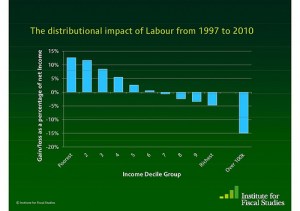
So let’s look. The IFS produced a chart showing the effect of Labour’s tax and benefit policies:

IFS graph of tax/benefit changes, 1997-2010

Corbynites would have you believe this chart is so unimportant you might as well have voted Tory. What it actually shows is a series of decisions taking money from the top 40%, but especially the richest, to give to the bottom 60%, but especially the poorest, on a large scale. That looks like pretty classic left-wing politics to me.

Now let’s look at their chart of Tory and Lib Dem tax and benefit reforms:

IFS graph of tax/benefit changes, 2010-19

You can see a kink at the top, due largely to keeping pre-planned Labour measures, but this is essentially taking from the poor to give to the fairly well off. It’s exactly the opposite of Labour’s record.

If you actually consider what Labour did, that’s not surprising. Working tax credit and child tax credit, higher National Insurance to fund public services (including above the upper earnings limit for the first time), more generous child benefit, pension credit, a 50p rate of income tax: these are exactly the sort of things social democratic governments normally do. The graph doesn’t, of course, show all the investment in health and education, Sure Start, the national minimum wage, the beginnings of childcare policy or a whole range of other things. And then there are all the other progressive things which wouldn’t show up on any UK bar chart – the advancement of LGBT rights, the Human Rights Act, doubling aid as a share of GDP and much more besides.

How can people possibly compare the last five years to the 13 years before that and then say there’s no point in a moderate Labour government? How can they possibly consider the most redistributive government in decades and then say it was just Tory-lite? Half the Corbynites’ rage is (rightly) directed at Cameron and Osborne’s attacks on the very things New Labour created: tax credits, Sure Start, extra help for families with children. But Labour was only ever able to do any of that because it met the electorate on their ground and won them over. If we cannot do that, raging is all we’ll have left to us.

When you win an election, you win political capital. Then you can use it to move politics your way. If you’re clever, you try and co-opt some of the areas where your opponents struck a chord too. Did the Tories call George Osborne ‘Labour-lite’ because he pretended to bring in a living wage? Did they lay into him for changing the rules on non-doms? No: they know they’re winning broader consent for shrinking the state. They get the art of democratic politics: a constant push-and-pull between what you ideally want, what the electorate will let you do and what’s practically possible.

And in government, Labour changed the weather too. Why did the Tories pledge to protect the NHS and not law and order – not just in 2010, but 2015 too? Why did they feel the need to raise the minimum wage? Why do we have 0.7% of GDP in aid now? Why do we have equal marriage? By 2010, it wasn’t OK not to protect the NHS; it wasn’t OK to sound openly anti-gay rights; protecting aid was a badge of Tory respectability. Labour governments made that true. Labour oppositions did not.

Owen Jones explains that the hard left is ‘defending New Labour’s legacy’. Great. So why is it simultaneously telling us none of it matters?

Corbynism (or why Nuneaton has a point)

I think Jeremy Corbyn would be an electoral disaster for the Labour Party from which it would take at least 10, probably 15 and quite possibly 20 years to recover. Too many of his supporters seem either indifferent to electoral success or utterly unaware of what that requires – but they’re right that the rest of us haven’t talked enough about policy. So here are a few of my concerns about his policies.

Jeremy says some things I support but don’t believe the British people will currently buy (a clear defence of higher taxes, though not necessarily his specific ones). There are also some I support and think they might well buy (universal childcare). But much of Corbynism isn’t just unelectable, but ill-thought-through, impractical and downright wrong.

Housing policy

Jeremy is calling for rent controls, with rent levels fixed in relation to earnings. Sounds wonderful: so why doesn’t Shelter buy it?

If you just cap prices in a situation where you haven’t got enough of something and too many people want to buy it, odd things start to happen. In this case, lots more people might sell rather than buy. Granted, we’ve all been saying we want more people to be able to buy homes. But what happens to people who can’t afford a deposit (or the still-uncapped mortgage payments) if the rental stock reduces too rapidly and the total housing supply doesn’t increase fast enough to match?

Will landlords just become more discriminating about people’s characteristics rather than the price they charge (‘No DSS’)? Will they cut back even further on things like repairs? Or will they subdivide properties more and more? More nuanced policies might be a different story (look at the rest of Europe, or the 2015 Labour manifesto), but just legislating a problem of supply and demand out of existence won’t work.

Jeremy is also proposing to extend some kind of ‘right to buy’ to the private sector. First of all, that seems a very odd spending priority for housing: our primary problem is insufficient stock, so why spend however much money on yet more subsidised ownership? (And since people in social housing have lower average incomes than private renters who can afford even a discounted property, isn’t it an odd distributional choice too?)

Second, how on earth would you control the cost? Right to buy may have done great damage, but at least councils actually owned the asset which was being flogged off: here, the state would have to pay the difference to landlords. (I suppose we could theoretically just take people’s property and give it to someone else at an enormous discount. Good luck getting that past the European Court of Human Rights.)

Third, why would you ever rent out a property if you could have it taken off you at any time? Like it or not, plenty of people can’t or don’t want to buy: they need a reliable private rented sector. By all means talk about how to improve it. But treating private rent with such abandon could really harm people who desperately need somewhere to live.

NATO membership

Jeremy has said he wants to leave NATO – our principal defence guarantee. Right now, our ‘if all else fails’ policy is NATO and, via NATO, the US commitment to Europe. We know that Jeremy doesn’t intend to raise defence spending way beyond 2% of GDP – it’s just about the only thing he’d definitely cut. There’s arguably an implicit defence guarantee in the EU treaties, and we have a European Defence Agency to co-operate on procurement, but these are a) pretty vestigial and b) exactly the kinds of things Jeremy won’t want the EU doing (assuming we stay in: see below).

So, given the rapidly rising costs of defence, Corbynism is offering us a radically reduced domestic capability, the abandonment of our key security guarantee and no replacement for either. That is not a defence policy. It’s crossing our fingers and hoping everyone will be nice to us forever.

EU membership

Jeremy has said he wants to fight for ‘a better Europe’, though we still don’t have a definite answer on how he’ll vote in the EU referendum.

Labour should, apparently, set out its own position on reform negotiations – which is fine as far as it goes. But almost nothing on David Cameron’s shopping list is going to appeal to Jeremy – and I doubt anything on Jeremy’s list will appeal to Cameron. The only real question is how much further Cameron will succeed in taking the EU away from Jeremy’s ideal.

If Jeremy might vote No, what would be his alternative? The European Economic Area (most of the free-market regulations without any say)? A Swiss model (slightly fewer regulations, slightly more say, but not a model the rest of Europe will ever offer)? No deal at all (and new tariffs on half our trade)? What makes him think Britain would discover the joys of radical socialism after voting with UKIP? And how does it help climate change negotiations to weaken one of the better players in said negotiations?

Again, this isn’t a policy. It’s a vague statement that the EU should be different, with no route map to change it.

The list goes on. You can’t talk about a ‘wealth tax on massive incomes’, fail to recognise that wealth and income are different things, conflate annual wealth taxes with one-off windfall taxes and expect to be taken seriously. You cannot talk about £50 billion of uncollected tax as though you can easily collect it in one fell swoop and expect anyone to think your sums add up. You cannot describe ‘not reducing our deficit as quickly’ as ‘funding’ free tuition and expect anyone to trust you not to wreck the public finances.

We’re not the Green Party: we’re supposed to be choosing a future Prime Minister. You cannot ask to govern a country with policies like these – not because they’re unelectable, but because they’re unworkable. Nuneaton wouldn’t buy Jeremy’s pitch: but we shouldn’t even be trying to sell it.

Organise and divide? Belated musings after the J30 strike

One of the current Government’s core tactics, when it comes to steering through cuts, is defining different groups against each other. Whether it’s pitting private sector workers against the public sector, justifying cuts to housing benefit on the basis of unfairness to people in work or distinguishing deserving from undeserving social tenants, the Coalition understands the political gain of identifying a particular group, claiming that they’re gaining unfairly and then cutting in the name of fairness.

One nation social democrats?

Left-wingers have tended to argue against this kind of narrative, for obvious reasons. They reply that, even if ‘divide and rule’ sounds effective, it doesn’t cut much ice in a two-earner household where the only reliable pension is from the public sector employee, the family whose 20-something son or daughter is on ESA but whose parents are in full-time work or the low earner in London who relies on Housing Benefit to pay the rent. There is, of course, a lot of truth to this: the lives of people in different jobs, different housing tenures and different personal circumstances are often deeply intertwined.

Note, though, how much these examples rely on people’s own specific lives being intertwined. Not every public sector worker lives with, marries or relies on someone in the private sector; most families don’t have a member on ESA. In fact, assortive mating means that people are often likely to end up with people like them than not. (The overwhelming majority of people I know work outside the for-profit world – the state, political parties, universities, charities, NGOs … almost anything, in fact, but a private company.)

Partly as a result, many of these divides are more real than social democrats like to admit. In my own family, some of our most visceral differences come from the fact that I don’t work for the private sector, but my father does. Left-wingers’ own attitudes often contribute to those divides: in my heart of hearts, I know that I tend to place the public sector, its values and its ethos higher on my priority list and to treat it as an ethically better option. I’m not saying I should: I’m saying I recognise my own prejudice – and that it makes it harder, not easier, to win over people who do work in the profit-making economy.

Trade unions suffer badly from this – and it’s very hard for them to get out of the bind. It’s worth noting that, since May 2010, unions have been keen to ‘speak for society’ and to emphasise their role in defending public services. Unions 21’s new report highlights some of the problems they face presentationally, both through their own failings and through hostile reporting; but at least part of the problem is intrinsic. Trying to articulate the national voice is, by its very nature, going to be in tension with action on behalf of members’ specific interests: not necessarily in conflict, but in tension. When considering responses like the 30 June strikes, this is worth bearing in mind. The unions’ great opportunity is to be seen as on the side of the public; their great danger is convincing the public, again, that their powers need to be curbed.

Justice versus envy?

Left-wingers can also risk playing to the Coalition gallery in the way they talk about justice. Much of what we consider to be justice is, of course, decried by the right as the ‘politics of envy’ – when complaining about the super-rich, for instance. Now, of course, this is spurious: there is a distinction between saying ‘the wealthy in our society have too great a share of the wealth, while millions of people are in poverty’ and saying ‘I haven’t worked my way up the ladder, so I want to pull you down to my level’ – and if we can’t make that distinction, the debate about fair shares is effectively over. But, rhetorically and in the eyes of people less committed to our own values, the line is a hard one to police. Arguments about ‘reverse class war’ may make it more difficult, rather than less – though it’s important to remember that defining a privileged minority working against the interests of most people is a long tradition of the left, as well as the right (People’s Budget, anyone?).

This is part of the reason why, when dealing with tax paid by the wealthy, issues like tax avoidance are so useful. They tap into a very widely held view that the rules should be the same for all of us – providing a way of arguing for the wealthy to pay their share and binding us together, as a society. (Even Ted Heath talked about ‘the unacceptable face of capitalism’, after all.)  In particular, this argument helps to explain why focussing on paying due rates of tax, rather than just raising the rates, tends to have a wider political appeal.

All in all, I have more of a sense that there’s a problem than I have of the answers. But for what it’s worth, people on the left need to be aware that they too have prejudices in favour of particular social groups (maybe even vested interests … sometimes). We need to ask ourselves whether we make enough effort to engage with others – private sector workers in particular, who do after all provide much of the revenue for social programmes. We need to do more to connect campaigns to the wider good – where union campaigning can be linked to the interests of patients, pupils, parents and families, it should be. And we may even have something to learn from the language of one nation conservatism: it was, after all, Benjamin Disraeli who first talked of ‘two nations’!

Lords in limbo: apply the Salisbury Convention in spirit as well as letter, please

Lords reform has been fairly heavily trailed for some time now, and we’ve had a bit more confirmation that the White Paper is on the way in the past couple of days. I’ll be glad to see the Government make headway on this: despite the outcome of the AV referendum, Lords reform has been a longstanding commitment from politicians of all parties and the evidence has always been pretty clear that a majority of the public believe our second chamber should be (at least predominantly) elected.

Personally, I think this really should be a fairly cut-and-dried issue. Members of the House of Lords are not primarily independent experts, sources of warnings or nods to tradition. These are all understandable things to want, and we ought to think much harder about how we integrate expertise into our legislative process, but they are not the primary role of the people who vote in the second chamber. They are, first and foremost, legislators – and legislators whose record of changing Bills and therefore policy is significant and growing. If we want expertise, we should make sure we have it in the right committees and the right debates for the right issues. (Could some experts even sit on Select Committees, in the Commons and in a new second chamber, as non-voting, co-opted members?)

The people who actually do make our laws should be democratically accountable. In an ideal world, therefore, we should finish up with nothing less than a 100% elected second chamber. I’m relatively relaxed about the finer points of STV versus open lists (lists where you can choose a candidate within a party list rather than just opting for a party): so long as it’s a proportional system where voters don’t just have to tick a party box, I’ll settle for it.

With regard to the likely plans to come from the Government: I’m not ecstatic about the idea of 15-year terms and I have fairly serious reservations about single terms – I think it’s an important principle that legislators should have to at least consider the possibility that they might want to face the electorate again, and if we’re serious about democracy then we have to accept that that requires accountability. Electing by thirds (or halves, or quarters) is sensible, though: our new Senate should be a more continuous body than the House of Commons, and a combination of PR and staggered elections would help to make sure it fits the bill. In terms of dealing with the current members of the Lords, I think an arrangement along the lines of the Cranborne deal might make sense – which would mean that we’d have 200 left in 2015, 100 left in 2020 and none by 2025 (when the full complement of Senators would have been elected).

But I’m enough of a pragmatist to understand that, if you want Lords reform at all, you can’t let the best be the enemy of the good. The fact that people haven’t recognised that is exactly why Lords reform hasn’t happened, even with a Labour government who said they wanted it in charge for 13 years. So if Nick Clegg can even secure an 80% elected second chamber, even with twelve voting bishops (though the latter will cause me real pain …) and even with all the other peers staying until 2025, then I’ll see that as a major step forwards and a real achievement. Of course, that depends on his Coalition partners voting it through. Whether the Conservatives will choose to live up to the spirit, as well as the letter, of the Coalition Agreement remains to be seen: if they choose not to, no doubt Liberal Democrats will feel even more betrayed than many of them do already.

The other question is how fiercely the House of Lords will resist being reformed. Everyone seems to agree that they will fight tooth and nail against reform. I do appreciate that, when people find themselves on the red benches, they have an uncanny knack of seeing the wisdom of allowing the nation to carry on benefiting from their wisdom. The Cross Benches’ reluctance is understandable, given that there would undoubtedly be pretty few (if any) of them in a 100% elected second chamber and that their role would inevitably be questioned in an 80% elected one. In any case, the difficulties the Lords could cause for reform, and for large areas of Government business, are very substantial indeed.

It’ll eventually be a question of whether the Coalition has the political will to push change through, whether peers like it or not. But one thing I really don’t understand is: on what basis do the Lords think they have any right to derail this legislation at all?  All three main party manifestos called for a wholly or mainly elected second chamber. All parties have been reasonably clear, with some wobbling from the Conservatives in the past, that the second chamber would need to be elected by some sort of proportional system. In 2005, both Conservatives and Liberal Democrats also called for a wholly or majority elected second chamber too.

It seems to me that, if a pledge won the support of both parties in the Coalition when they went to the country (as well as the Opposition and a number of the smaller parties), we have a pretty clear case of the Salisbury Convention in action. I can see why the Lords might query some Coalition compromises in that regard: no one got to vote for the Coalition Agreement. But on this one, I just can’t see where the ambiguity lies. It was proposed: it was in the manifestos: it’s now in the process of being turned into a White Paper, and hopefully a Bill. If there’s any defence, it’s surely of the most technical kind. Where exactly did the Salisbury Convention include a bit saying the Lords didn’t have to apply it to their own seats?

The March for the Alternative, and why it’s OK for the marchers to want different things

Like many (probably most) of my friends in London, I spent my Saturday marching in protest against the Coalition’s planned spending cuts. Like everyone else on the march, I don’t believe that £81bn of spending cuts by 2015 and only £29bn of tax rises represents a plan in any way compatible with social justice: and I do believe that it will do terrible social damage and wreck lives.

I’d have to concede, though, that the alternatives put forward by the marchers were many and various. People miles to my political left and my right were there – from those who were much more concerned by the speed than the composition of the fiscal tightening through to those who ‘opposed every cut and fought for every job’ (except Trident, usually!). The Coalition’s response has been, in essence: ‘You have no alternative; we have a plan; we’re carrying on with the plan’.

The trouble is, their plan bears no relationship to anything the public could reasonably be said to have endorsed. Forget the fact, for the moment, that all three parties fudged and dodged a real accounting of what would have to happen in this parliament. Even on the points which did come up – should we cut over five years or over eight? – the current plan is at odds with the votes. During the campaign, the public displayed a preference for the more gradual approach. 52% of people voted for parties who (at the time) agreed. Whatever you think about the balance of taxes and cuts, this is not a mandate for shock therapy in Britain. But that is what we’re getting: the sheer depth of austerity we now face parallels the 1920s.

And a large part of the reason for this is that, in the coalition negotiations, the Liberal Democrats didn’t prioritise economic policy when they chose their sticking points. In fact, they may well have decided to reverse their policy before they even entered the room; according to Nick Clegg, at least some of them changed their minds before they went to the ballot box themselves. The result is that the basic process of discussion, of splitting the difference – of negotiation – which a hung parliament might have been expected to require has been short-circuited. Instead, we’ve got a deficit reduction plan written in outline by one party alone and occasionally coloured in slightly different tones by another. Perhaps that’s not so different from the norm in British politics: but then, a hung parliament was supposed to change all that.

The marchers wanted a range of different things, granted. A march for any other alternative, if you will. But what they were trying to start, in a way, was that very negotiating process which our Parliament so signally failed to carry through. That’s why it was a March for the Alternative: Saturday’s protesters all agree that there are alternatives, even if they don’t agree which ones should be chosen. And that’s why, rather than saying ‘what’s your alternative?’, the powers that be ought to look at the range of alternatives we do have.

If we’re looking at compromises from the Coalition, they might involve more capital spending, combined with a reduction of the structural deficit at the planned rate; they could involve a greater emphasis on taxes. I appreciate that a Conservative government is not going to give me the deficit reduction programme I actually want – but then the voters didn’t elect a pure Conservative government, even if the deficit reduction programme makes it look as if they did. It’s high time the government acknowledged this reality in its economic policy.

And by the way, they should remember that mass demonstrations don’t always have an effect on the government’s policy … but if that policy goes wrong, the demonstration has a habit of making the government look a whole lot worse later on.

Coalitions, majorities and mandates

One of the most interesting questions of the next few years is whether or not we’ve embarked on an era of hung parliaments, minorities and coalitions. I’m not necessarily convinced: I certainly don’t think we’ve started a period of constant hung parliaments, and post-coalition Conservatives and a more liberal Labour might even reinvigorate the two-party system (at least for a while).

So Vernon Bogdanor’s piece in The Guardian covers important ground. Our current Coalition has caused enormous anger for many – in large part because of the sheer scale of the damage being done to public services and the welfare state, but also because people feel that ‘this isn’t what I voted for’. Liberal Democrat voters, of course, feel this way particularly strongly. Bogdanor is absolutely right that the formation of government mustn’t become insulated from the people.

I assume he isn’t being literal when he says that parties should be required to signal their intentions and likely concession in a hung parliament scenario. It’s not just impractical for parties to show their hand in advance (no party leader is going to throw away all their bargaining power before they even know how much they have); it’s actually vital, if coalitions are to reflect the election results, that concessions by coalition partners have some flex. In terms of democracy, the Lib Dems should expect to make more concessions if they win 15% of the vote than if they win 24%; and no formula can pin that down in advance. He does have an important point about preferred coalition partners: British parties have, morally if not pragmatically, something to learn here. It’s worth pointing out that Clegg, for all his faults, did stick to his pre-election commitment (‘the party with the strongest mandate – the largest number of seats and votes – has the first right to seek to govern’) on government formation: but in Germany or Sweden, for instance, parties make it quite clear who they will and won’t work with. A Swedish vote for the Moderates, Liberals, Centre or Christian Democrats will go towards a four-party, centre-right coalition; Green votes in a German federal election will help support a centre-left, Red-Green government. That makes the electoral choice clearer and it helps legitimise the coalition process.

But I would also question the implied account of what actually happened in 2010 and in previous elections: the notion that normally we elect governments directly, but that in 2010 the third party decided who governed Britain and voters were excluded. I don’t think Bogdanor thinks exactly this, incidentally, but it’s a narrative which informs the argument. It deserves some scrutiny.

At the heart of the case for coalitions is a sense that the largest minority party, which generally wins a majority under first-past-the-post (and usually would under AV too), isn’t necessarily in possession of a clear mandate to govern. I am not convinced that the Labour Party, which won 35.2% of the vote in 2005, was a ‘directly elected government’. Granted, political negotiation plays an essential role in delivering the government in hung parliaments; the government’s election is, in that sense, indirect.

But normally, the voting system just turns minorities into majorities for us instead. I don’t see that that’s a more democratic approach. I believe that when the voters don’t give any political party anywhere near a majority of the vote, a coalition government – a compromise between two positions – has a better shot at reflecting the balance of views of the public than a single-party government. Would a majority Conservative government be nearer the political centre of gravity in the UK than the Coalition, for instance?

I’m also unconvinced by the (implicit) analysis of what happened in May. The formation of the Conservative-Liberal Democrat coalition was absolutely bound up with the electoral arithmetic and with perceptions of legitimacy. 306 Conservative, 258 Labour and 57 Liberal Democrat MPs meant that a Lib-Lab coalition deal didn’t have a majority: and crucially, it was felt that the Labour Party had lost the election. The Liberal Democrat leadership feared the consequences of a ‘coalition of losers’: a government which many might deem illegitimate. Far from representing an overriding of the election result in the name of ideological agreement – even now, we need to bear in mind that most Lib Dem members, activists and even elected representatives would have found Labour a more natural partner – the resulting government was absolutely bound up with a particular interpretation of who won, who lost and what the electorate wanted.

Part of the problem with our debate at the moment, I think, is that all parties were evasive at best about what lay ahead. All three parties failed to outline more than a minority of their plans to tackle the structural deficit: all three parties emphasised ‘waste’, fairness and protecting the vulnerable. No one said that they planned to take an £18 billion axe to welfare benefits!  Labour in government would have found themselves assailed by the same cries of ‘broken promises’.

Our present position isn’t an indictment of coalition government: it is in large measure the consequence of a belief, shared by all mainstream parties, that the people simply will not vote for frankness in a general election. I’m not convinced they’re wrong about that: but in any event, the fact that politicians are either too scared or too canny to face voters with unpalatable truths in an election campaign says very little about the merits of coalition government.

Taxes, taxes, taxes

I realise very few people see it as an interesting exercise to sit down and work out how the plans for £29 billion of net tax rises break down. But if you’re going to think about better ways to close the gap between what we spend and what we raise, then it’s not a bad idea to look at what we’re doing at the moment. And in rough and ready fashion, based on the Emergency Budget* figures, the planned breakdown of net tax rises in 2014-15 is about as follows:

Tax Net revenue raised (£ billion) Tax Net revenue raised (£ billion)
VAT and IPT 13.9 Green taxes 0.7
Pension contribution relief 4.6 Stamp Duty 0.3
National Insurance 3.3 Inheritance Tax 0.3
Income tax 2.5 Other tax rises 0.2
Bank levy 2.4 Other tax cuts -0.2
Other pension tax breaks 2.1 Council Tax -0.6
Capital Gains Tax 0.9 Various business taxes -0.8
Sin taxes 0.8 Corporation Tax -1.3

Those figures conceal significant tax cuts in terms of income tax (£3.9 billion goes to raising the personal allowance by £1,000) and National Insurance (£3.7 billion spent on raising the threshold for employers’ NI to offset some of the increased costs), as well as a number of tax hikes in Corporation Tax to help pay for a headline rate cut. But in terms of where the main burden is falling, you’ll get a fair idea here.

It shouldn’t take too much to work out that any attempt to raise another £26 billion, say, is going to be very politically difficult. Labour have argued for keeping the bankers’ bonus tax (£3.5 billion or so – assuming revenues don’t fall if the tax stops being a one-off), and they’ve pointed to their National Insurance plans too (£3.7 billion more). If you were to argue for, say, 5p on the higher rate of income tax (taking a very brave example), the Treasury’s Ready Reckoner suggests you’d raise about £4.6 billion. Lowering the starting point for the 50p rate to, say, £100,000 might raise £1.3 billion (or about half that, if you raise the 40p rate to 45p – otherwise you’re double-counting). The Liberal Democrats’ famous ‘mansion tax’ was intended to raise about £1.7 billion. If, in another act of extreme bravery, you were to raise Inheritance Tax to 60%, you might net about £1.4 billion. The exact amount of money you could get from tackling avoidance may very well be substantial – but it’s difficult to bank on, and I wouldn’t envy the Chancellor who tried to rely on it as a main tool for tackling the deficit.

This clearly doesn’t, even in terms of orders of magnitude, add up to a £26 billion alternative to the Coalition’s plans. So in the end, substantially higher taxes will mean that people on moderate incomes will also end up paying more – not just the wealthy and the banks. In saying that, I’m not arguing against the idea: in almost all cases, tax rises are more progressive than cuts to services – and of course, it’s quite possible to use some revenue to compensate the poor too. It’s no accident that Scandinavian social democracies pay substantially more VAT than the UK – if you’re serious about social justice, the volume of money for benefits and services will make much more of a difference than the exact degree of redistribution managed through taxes on their own, and the tax burden has to be fairly widely spread in order to be politically accepted.

So not only would a centre-left government almost certainly end up raising VAT at some point, for instance; it would probably be right to do so, though probably not right now. It makes sense that, in an economy which needs to move towards more saving over time, we might increase taxes on consumption. The debate over how progressive/regressive VAT is has run and run, but it’s certainly more progressive than even more service cuts – and if it’s difficult enough to find £26 billion extra, try finding £40 billion instead. In the same way, further income tax/NI rises would be pretty hard to avoid. Property taxes would be politically very difficult, but probably sensible as policy. And if the centre-left want to reduce the damage done to public services, welfare benefits and public investment more generally, then we’d better start learning how to argue it’s worthwhile for all of us to pay more taxes in a good cause.

How much of this does Labour need to spell out? Some of it, at least – at least as an indication. The Conservatives didn’t give much away on their plans in 2010, but they did highlight plans to raise the retirement age faster and taper tax credits more aggressively. Not an obvious route to electoral success, in a way, but a manifesto which made no mention at all of any difficult tax/spending changes wouldn’t have been more popular: it would just have made people think they either weren’t being given the full story (even more than they already did!) or that the party in question shouldn’t be trusted with the public finances. And in reverse, the same applies to any party of the left.

* Figures weren’t provided for revenue raised by the 50p rate, the restriction of the personal allowance from £100,000 or revenue raised from Labour’s changes to ‘sin taxes’ (alcohol, tobacco etc.) – I did find a Treasury figure for 2014-15 for the first, but the other two had to be extrapolated a bit from previous Budgets. But the broad outline stands.

Deficits: paying for credibility

In a way, it’s easy to be a leftie just now. £81bn of spending cuts and only £29bn of tax rises fill most social democrats’ hearts with dread – and as the scale of what’s in store becomes clearer, the public are likely to be pretty horrified too. So unless you’re a left-wing Lib Dem, the line to take is less complicated than at any time since … well, since the last time the Tories were in power.

I think, though, that this could present a very real trap. It’s refreshing for the left to be able to rail against the enemy’s Budgets; even more refreshing when the public is quite possibly on its side. But Labour’s problem now isn’t just (or even mainly) about popularity per se; it’s about credibility. And that’s exactly where just railing won’t get them very far.

This isn’t just a case of it being unclear what share of the deficit Labour should tackle through tax rises (40%? 50%? 60%?); that’s a cause for concern, but you could argue the party needs some time to redefine itself and that Ed Miliband hasn’t even been leader for four months yet. More worryingly, though, I don’t see any real evidence of Labour engaging with what any of these options actually mean. I understand the difficulties: a party which still remembers what tax plans did to their chances in 1992 is obviously going to have its worries about talking about tax rises too much. But like it or not, Labour’s economic and fiscal record did a great deal to lose them the last election. It may very well be (mostly) unfair, but it’s also a fact of political life with which Labour needs to come to terms.

That means that, even though Labour thinks the deficit should be reduced at a more measured pace, it needs to show it has an idea how it might go about doing so eventually. Bankers’ bonuses, tax avoidance and going for growth by postponing cuts won’t cut it as an economic policy for the next two parliaments. Of course Miliband and Johnson don’t need a detailed Shadow Budget – opposition is not government and the Tories never presented one when they were out of power. But some sense of where the pain would be felt by the public themselves may be important – because it would help to provide some credibility for the Opposition. It’s worth bearing in mind that, if the UK wanted to cut the deficit at the current speed but do half of that through taxes, we would need to raise an extra £26 billion per year by 2014-15.* When the fiscal challenge is that big, ‘no pain (for almost all of you)’ is a deeply implausible message – even if it’s only implied. ‘Pain fairly shared’ sounds less appealing, but has a better chance of being believed.

The need to have alternatives in mind will get more pressing, because the arguments over the speed of deficit reduction will be overtaken by events. I think the Coalition were very wrong to pin their colours to the mast in the way that they have: but they’ve now made it critical to their political, and quite possibly market, credibility. That means that, unless the economy really does go into reverse as a result (in which case all bets are off) or the Government falls (which would have its own problems in terms of market panic and thus the required speed of the tightening), we’re stuck with this pace. By 2013, if the economy hasn’t gone into a double-dip recession (even if growth is sluggish), ‘don’t do this so fast’ may very well seem like yesterday’s news.

So there needs to be a better sense of what Labour would do, not just when it would(n’t) do it. But that also needs to be informed by a clear sense of why Labour wants to do it in a given way. When Alan Johnson talked about shifting the balance of tightening towards taxes enough to roughly halve the size of cuts to capital expenditure, we had a hint. The consistent focus on ‘who pays’ is another. These need to be more explicit. If Labour’s attack is consistently based on ‘what will a particular cut do to our ability to grow the economy?’ and ‘will this cut mean that the poorest are hit hardest?’, then you have the beginnings of a consistent approach to the deficit.

Of course, there is an obvious next question: what sort of tax rises could you go for to cut the deficit, if you’re going to argue that taxes should take more of the load?  Again, Labour doesn’t have to have a fully worked-out Shadow Budget; but it needs to understand the magnitude of the shift it might end up arguing for. But that’s for another post.

* According to the Emergency Budget, £83 billion of spending cuts and £29 billion of tax rises. The Spending Review set more money aside for capital investment, reducing the scale of cuts to £81 billion. A 50/50 split would amount to £55 billion in net tax rises and £55 billion in cuts – an extra £26 billion of taxes on top of the planned £29 billion.