Brexit, borders, smoke and mirrors

It’s a truism, but very probably correct: if voters prioritise jobs, growth and the economy, Remain will win the EU referendum; if they put immigration and borders first, Leave will triumph.

Remain has by far the stronger economic case: the likely effects on economic growth, the public finances and trading relationships are very clear, and Leave hasn’t really even tried to explain them away. Inevitably, they’re starting to major on migration; and depressingly but unsurprisingly, many leading Leavers are doing so in a profoundly unpleasant fashion.

The evidence on migration’s impact is mixed. Economically, most agree it makes for more growth. Immigrants create demand and thus jobs as well as filling vacancies. Most people’s wages seem very marginally affected, if at all. That said, those at the bottom of the income distribution may lose slightly – although the impact is dwarfed by the economic self-harm Brexit represents, or for that matter the Conservatives’ cuts to welfare, any ‘marginal’ loss will undoubtedly affect them far more than their fellow citizens. Undoubtedly, public services have come under real pressure in areas where migration has been most rapid (though immigrants also play a large role in staffing many of those services).

So it’s completely fair to raise immigration as an issue for wages, public services and indeed a source of anxiety about the pace of change. But it’s not OK to peddle promises you can’t or won’t keep in order to score a point: and Leave has been doing exactly that.

Single market membership means free movement

There is one country in the European Economic Area which has membership of the single market without being required to accept free movement (at least for now): Liechtenstein. Liechtenstein has a population of around 37,000 and a very high proportion of people born abroad. Every other country with single market membership has to accept free movement as part of the deal.

The UK is a relatively large European country. Its net migration rate isn’t exceptionally high by the standards of western Europe. And immigrants contribute more to its public purse than they take out. There is no good reason for it to argue that it and Liechtenstein are the only two countries in the EEA who merit special exemption from free movement, and no reason to believe the rest of the EU will see fit to grant it one anyway.

Global free trade? Get in the queue

As a result, the Leave campaign has talked itself into an economic corner, tacitly arguing for leaving the single market outright. The vast majority of economists are clear this would be immensely damaging for the economy, and thus for British jobs and wages. It would hurt the real incomes of the poorest far more than immigration from EU member states ever could.

At the very least, you might expect Leavers to have some semblance of an economic alternative for the UK once it leaves the single market covering 44% of its trade and the trade deals covering more again. So far, the strategy seems to be ‘strike a free trade deal with the EU and a whole host of other countries and then be a hyper-liberal, hyper-open economy afterwards.’

This relies on other states, many either profoundly alienated or utterly bemused by Britain’s presumed decision to walk out on its neighbours, moving the UK to the front of the queue for special trade deals – a willingness which the US, WTO and others have made clear does not exist. Brexiteers often seem to think it also involves torching EU-protected workers’ rights: centre-left Leavers should think hard before lending their names to it.

Open economies have porous borders

How does all this relate to the immigration debate? Let’s look at the 2015 estimated net migration rates per 1,000 of population for the main developed economies (microstates aside) outside the EEA and Switzerland, by comparison with the UK.

UN Population Department CIA World Factbook
Singapore 14.90 14.05
Canada 6.71 5.66
Australia 8.87 5.65
Hong Kong 4.20 1.68
United States 3.17 3.86
United Kingdom 2.83 2.54
Israel 2.24 0.50
South Korea 1.27 0.00
Japan 0.55 0.00
New Zealand 0.33 2.21
Taiwan —– 0.89

Note that the free-market entrepôts (Singapore, Hong Kong) have pretty high migration levels. That’s unsurprising: they’re open to cash from abroad, trade with abroad, investment from abroad – and thus, generally, people from abroad. Multinational companies want to bring people in; relatively open labour markets attract people looking for work, and employers can find it hard to fill gaps; aggressively anti-immigration policy/rhetoric may deter investment. The US, Canada and Australia have notably higher immigration levels than ours (New Zealand’s rate has fluctuated over the years). The exceptions are the East Asian countries, and they all face severe demographic crunches. Japan, in particular, has had sluggish growth for decades and has been trying to tackle its labour market problems without more immigration – without much success.

So is Leave’s plan for Britain to assert itself as a detached, trading nation, dealing with the whole world as openly as possible and pursuing a free trade strategy with the wider world? If so, it’s singing siren songs of pulling the drawbridge up, while its economic ‘strategy’ implies throwing it down. The tenor of its campaign is ‘Stop the world, I want to get off’; the logic of its economics is ‘Ride the world at breakneck speed.’

Perhaps immigration levels would be a bit lower outside the single market; perhaps a somewhat lower share of immigrants would be unskilled workers. But Brexit wouldn’t change the fundamentals: we would still have substantial net immigration, and the ‘tens of thousands’ target would remain a chimera. (People who say Brexit would allow more liberal Commonwealth migration know this perfectly well: net migration from outside the EU is 188,000.) Being ejected from the single market we helped create, helping set off a race to the bottom on workers’ rights, losing security co-operation, undermining a leading actor on climate change and losing influence in the world is a very high price to pay for some tweaks at the margin.

Brexit and the excluded middle

The Leave campaign has spent plenty of time, at least until recently, assuring us we can have the best of all worlds. If you believe them, Britain’s clout will be enough to secure single market access, an end of free movement, no need to accept EU rules and more besides. We will, apparently, be free from all Europe’s supposed downsides and keep all its benefits.

This is pure fantasy, for reasons ably outlined elsewhere. The rest of the EU won’t offer a deal where the UK gets full market access, including services, without taking on EU rules and accepting freedom of movement. The UK may be larger than Norway, and a major partner for the rest of the EU, but they account for 44% of our trade and we account for 8% of theirs: it’s quite clear who needs whom more. Anyway, we’re not going to be allowed to be a member of the single market with no obligation to implement EU rules as a matter of principle. A 64-million strong loophole in the rules of the single market will, reasonably, be seen as flagrant social dumping, and if the purpose isn’t to allow the UK to have lower social and regulatory standards than the EU, then why would we be trying to opt out in the first place? Above all, it would set a baleful precedent for future exits: if Britain could leave, keep everything it liked about the EU and drop everything it didn’t, why couldn’t anyone else? And how long would the EU itself last in such circumstances? The whole project is built on compromise and tradeoffs: Europe can’t afford to unpick the whole bargain thread by thread. So if we leave, the question will be how many trade-offs we choose to make to keep some of what we have now as an EU member.

But it’s worse than that: the very terms of the referendum debate could make even a least-worst Brexit deal impossible. Vote Leave and Leave.EU are currently fighting campaigns where immigration and (narrowly defined) sovereignty take centre stage. How could a post-Brexit Britain, having rejected the very principle of common rules it played a major part in making, then accept common rules on which it didn’t even get a vote? How, having voted against free movement, could it then accept its continuation in return for less influence in Europe and more imperfect access to its markets than before? How on earth could the Leave side defend such an outcome, and how on earth could Britain see it as an acceptable relationship with the EU after Brexit?

The answer, surely, is that it couldn’t. The victorious Brexiteers couldn’t be seen to accept such terms: their own side would tear them apart, and they wouldn’t want to anyway. Many of them have dedicated their lives to tearing down supranational cooperation: why would they readopt it immediately after their greatest victory? People in Vote Leave don’t really think they would: why else are they happy to cite the Canadian free trade agreement (which doesn’t include services) as a favourable model?

Brexiteers’ claims and their stated aims lead inexorably to outright rejection of the single market and a loss of full access. In time, that means a return of barrier after barrier to half our trade, or a slew of standards set by others which we’ll have to meet (again, for less access than we’d have in the EU or EEA), or a bit of both. There’s a destructive dynamic to this campaign on the Leavers’ side: their ideological hostility to the European institutions forces them into ever more uncompromising degrees of separation. The consequence is that abstract sovereignty takes precedence over concrete jobs; marginally reduced immigration trumps the end of single market access.

If you’re voting Leave to secure some middle ground, don’t: not only the preservation of the EU but also the logic of the Brexiteers’ own arguments make it a mirage. Rightly or wrongly, Britain already has a middle ground – outside the euro and Schengen, granted an opt-in on justice and home affairs, but still a major player in the European institutions. We secured that status because we had a seat at the table and a vote on the rules. If we walk away from the table and throw our vote away, don’t expect us to pull it off a second time.

Antisemitism: on putting our house in order

In the past couple of days, we’ve heard about a Labour MP sharing posts which effectively called for transferring Israeli Jews out of Israel and talked about ‘the Jews rallying’ to vote in an online poll on Gaza. We have also had a former Labour Mayor of London say, among other things, that ‘Hitler was supporting Zionism’ and ‘real antisemites don’t just hate the Jews in Israel; they hate the ones in Golders Green too.’ Over a longer period, we have also had former Labour councillors who linked ISIS to Israeli intelligence, a former CLP chair who talked about Jewish people’s big noses and Israel behaving ‘like Hitler’, and more besides. We have seen the Co-Chair of Oxford University Labour Club resign over his experience of antisemitism within the group. We have also seen Jewish Labour MPs targeted, at least in part, as Jews by some activists.

It shouldn’t be controversial to say that these incidents point to a serious problem in parts of the Labour Party. A party committed to equality should want to crack down on this, take a long hard look at its own practices and put its house in order. However, the Labour Party has temporarily suspended, readmitted and then resuspended people like this in more than one case recently. In both the cases linked to, a Google or Twitter search could have uncovered plenty of relevant information. The Compliance Unit (which looks into these issues) may very well be under-resourced: if so, we need to consider its resourcing, not talk about abolishing it.

Labour’s response

In the past few days, our leadership has dragged its feet in responding to the revelations about Naz Shah’s posts and Ken Livingstone’s comments. Statements which should have immediately provoked suspension pending investigation weren’t dealt with until an outcry from MPs, the media and activists forced the pace. You might talk about time to consider, but you don’t need over four hours to clock that saying ‘Hitler was supporting Zionism’ crosses a line. It shouldn’t take more than 24 hours, and a direct attack at Prime Minister’s Questions, for an MP to be suspended for talking about ‘the Jews rallying’ to respond to an online poll.

The leader of the Labour Party, furthermore, seems incapable of speaking about the problem openly or with proper recognition of its gravity. In this, he apparently reflects far too many of his supporters, who often seem more interested in talking about media or ‘Blairite’ conspiracies against the leadership than weighing up the problem and tackling it. When an MP and the former Mayor of London are found to make serious antisemitic remarks, you act promptly; you condemn antisemitism without equivocation (and you don’t insist on bracketing it with all other forms of racism – you don’t need to qualify or justify a focus on prejudice against Jews); you certainly don’t speak as though you think the problem is a conspiracy against your leadership. And when someone (even if it’s your brother) thinks it’s appropriate to respond to worries about antisemitism by saying ‘Zionists can’t cope with anyone supporting rights for Palestine,’ you make sure to dissociate yourself from such sentiments. Difficult? Perhaps, but if you’re a candidate for Prime Minister, and you want to run the whole country, it comes with the territory.

Laying into the media or the ‘Blairites’ is beside the point, and it’s alarming that so many people have done so in preference to addressing the problem. (In any event, much of the media hue and cry is thanks to our own failure to get onto the front foot.) When you hear about any form of prejudice within your ranks, you don’t shoot the messenger: you read their message carefully and get to the bottom of it. It says a great deal that, even now, the new inquiry (very welcome in itself) will focus on general racism rather than antisemitism specifically. It says a great deal that, on the available evidence, the leadership had to be pushed into going so far – and two Shadow Cabinet members felt they might have to resign to get action to be taken.

Sorry, but this is basic stuff. It’s Anti-Discrimination 101 to take allegations seriously and investigate them fully and promptly when they’re made. Charities, private sector employers and trade unions throughout the UK have policies to deal with incidents of discrimination or prejudice: it simply is not good enough that the leadership of Britain’s main left-wing party has to be pushed by the media, its MPs and its activists into following these basic principles. The vast majority of Labour members and activists hate antisemitism – of course they do – but the number of incidents (with more being identified as I write) and the initially inept and then delayed response to them suggest an institutional problem with tackling it when it arises. We also have a leadership which has done little, if anything, to give confidence that such a problem will even be acknowledged, let alone addressed.

A hierarchy of prejudice

The whole debacle illustrates a broader problem. The left has generally recognised that specific accusations, slanders and types of language tap into prejudices against particular groups: as a gay man, I’m particularly sensitive to any hints of associating homosexuality with paedophilia, for instance. As with homophobia, so with antisemitism: antisemitic tropes are insidious and many-headed. But too often, too many on the left seem to have a blind spot in this area when it comes to Jews.

So we need to clarify: it is antisemitic to deploy particular tropes. For instance, the linking of the belief in the Jewish people’s right to a state with the man responsible for the Holocaust is intrinsically offensive, as well as historically spurious, and forms part of a broader antisemitic tendency to try and link Israel and Nazism. Attempting to make that link is a well-established delegitimising tactic. The left should be the champion of anti-discrimination and has a responsibility to educate itself. It would do so for other groups who experience oppression: Jews should be no different.

The problem lies disproportionately, but not exclusively, on the hard left: a long-standing ‘anti-imperialist’ worldview, rooted in hostility to US power and Western states in general, with Israel at the forefront, has intertwined with a whole series of unpleasant, insidious antisemitic tropes in far too many cases. To be clear: this isn’t to say activism opposing Israeli policy and presence in the Occupied Territories is in any way invalid. Of course it’s not, and most people manage to keep on the right side of the line. But too many people, too often, use language linking that activism with claims about the ‘Zionist media’, citing the Holocaust as a stick with which to beat Israel, calling universities ‘Zionist outposts’ on the basis of the size of their Jewish Societies and so on. And the minority who speak and think like this have been given a platform, accepted by people from the majority who don’t, for far too long.

This blind spot has had dangerous, deeply damaging consequences. It means we’ve got out of the habit on the left (not just the far left) of drawing the line, standing firmly on one side of it and calling the people on the other side out. It means people who mean well have too often for comfort tapped into some delegitimising tropes themselves (uniquely requiring Jewish cultural festivals not to receive state sponsorship from Israel, for example). And partly as a result, we’ve let attitudes which shouldn’t be given a moment’s house-room seep into the main left-wing party in Britain, and into other parts of the left.

Enough is enough. The Labour leadership, and the left more broadly, need to act. If Jeremy Corbyn is willing, he can do more than almost anyone else to draw a line: to distinguish between trenchant criticism of the Israeli government and prejudice in code; to use the word ‘Israel’ without immediate, axiomatic condemnation; to condemn antisemitism without bracketing or qualification. Labour members should demand that he does so.

If you want to show solidarity with Jewish members of the Labour Party, you can join the Jewish Labour Movement as an affiliate.

Physician, heal thyself: Britain, democracy and the EU

The European Union is always slated as undemocratic (or anti-democratic). And its democratic credentials aren’t perfect: far from it. But the vast majority of EU legislation is passed by a directly elected Parliament and a Council representing 28 EU governments; the Commission President in 2014 was chosen on the back of the Parliament’s election results; and every Member State can appoint its own Commissioner. Further, if we have a problem with how democratic our relationship with the EU is or isn’t, shouldn’t we think about what we can do about it, rather than just moaning about Brussels?

You might think that improvements would all require Treaty change or unanimous consent from governments. But precisely because the EU actually isn’t an ultra-centralist state, there is actually quite a lot the UK could do on its own to make its MEPs and its government more accountable in Brussels.

European Parliament

The UK has 72 MEPs in the European Parliament: more than any other country except Germany and France. The British media loves to portray the Parliament as toothless and useless, but it actually has power and uses it. In 1999, it forced the resignation of the whole European Commission; in 2004-05, it radically watered down the Services Directive; in 2010, it rejected the SWIFT accord with the US until data protection changes were made. In 2014, it succeeded in ensuring that the leading candidate put forward in the European elections for Commission President got the job.

So the Parliament isn’t just a cypher. It’s not perfect: leaving the famous ‘single seat‘ issue aside, it’s hard to argue that most voters pick their MEPs on European issues. We don’t have a ‘European electorate’ voting on the issues the Parliament can affect, which inevitably affects its legitimacy. It’s probably also true that, especially with longer-serving MEPs, many tend towards a much more integrationist or federalist position than their voters at home (and, indeed, that of their national parties). The UK’s position in the European Parliament also suffers from the behaviour of many of its political parties.

The UK and its parties could and should do more, though, to both fix this and to re-engage with the Parliament. First, its political parties need to do more with the seats they’ve got in Brussels. In particular, one of David Cameron’s most stupid mistakes was to take his MEPs out of the main centre-right grouping in the Parliament (the EPP-ED at the time) and create a smaller, more right-wing and less influential group instead. Cameron said this needed to be done because the EPP was far more federalist than the British Conservatives, which indeed it is, but the Tories could already take a separate line on those issues, and the Parliament doesn’t get to decide on what powers the EU should have anyway. The result is that the UK has no direct influence on what the single largest bloc of MEPs does.

The fact that the UK now uses PR to elect its MEPs is a good thing and means that most voters have an MEP from a party they voted for. We have, however, managed to choose one of the worst possible forms of PR, meaning voters have no way to choose a particular candidate – so there’s no reward for constituency work, or raising issues voters care about in Brussels. If we don’t want to move towards the single transferable vote, we could at least have an open list system, so people can choose particular MEPs.

Finally, if we’re worried about MEPs ‘going native’, we might ask whether it’s really a good thing to have MEPs who can potentially spend 20 years in post (especially under a list system). I normally oppose term limits: re-election (or not) helps accountability. But if we’re worried about the gap between MEPs and their voters, and we know the public don’t tend to vote on European issues, then we might think about whether making sure they don’t spend too long in the Parliament might keep them more in touch with their constituents. I think this could be done within EU law – and even if we don’t want to put it in statute, political parties could try it out themselves, perhaps banning any candidate who has served in the last two terms from being selected again.

Council of Ministers

The Council is made up of ministers from each EU government. Like everyone else, the UK’s government is represented in all decisions which include the UK. Legislative sessions are held in public, though of course they very rarely hit the headlines. Of course, plenty of negotiating isn’t done in public – but that’s the nature of any deal-making anywhere, from the UN to the Good Friday Agreement.

Britain usually gets a compromise it’ll vote for – the share has fallen a bit in recent years, due partly to the relative lack of interest the UK Government has shown in building alliances since 2010, but the UK is still on the ‘winning side’ the vast majority of the time. In fact, governments agree unanimously most of the time – and the more a government cares, the less willing others are to override it. It’s true that in order to get what you want in the EU, you need friends and allies: it’s also true that Cameron’s Government has been notably inept on this front until very recently.

The most obvious solution is for the Government to re-engage, and to do it properly – not just in a crisis. The EU renegotiation shows that Cameron can do shuttle diplomacy: but it’s not good enough to do it at the last minute for one short-term objective. Blair’s government played its hand far better – promoting enlargement, generally taking much greater care to cultivate new EU members, working closely with France on security and defence and building stronger relations with Germany too. You might even argue it was too successful: by 2004-05, the French public and commentariat were fretting about l’Europe libérale or l’Europe anglo-saxone, with dramatic consequences.

If British governments need to play the game better, so do British parliamentarians. The House of Lords’ European Scrutiny Committee gets lots of credit for providing learned reports – but in terms of actual power, our MPs exercise relatively little control over their ministers’ actions in Brussels. That isn’t the EU’s fault: DenmarkFinland and others have EU Committees which can mandate their representatives, setting out negotiating remits and key priorities and involving Parliament in the decisions. We can debate how far to take it, but why can’t we do something similar? We have statements after meetings of the European Council: why can’t we have a ‘State of the EU’ debate every year, where the Government sets out its priorities at EU level – not permanently obsessing about where powers lie, but talking about what to do with them? If Eurosceptics feel power is moving away from Westminster, they need to make it better at watching what’s done in its name.

European Commission

The Commission, home of the famous ‘unelected bureaucrats’, probably takes more flak than any other institution. It’s worth just pointing out that governments nominate a Commissioner each: Jonathan Hill, the Commissioner with responsibility for financial services, was ours this time round. Further, the European Parliament actually managed a major coup in 2014, linking the choice of Commission President to the election results to the Parliament. The British parties failed to engage with the whole process, but Jean-Claude Juncker’s appointment is more closely linked to (and, in fact, dependent on) an election result than any previous one.

Given that the President of the Commission is a major role, and since direct election clearly isn’t on the cards, British parties should engage more with the process of choosing Commission candidates. Last time, the Conservatives’ self-imposed isolation meant they had no role at all in the choice of a candidate; Labour scrabbled to try and find any alternative to Martin Schulz, without success. (Taking the process more seriously is important for all EU governments and national parties, not just the British: apart from anything else, more engagement might produce less uninspiring candidates.)

In the meantime, why can’t we do more to open up our choice of Commissioner to scrutiny? Could British MPs hold public hearings for candidates for the UK post? Could the House of Commons nominate or elect the British candidate? Again, the UK Government acts in this area with very little input from parliamentarians: and again, the issue is less to do with Brussels and more to do with MPs keeping their own ministers on a tighter leash.

Court of Justice

Finally, the European Court of Justice is often attacked by anti-Europeans. First, the principle: EU law needs a final court to arbitrate on its meaning. It is fundamental to the single market that, once we agree on rules, they apply throughout that market. Most cases aren’t referred to the ECJ, but EU-wide interpretation of the rules must be available if we don’t want the single market to become ever more nominal as different countries read the rules differently (and as one of the more conscientious rule-followers in the EU, we don’t). You can argue about its decisions, as with any court: but the principle remains.

The much-attacked primacy of EU law is part of the same principle. If you want rules to operate throughout the EU, they can’t be overruled by all conflicting national legislation: that way lies a self-destructing single market. In the UK, the primacy of EU law operates through the European Communities Act 1972, so the principle of parliamentary sovereignty remains intact: the courts disapply UK legislation where it conflicts with EU law, but by virtue of UK statute. Further, the primacy of EU law doesn’t mean the EU can legislate in all areas: it applies to EU law, which must be passed in areas where the EU actually has competence.

Ultimately, the role of the ECJ needs to be better understood. But if we want to talk about a more robust dialogue between UK courts and the ECJ, that may well be possible, perhaps through UK courts including a provisional opinion on cases referred to the ECJ more frequently, in addition to giving reasons for the reference. In a different (though often conflated) area, we’re already seeing a more robust dialogue between the UK Supreme Court and the European Court of Human Rights. On further appeal, the Strasbourg court has often revised its view in line with our domestic courts.

Physician, heal thyself

The EU is and probably always will be, as long as it lasts, a mix of the supranational and the intergovernmental: directly-elected MEPs, EU courts and the Commission will rub along against governments in the Council of Ministers and the European Council. That means we have to consider democracy in two ways: yes, we need to question how democratic the EU institutions themselves are in themselves, but we also need to do much more to hold our own Government to account for what it does in our name.

There are, in fact, plenty of things we can do in the UK to make our relationship with the EU more democratic. The EU’s opponents cannot have it both ways: they talk about closed rooms and secret negotiations, but deals between sovereign governments always involve negotiation. It’s because the EU isn’t a superstate that we get this: intergovernmentalism requires wheeling, dealing and fudge. And if that’s your problem, you can look at the more ‘federal’ bits of the EU as an alternative, or you can do more to keep tabs on what your own government is doing in negotiations, or you can do a bit of both.

What you can’t do is just rail against the whole thing, with no alternative but disengagement. Any relationship with any other country will pose problems of transparency to a greater or lesser extent. It’s not just the EU: what about NATO, or the G8, or the WTO? In many ways, in or out of the EU, sovereignty is the right to a seat at the table: shouldn’t we be asking our Government more about what it does when it sits in the chair?
In Europe, on principle

Pro-Europeans will, for the most part, fight the EU referendum on pragmatism, ideas of Britain and the risks of leaving, and for good reason: these matter far more to most voters than the abstract idea of Europe. Most British people see the EU as a question of pros and cons. Plenty of people will make those arguments. But on Europe, I am an unashamed idealist. I believe in the European idea; I believe in the EU’s moral purpose.

Why so? For all its many faults, the EU has done more than any other organisation in history not only to help countries to co-operate, but to change the very way they relate to each other – to create a government of laws and not of men between countries and not just within them. ‘Classical’ international relations are ultimately based on power; on might making right; on the short-term and long-term calculus of interests between states, with all the insecurity and destruction that often entails. In the EU, we have rules, laws, votes and courts.

Once upon a time, Belgium was the cockpit of western Europe. It was handed from Spanish kings to Austrian Emperors; studded with Dutch-garrisoned and British-funded forts; fought over, traversed, occupied; handed to the Netherlands; given neutrality and independence; and then invaded twice in the last century, devastated twice. Now it can take its turn in the Presidency of the EU, jointly shape rules which govern much of the continent and host a directly-elected parliament representing the countries which once tore it apart.

We don’t just know we’d be mad to fight each other or conclude we have no interest in doing so: we don’t think about each other in that way anymore. Even countries like Norway and Switzerland are really debating how much they wish to integrate with the EU and how much having a direct say matters to them, not whether to be in the EU system at all. NATO and the nuclear balance may have made war impractical; the EU made it unthinkable.

The EU has promoted the rule of law within states, not just between them. We take democratic Greece, Spain, Portugal and eastern Europe for granted: but in fact, it’s astounding how far constitutional, liberal norms have been entrenched across those countries. Despite the (very real) concerns in Poland and Hungary, the creation of a swathe of liberal democracies in such a short period of time is not typical, and the European idea played a huge role in making it happen. Because countries wanted to join, they had to meet EU standards for democracies, not just markets – and not just elections, but courts, civil society and the civil service too. Britain played a major role here: as Margaret Thatcher said in her Bruges Speech, ‘We shall always look on Warsaw, Prague and Budapest as great European cities.’

If you doubt whether EU enlargement matters, look at what happens when the EU cannot deliver on its promises. When Recep Tayyip Erdoğan first took office, his government abolished the death penalty and started to improve conditions for the Kurds; Kurdish parliamentarians were released from prison, the State Security Courts were abolished and more besides. This went hand in hand with the opening of accession negotiations in 2005. As we all know, the negotiations slowed down, ground to a halt and mostly froze. The shift back to more authoritarian governance has gone hand in hand with drifting away from Europe. Macedonia had brought itself to the point where the Commission recommended accession talks; the name dispute froze the process, and we now find ourselves with a country which cannot hold credible elections in April. The EU’s not the only factor, but the contrast between countries where the EU can deliver and those where it cannot tells a powerful story.

It’s overwhelmingly in our interests to support the EU and thus a more democratic, stable, peaceful continent. Britain never could afford to stand aloof from the rest of Europe when the chips were down. But this isn’t just about that: it’s about the kind of country we want to be. I don’t want us to be the kind of country which turns its back on friends and allies; I don’t want us to define ourselves by our isolation; I want us to pride ourselves on the contribution we make to our continent and our world, not just what we get from them. Britain has, for better and for worse, almost always been engaged in the world. We now have the second-largest development budget, a seat on the Security Council, membership of the G7 – and a key place in the European Union.

We have been awkward partners in Europe, yes, but we have contributed a great deal to it too – a key role in promoting the single market, championing enlargement, co-operating on security and defence. We cannot run Europe alone: no one country can and no one country should. But we can play our part: our voice usually is heard. Germany, the Nordic countries, the Baltics and the eastern European states fear our exit precisely because we do have a voice in Europe, with which they often agree, and without which Europe would be the poorer.

It is too easy – far too easy – to be complacent about the relatively peaceful continent we now have. 70 years of peace in liberal-democratic, welfare-capitalist Europe have made it all but impossible for us to imagine the veneer of civilisation cracking again. But civilised, developed, democratic peoples descended to the depths before, and it could always happen again someday. The EU is a tool to keep states civilised in Europe; to make co-operation the norm rather than conflict; to produce fudged compromises rather than pitched battles; to try, as best we can, to work together on the basis of rules and not of might.

The EU is only one institution welding the Euro-Atlantic world together, along with NATO, the Council of Europe and others: no one is saying the end of the EU means an immediate descent into barbarism. Perhaps we’d all cope if it fell apart. But if Europe reverted to an unmitigated patchwork of squabbling states, if its ineffectuality sapped America’s will to guarantee its security, if Putin’s Russia fomented instability on democratic Europe’s border, what kind of Europe might we end up with? War in our lifetimes: almost certainly not. War in our children’s lifetimes: probably not. But war in our grandchildren’s lifetimes? This Europe can fail too: all other attempts to keep the peace in Europe have collapsed so far.

The European Union embodies a fine and precious ideal. It has changed the way Europeans deal with each other and helped spread democracy across Europe; it is a project to which Britain has given and from which we have gained a great deal. And like any fine ideal, it could collapse and fail. The EU is at risk already. It would be a tragedy, and a betrayal of our own best instincts, if Britain dealt one of the blows which tore it apart.

On double standards

As a democrat, I believe in people’s equal rights to live under a government of their choosing. I believe in self-determination, and I believe that a people who have lived on their own islands for nearly 200 years and who almost unanimously want to stay under their current government have every right to remain so. As such, I frankly cannot see what is so complicated about the case of the Falkland Islands.

If the argument is territorial integrity, then I fail to see why Argentina’s share of Tierra del Fuego (non-contiguous, on an island mainly in Chile) is legitimate while the Falklands (300 miles away) are not. Nor do I understand why the Canary Islands, Ceuta and Melilla, Alaska, French Guiana, Kaliningrad and many others besides somehow fit the bill. I don’t accept that 3,000 people living on a previously uninhabited set of islands are somehow a remnant of colonisation to be subjugated or deported. I simply do not concede that Argentina has any argument worthy of the name.

My party leader’s view that the UK should discuss sovereignty over the Falklands with Argentina, despite the clearly expressed wishes of their people, thus strikes me as unconscionable. Never mind whether British voters believe that British citizens in British territory who wish to remain British have every right to remain so, though they do. Never mind whether a leader who refuses to defend his fellow citizens from foreign aggression is unelectable, though he is. His stance is just plain wrong.

The correct position is: “The United Kingdom holds no selfish or strategic interest in the Falkland Islands and is more than happy to discuss matters of day-to-day concern with the Argentine Republic. Its only concern is to uphold the democratic rights of its people. On the day it can be shown that Falklanders’ wishes have changed, the UK Government will do all in its power to fulfil them. Until that day arrives, it will not abandon its fellow citizens. Sovereignty can only be placed on the table by the Falklanders themselves.”

So far, so simple. But many people who support Corbyn on this issue come back with accusations of hypocrisy. They ask: “But what about the Chagos Islands? What about the handover of Hong Kong? Why is realpolitik fine for them?” The argument extends over huge swathes of British foreign policy.

In many cases, the response is that it’s not “fine for them”. The UK’s treatment of the Chagossians was and remains unconscionable, too: we should never have been willing to remove 2,000 people from their islands just so our ally could be assured of not having anyone anywhere near its military base. We should put matters right now, and Corbyn has every right to point out the West’s hypocrisies in the Indian Ocean. But that makes no difference to the rights and wrongs of the Falklands.

In many others, though, the answer is murkier: unlovely pragmatism is often required in foreign policy. Hong Kong was, at least in part, a case in point. The UK had a permanent legal title to Hong Kong Island and Kowloon, but not the New Territories. It may well have been that Hong Kongers would have preferred a political arrangement which didn’t involve being part of the largest dictatorship on Earth, but the bottom line was that Hong Kong’s water supplies depended on the New Territories, China had no intention of re-leasing them, the UK would have had no military ability to defend Hong Kong anyway, and no one was going to help us do so.

The only option available was to make the best terms available. You might (validly) question whether the best terms were, in fact, made; you might decry the UK Government’s failure to press China on behalf of Hong Kong since 1997; you absolutely should lay into John Major’s Tories for refusing to offer the Hong Kong Chinese British citizenship. But no UK Government could seriously have been expected to try and defend Hong Kong against the People’s Liberation Army.

Realpolitik is usually ugly, but often necessary. However, there’s no conceivable need to trample on the Falkland Islanders. Argentina’s periodic fits of pique are an irritant, but no more than that. No lease is about to expire; no water supplies depend on Buenos Aires. The UK doesn’t have to put the sovereignty of the Falklands on the table: it would be an act of choice, not compulsion.

One of the most pernicious aspects of much of the hard left’s foreign policy is that it lays into the UK’s cynical or pragmatic compromises (sometimes necessary, sometimes not) not to call for a policy based on consistent defence of human rights or self-determination or the rule of law, but simply a policy based on the assumption that the West is always wrong. And it devalues the very notion of aiming for a genuinely better foreign policy as a result, because it refuses to set consistent yardsticks: we’re wrong whatever we do.

This isn’t just whataboutery to avoid the issue: it’s whataboutery in the name of dismissing virtually every other principle in favour of callow anti-Western, anti-American sloganeering. So Syria ceases to be a question of what can best be done to combat ISIS, or protect civilians, or negotiate a deal – but an opportunity to denounce the sins of Britain, France and America. Ukraine ceases to be about the rights of democracies on the border of an aggressive great power, or how best to allow Ukrainians to live in peace under a government they chose, but a chance to snipe at NATO enlargement. And yes, the Falklands cease to be the home of 3,000 people who have rights like the rest of us and become a chance to complain about British colonialism.

Foreign policy is often murky; double standards are often unavoidable. It is sad indeed that, in the name of a more ethical foreign policy, parts of the left wish to add so many more, with no real need or purpose.

Free votes: or how I stopped worrying and learned to love the Whip

Free votes are funny things, and much overrated. We always have them for changing parliamentary procedure. We normally have them on things like abortion, equal marriage and euthanasia: essentially, ‘God issues’. Sometimes, we have them for no very obvious reason: fox-hunting was a case in point. And occasionally, we have them to make a point: Ted Heath held one on the ‘in principle’ vote for entering the EEC in 1972, largely to encourage Labour to split as badly as possible on the same issue.

It’s easy to see why they appeal. We complain about spineless lobby fodder, MPs with no independence of thought, rigid party dogma and so on. Allowing a freewheeling debate, with MPs able to vote their conscience, sounds great (though actually, plenty of MPs rebel). You even hear people saying we shouldn’t have whips at all.

But there’s a reason why in practice, MPs usually get free votes when either the party doesn’t care too much, the outcome isn’t in doubt, religion comes into play or party management means leaders think they have no choice. Equal marriage is important to me personally, for instance, but the whole of government policy on tax, benefits and inheritance wouldn’t have fallen apart if it hadn’t gone through. Not everything can be separated out so neatly.

Take the free vote principle too far, and eventually governments can’t govern coherently at all. If the Budget is completely rewritten by a series of splits, you’re not going to get a massively improved document with better policy for all: you’ll probably get a complete mishmash with everyone running round to try and square all the contradictions after Parliament has voted.

If you run a foreign policy on a ‘voting at will’ basis, you’ll also get an incoherent mess. The Government’s decision to allow Cabinet ministers to campaign against each other in the EU referendum and Labour’s free vote on Syria both illustrate the point. EU membership and decisions on military action are fundamental to UK policy. You can’t just say ‘Well, we’re neutral on leaving the EU, but basically our foreign, security and economic policies are the same either way’ or ‘Well, we don’t have a line on military action in Syria, but basically our policy on the Middle East is the same either way’. These decisions are game-changers: if you don’t have a position on them, you don’t have much of a position full stop.

Too many free votes don’t just make governing harder: they blur government accountability. Most people don’t think they vote for their individual MP: they think they vote for their preferred government, or their preferred party, or to send a message of some kind. The link between how we vote in an election and what policies we get depends, ultimately, on ensuring that MPs from a given party usually vote the same way. I don’t want a completely unwhipped Parliament for the same reason I don’t want a House of Commons filled with independents: parties may be unpopular, but they’re also necessary.

This isn’t to say MPs should be partisan lobby-fodder: dissent is important. But you can’t dissent when there’s nothing to dissent from. Most of the time, governments have to set out their stall and make sure their MPs are happy enough with the collective line that they can get it through Parliament. Rebellions serve a purpose, but so do concerns expressed on the floor of the House or in Committee: they allow for an interplay between a government and its MPs.

And if enough of your MPs won’t toe your preferred line, then you usually need to change it. When Labour MPs made it clear to Jeremy Corbyn that they wouldn’t be led down anything other than a pro-European path, that was the principle of parliamentary democracy at work. To his credit, he gave way, and Labour will now campaign to stay in the EU. No leader can survive without the acquiescence of the MPs they’re meant to lead. Tony Blair shouldn’t have had a free vote on Iraq: he should have had a policy with which MPs were more comfortable.

So yes, we need MPs who don’t always toe the party line. Sometimes MPs have to rebel. But let’s not confuse valuing dissent with not taking a position at all.

To Jeremy, on Syria

Like most Labour members, I received a request for my views on Syria from Jeremy Corbyn. Below is my response.

Dear Jeremy

Thank you for your email asking for members’ views on military action in Syria.

I do not envy our MPs the choice they face. I think they have a duty to their voters and consciences, not just party members, and I neither expect nor want them to vote solely on the basis of their CLPs’ views. I am not an expert, and I know I may be wrong. I should also say that I strongly opposed the 2003 invasion of Iraq: I do not take the prospect of military action lightly.

However, I personally believe that the UK should support the multilateral military effort in Syria as well as Iraq. I would prefer the Parliamentary Labour Party to be whipped to support this, though I recognise that some MPs would feel unable to follow such a whip.

ISIS controls large areas of territory, has committed and continues to commit unspeakable atrocities, has murdered 130 people in Paris, and promises to attempt to kill more people in Britain and elsewhere. When an organisation establishes a form of theocratic totalitarianism over large swathes of territory and the people who live there, wages war on all its neighbours and threatens our and our allies’ citizens, I see a very good moral case to act.

Further, no political settlement can defeat or contain ISIS on its own. ISIS has told us what it wants with glass-like clarity: it wants to create a caliphate on the model of the 600s. For ISIS, accepting a border to the caliphate is literal anathema; permanent peace treaties are literal anathema; failing to wage jihad at least once a year is literal anathema. The Vienna Process does not include them; it never could. At some point, someone will have to force ISIS back by force of arms.

Therefore, to treat diplomatic efforts and military action as incompatible is to present a false choice. An inclusive government in Syria would be better able to tackle ISIS; a weakened ISIS would have less scope to weaken more moderate opposition groups, as it currently does – to the tacit benefit of the Assad regime, reducing the chances of a meaningful political process in Syria.

Of course, air strikes are already being carried out against ISIS in both Syria and Iraq. The UK already carries out airstrikes in the latter, at the request of Iraq’s government. I recognise those strikes have produced mixed results so far. Clearly ISIS still exists. But it controls 30% less territory in Iraq than it did, and local forces exist who can advance with air support. The Kurds liberated Sinjar in Iraq; local Sunni forces have also liberated territory. It can be done. We should also ask: how much stronger might ISIS have become without the current air strikes? Presumably opponents believe the current western action in Syria (and Iraq?) should stop: what do they think would happen if it did?

Escalated air strikes will not destroy ISIS on their own, as the Prime Minister has made clear. But reducing ISIS’ capacity to attack others and relieving pressure on the more moderate elements of the Syrian opposition are worthwhile objectives. The Government’s estimate of 70,000 moderate forces can never be certain, and depends on the definition of ‘moderate’. But the figure fits much of the most thorough research, and most analysts accept the broader point: there are Sunni, locally-focused forces who might often be conservative Islamists, but oppose ISIS and Assad and are distinct from the al-Nusra Front.

Further, France – one of our nearest neighbours, greatest friends and closest allies – has been attacked and has asked us to join the coalition effort in Syria. The EU’s mutual assistance clause has been invoked, and the Security Council has called on states to take all necessary measures in accordance with international law. France has not invoked Article 5 of the North Atlantic Treaty, no doubt to avoid alienating Moscow: but the wider principle of collective security is undoubtedly engaged. Collective security matters: in Labour, we might call it solidarity. Either way, our alliances form the bedrock of Britain’s security, and we spurn them at our peril.

Of course, I have reservations. This approach relies on a bolstering of moderate forces over time, protected in part by coalition air strikes. Russia takes a very different view of Assad to ours (and is bombing the Syrian opposition); Turkey is an ally, but its views of the Kurds are very different to the rest of NATO. We will need to try and press both to change tack, at least in part. We cannot know how local ground forces or the Vienna Process will fare. Ultimately, a ground force from other Middle Eastern countries might well be required to finish ISIS. But we face uncertainty whatever choice we make. My choice would be for the UK to play its full part in defeating ISIS by political, diplomatic and military means.

Finally, this consultation is no substitute for careful, substantive consideration by MPs of whether or not it is better to intervene in Syria. Given YouGov’s polling of Labour members (which contrasts sharply with its polling of Labour voters) and with Momentum, the successor to your leadership campaign, organising its members to lobby against air strikes at the same time, the majority of respondents will almost certainly oppose military action. But a two-day online consultation, with no way of knowing how representative respondents are and with only two days to comment on an immensely complex topic, is no basis for deciding whether to commit armed forces. I profoundly hope it will not be used in an attempt to intimidate Labour MPs who support the case for acting now.

Best wishes

Douglas Dowell
Leyton and Wanstead CLP

How I voted for the Labour leadership

My reaction to the disastrous result in May was unequivocal. ‘Dear Labour: please do whatever you have to do to win in 2020. I will swallow whatever compromises I must. Just win.’

That was, of course, simplistic. I don’t apologise for being desperate to see the back of the Tories, but I want to see the back of them for a purpose. I want Labour to reduce the inequality of income, wealth, health, housing, lifespan, education and enjoyment of life in Britain today – through redistribution, good public services and supporting people to act themselves. I also want a competitive, prosperous economy, with better jobs for people – well-paid, skilled and fulfilling. I want my government to face checks and balances, to respect the liberties of the citizen and to protect human rights – including (in fact, especially) refugee rights. And I want it to act on the environment, too.

Abroad, I believe in internationalism. I am a passionate pro-European; I support our membership of NATO; I believe in a world governed by rules. But I also suspect a multipolar world will probably be more insecure rather than less, and I want my government to have an answer to what we do if the US ever decides to walk away from our defence. I want a hard-headed approach to Russia and China, but I want to work with them on climate change.

I am a liberal-minded social democrat, in short. But we almost certainly can’t deliver everything I want at once. Resources are limited; a policy can deliver one aim and undermine another; the UK cannot make other governments do what it wants; and change almost always takes time (it’s hard enough to change an office tea-making rota, never mind the NHS). So if Labour disappoints me from time to time, it’s because you can no more govern a country than win an election without trade-offs. Those trade-offs are worth making.

Jeremy Corbyn

It follows that I would prefer any of Andy Burnham, Yvette Cooper or Liz Kendall to Jeremy Corbyn. I’ve written about some disagreements I have with his pitch; there are many others. Quite aside from political realism, I have a fundamental problem with referring to members of Hamas as friends, tacitly equating the British Army with the IRA, arguing against allowing democracies to decide their future because Russia dislikes it and many other things besides.

Electorally, the evidence is overwhelming: a Jeremy-led Labour Party would have a headlong collision with the British public. We’re told that only 37% of voters voted Conservative, but 13% voted UKIP. An absolute majority of voters voted for the right. We gained an extra seven points from the Liberal Democrats this time, and still lost. Sections of the left have spent years adding Labour and Lib Dem votes together, pointing out that the total was over 50% and calling it a progressive majority. Well, the social democrats vote Labour now, and the theory has been tested to destruction. There is no automatic progressive majority: there never has been. We cannot win without persuading people who voted for the right.

The TUC’s survey data is clear: people who considered voting Labour, but didn’t in the end, were not generally looking for a more left-wing offering. Their biggest three factors were fears that Labour would spend too much and couldn’t be trusted on the economy, make it too easy for people to live on benefits and be bossed around by the SNP. (Non-voters are not a way around this: the evidence does not suggest they would turn out for radical socialism.) There is little evidence to suggest the public are likely to be swayed by the Corbynite big picture: when asked, respondents preferred ‘concrete plans for sensible changes’ to ‘a big vision for radical change’ by 74% to 15%. The research done for Jon Cruddas depicts an electorate which does want a fairer deal for most people, but wants to know the economy will be OK and the books balanced first.

Scotland is no better an argument for Corbynism. Social attitudes surveys are clear that there is either no skew to the left in actual Scottish attitudes, or only a very small one. The SNP knows this perfectly well and has governed accordingly. ‘Austerity’ was not the driving force behind the SNP surge: voters’ referendum decision was the defining divide, as shown by the British Election Study. If anything, the depth of Labour’s problems in Scotland means we have to reach even deeper into England to win next time. Anyway, even if Labour had held every Scottish seat in 2015, we would still have a Tory majority government.

The British are, mostly, a ‘safety first’ electorate. A very vocal minority would love Jeremy’s pitch – but as the Scottish referendum and the British general election have shown, loud minorities usually lose at the polls. A Corbyn pitch would scare off far more people than it would attract– and the people it would win over are disproportionately in safe Labour seats. With UKIP challenging in the north, the Liberal Democrats making a centre-left pitch under Tim Farron, the SNP dominant in Scotland and the Conservatives pitching to natural Labour voters, we would face disaster.

Andy Burnham, Yvette Cooper and Liz Kendall are all moderate, pragmatic politicians; all of them have acknowledged some of the issues which Labour needs to face up to if it wants to win a general election. I prefer any of them to the self-destructive diversion of being led by Jeremy Corbyn, and gave all of them a preference.

Liz Kendall

Liz Kendall is the only candidate who has been telling the electoral hard truths, facing us with facts we’d rather not – but must – confront.

It is also clear what Labour would do under her leadership. It would make it clear from day one that it took sound finances seriously, identifying what it could and couldn’t pay for. It would prioritise: not lower tuition fees for the middle-classes, but support for the early years. It would be clearly pro-business and in favour of good jobs: and in return, it would support a living wage society and workers’ representation on boards. It would take devolution seriously, rather than simply advocating a larger central state. In short, it would aim to persuade people who could vote Labour, but (usually) voted Conservative or UKIP in 2015, that they can trust us on the economy and the public finances, while delivering social democratic values.

Liz is less experienced than the other two moderate candidates. Her media performances can be excellent, but they have varied. Her instincts are right: her implementation can be mixed. However, only she and Jeremy have been clear and consistent about where they would take the Labour Party.

Yvette Cooper

Yvette Cooper is tough, experienced and competent. When she took Jeremy on, she did a brilliant job – the most forensic exposition of why Jeremy’s policies would be wrong for the country, combined with passion and policies which inspired me. Her focus on families and on childcare could, I believe, appeal to the country in 2015. Her focus on new jobs and technological change could be important. I also believe she would correct many of Ed’s mistakes: his relationship with business, in particular. There is a very powerful case for her as leader.

However, I would have liked more clarity on her strategy for Labour in this parliament. I understand she wants to broaden Labour’s support – no one will argue with that. But her preferred hard choices have, until very recently, been almost invisible. They remain less defined than Liz’s. She mounted a brilliant challenge to Corbynism – but very late: possibly too late. Finally, she remains ambiguous about fiscal policy: and whatever line we take, we need a clear one.

Andy Burnham

Above all, I want to maximise Labour’s chances of victory in 2020. The polling generally points to Andy Burnham as the most appealing candidate when a straight question is asked. He is probably the most immediately personable of the candidates. He’s right that many former Labour voters have lost their emotional connection with the Party. Like Liz, he takes a clearer position on Labour’s fiscal record than Ed.

But I worry about how he’s already put forward a number of unfunded major spending commitments. We lack fiscal credibility: there is little point in saying so, only to commit to billions of pounds’ worth of spending on the back of a commission to work out how to pay for it all. His tone on the EU worried me, though it’s improved recently: point-scoring against the Tories more than making the case for Europe could endanger the referendum result (and make Labour look less credible). His tone on immigration risks sounding like we’re promising things we can’t deliver. I think the British people voted against our message, not just our messenger, in 2015: it is not clear enough to me how Andy would change that message in 2020.

Conclusion

I gave my first preference to Liz, because I think her electoral analysis is right. The British people didn’t trust us to manage the economy or balance the books, and we have to acknowledge that loud and clear. Further, any government would be fiscally constrained right now, so we have to decide what matters most. Actually, that’s always true: ‘the language of priorities is the religion of socialism’. For instance, Liz is right not to prioritise cutting tuition fees and to put money into early years services: you make the most difference at the beginning of childhood, not the end. She has done more than any other candidate to marry social democratic values to a genuine engagement with why we lost, and that deserves support.

I gave my second preference to Yvette, in the full knowledge that she is much more likely to make the final round than Liz. She has not been as clear on strategy, and it took her a long time to take Jeremy on. But when she did, it was passionate, forensic and convincing. I think that many of the areas where she is radical – childcare, in particular – are areas where we can gather widespread support. She would correct many of our 2015 failings and put us in a stronger position in 2020.

I seriously considered putting Andy second on tactical grounds. His speech two weeks ago decided me against it. I believe we have to draw a clear line between moderate Labour and Corbynism: Liz and Yvette are much more likely to do so. But whatever the result, the centre and right of the Labour Party need to engage with many who are considering Jeremy this time: and I understand why Andy is trying to win them over. I gave him my third preference.

I want a credible Labour Party to make Britain more equal, open and tolerant, playing a full and constructive role in Europe and the world. We can only do that in government: so we have to face up to why people rejected us and address their fears. I hope the Labour Party will remember that when we make our choice.

The case for gradualism (or why it’s worth taking Nuneaton with you)

One of the most infuriating memes of this leadership election is the claim that three out of four candidates are ‘Tory-lite’. The fact that the gap between Jeremy Corbyn and David Cameron is titanic doesn’t mean the gap between Liz Kendall and David Cameron doesn’t exist. It’s real and it’s large: and people’s lives are transformed or wrecked within that gap. Jeremy came into the contest saying he wanted a broad debate: his supporters do nothing to help that by claiming that anyone to the right of Jeremy is the same as David Cameron.

Like Jeremy, the other contenders for the Labour leadership want to steer the ship of state in the opposite direction to David Cameron and George Osborne. They are talking about universal childcare, more rights for employees to influence the direction of their workplace, supporting union rights, supporting further education and finding money to protect tax credits. They want to both use state power and support others to narrow the gap between rich and poor in every sense: income, wealth, health, horizons, quality of life. They did not, however, go into politics just to wave a placard, or protest against a right-wing government, or preach the gospel to their activists and leave the public cold.

They’re right in that – partly because you can’t do anything if the voters reject you, and partly because life isn’t that simple. Changing anything is long, slow, gruelling: you have to set a goal, get people to sign up, repeat the same message constantly, check up on the delivery. It’s hard enough to get people used to a new company logo, never mind build millions of new homes. The bigger the task, the more undreamed-of problems you’ll encounter.

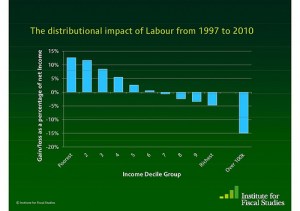
But with time and effort and will, you can change things – and Blair and Brown did just that. There is a tendency, when confronted by people to their left, for social democrats to reach for bar charts and graphs and tables of figures. I’ll make some apology for that, but only some. If you want to reduce poverty and put a stop to avoidable human misery, you have to care about the data and you have to be interested in the actual impact of your policies. If you aren’t interested in what’s actually happened to low incomes, don’t call yourself a leftist. If you care about the poor, you can find the time to look at some bar charts.

So let’s look. The IFS produced a chart showing the effect of Labour’s tax and benefit policies:

IFS graph of tax/benefit changes, 1997-2010

Corbynites would have you believe this chart is so unimportant you might as well have voted Tory. What it actually shows is a series of decisions taking money from the top 40%, but especially the richest, to give to the bottom 60%, but especially the poorest, on a large scale. That looks like pretty classic left-wing politics to me.

Now let’s look at their chart of Tory and Lib Dem tax and benefit reforms:

IFS graph of tax/benefit changes, 2010-19

You can see a kink at the top, due largely to keeping pre-planned Labour measures, but this is essentially taking from the poor to give to the fairly well off. It’s exactly the opposite of Labour’s record.

If you actually consider what Labour did, that’s not surprising. Working tax credit and child tax credit, higher National Insurance to fund public services (including above the upper earnings limit for the first time), more generous child benefit, pension credit, a 50p rate of income tax: these are exactly the sort of things social democratic governments normally do. The graph doesn’t, of course, show all the investment in health and education, Sure Start, the national minimum wage, the beginnings of childcare policy or a whole range of other things. And then there are all the other progressive things which wouldn’t show up on any UK bar chart – the advancement of LGBT rights, the Human Rights Act, doubling aid as a share of GDP and much more besides.

How can people possibly compare the last five years to the 13 years before that and then say there’s no point in a moderate Labour government? How can they possibly consider the most redistributive government in decades and then say it was just Tory-lite? Half the Corbynites’ rage is (rightly) directed at Cameron and Osborne’s attacks on the very things New Labour created: tax credits, Sure Start, extra help for families with children. But Labour was only ever able to do any of that because it met the electorate on their ground and won them over. If we cannot do that, raging is all we’ll have left to us.

When you win an election, you win political capital. Then you can use it to move politics your way. If you’re clever, you try and co-opt some of the areas where your opponents struck a chord too. Did the Tories call George Osborne ‘Labour-lite’ because he pretended to bring in a living wage? Did they lay into him for changing the rules on non-doms? No: they know they’re winning broader consent for shrinking the state. They get the art of democratic politics: a constant push-and-pull between what you ideally want, what the electorate will let you do and what’s practically possible.

And in government, Labour changed the weather too. Why did the Tories pledge to protect the NHS and not law and order – not just in 2010, but 2015 too? Why did they feel the need to raise the minimum wage? Why do we have 0.7% of GDP in aid now? Why do we have equal marriage? By 2010, it wasn’t OK not to protect the NHS; it wasn’t OK to sound openly anti-gay rights; protecting aid was a badge of Tory respectability. Labour governments made that true. Labour oppositions did not.

Owen Jones explains that the hard left is ‘defending New Labour’s legacy’. Great. So why is it simultaneously telling us none of it matters?